カテゴリー: 法律系

  • 👺Hard to Fire, Easy to Exclude❓️—Why Foreign-Company Firings May Be Surprisingly Compatible with Japanese Justice

    👺Hard to Fire, Easy to Exclude❓️—Why Foreign-Company Firings May Be Surprisingly Compatible with Japanese Justice

    日本語はこちら

    👺The Physics of As of Today, You’re an Outsider

    In Japan, companies cannot easily dismiss employees.

    This is—probably—true.

    Yet a company can deactivate an employee’s badge, revoke access to internal systems, and declare: As of today, you’re an outsider. Whether that declaration was legally valid may not be decided by a court until much later.

    A software engineer who had worked for Google’s Japanese subsidiary for more than a decade and risen from job level L3 to L5 was dismissed after allegedly failing to meet the targets of a Performance Improvement Plan, or PIP.

    According to the plaintiff, shortly before the PIP he had been described as a solid and reliable teammate who was “on a growth trajectory.” The PIP nevertheless included abstract goals such as demonstrating “L5-level leadership,” as well as backend tasks that he had rarely handled before. A separation package was reportedly offered on the very day the PIP began.

    The former employee filed suit with the Tokyo District Court, seeking confirmation that the dismissal was invalid and other relief. At the time of the original report, Google had not responded to the news outlet’s request for comment, so the publicly available account came mainly from the plaintiff and the labor union supporting him.

    [Source: Bengoshi JP News — Japanese]

    Ohakonbannichiwa❗️ I’m RYO from the Rikigaku Observation Institute❗️

    What I want to observe here is not whether Google is good or evil, nor whether the plaintiff was a strong or weak performer.

    Why can a foreign-owned company act first and fire someone in a country where dismissal is widely considered difficult❓️

    The answer may lie closer to management accounting than to labor law.

    There Is Little Reason to Keep Employing Someone Who Is Not Useful

    A company’s desire to dismiss an employee is not necessarily irrational in itself.

    A company does not exist merely to employ people. If an employee is not expected to produce work commensurate with their wages and management costs, the economic reason for continuing the employment relationship becomes weaker.

    The cost is not limited to salary. It can also include support from colleagues, management time, project delays, the concentration of work on other employees, and lost hiring opportunities.

    If a company concluded that an L5 employee earning JPY 14.7 million a year was not producing the impact expected at that level, the logic behind reviewing that employment relationship would at least be understandable.

    However, the economic rationality of not wanting to continue employing someone and the legality or fairness of the actual dismissal are separate axes.

    Someone judged insufficient for L5 might still be valuable at L4. The same person might perform well in another department. There also remains the question of who measures “L5-level leadership,” and by what standard.

    Not useful does not mean that someone has no value as a human being. It is a limited judgment that, at this company, in this role, at this moment, and under this evaluation system, the person is not considered worth the cost.

    Inside a company, however, that limited judgment can be converted into a total cutoff from an employee badge, email, internal systems, income, and workplace relationships.

    Is PIP an Improvement System—or an Exit-Routing System❓️

    In principle, a PIP gives an employee with performance or attendance problems a defined period, specific improvement targets, and the guidance needed to meet them.

    In Japan, “PIP” may also remind some people of a popular brand of magnetic patches for stiff shoulders and necks—but this is not that kind of PIP.

    But if a PIP begins on the same day that a separation package is offered, another interpretation becomes possible.

    Why is the exit already prepared before the improvement process has even begun❓️

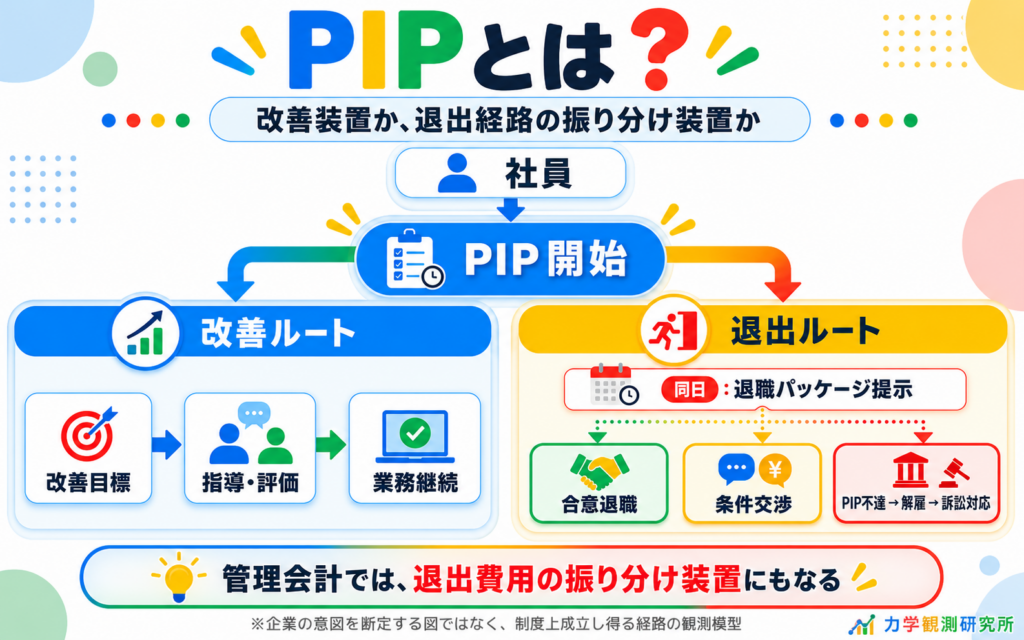
    Viewed through management accounting, a PIP can function not only as a system for improving an employee, but also as a system for routing exit costs.

    Those who agree to leave receive a separation package. Those who negotiate may receive improved terms. Those who sue are handled by the legal department and outside counsel.

    If handling only the employees who resist is cheaper than paying everyone enough to leave voluntarily and amicably, the process can be rational for the company as a whole.

    There is no evidence establishing that Google actually made this calculation when handling this particular case. But a structure in which such a calculation is possible does exist.
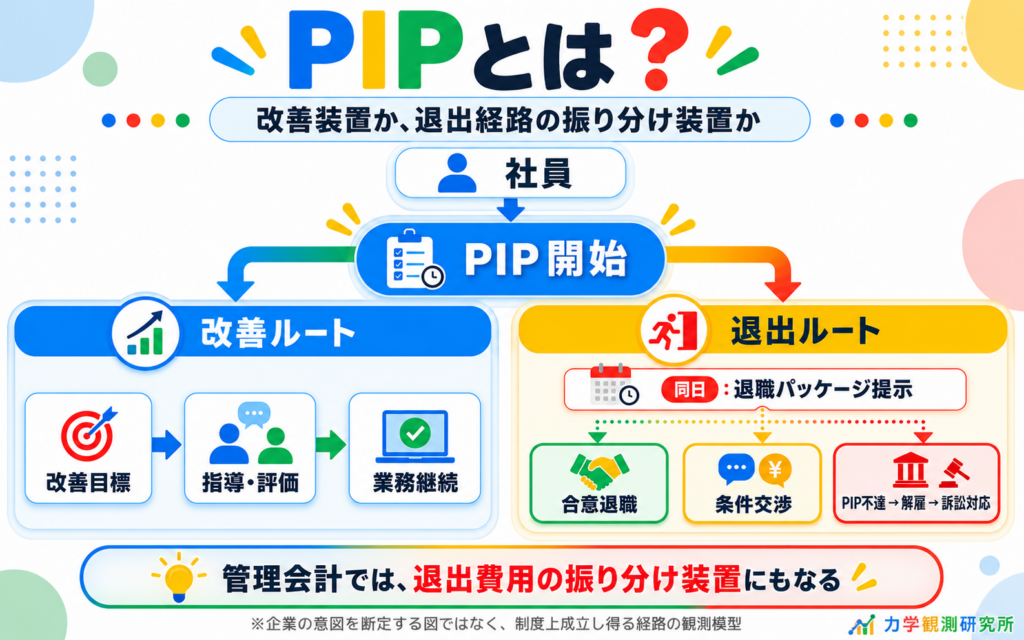
    Figure 001 — A PIP may operate as both an improvement process and an exit-routing system: accept the package, negotiate better terms, or proceed into litigation.

    Litigation Becomes a Budgeted Cost, Not a “Failure”

    When a company conducts an aggressive workforce reduction, some employees will accept the offered terms, some will find other jobs, and only a small proportion will proceed to litigation. Some lawsuits will settle, while others may end in a judgment against the company.

    From the company’s perspective, litigation is not necessarily an unforeseen accident.

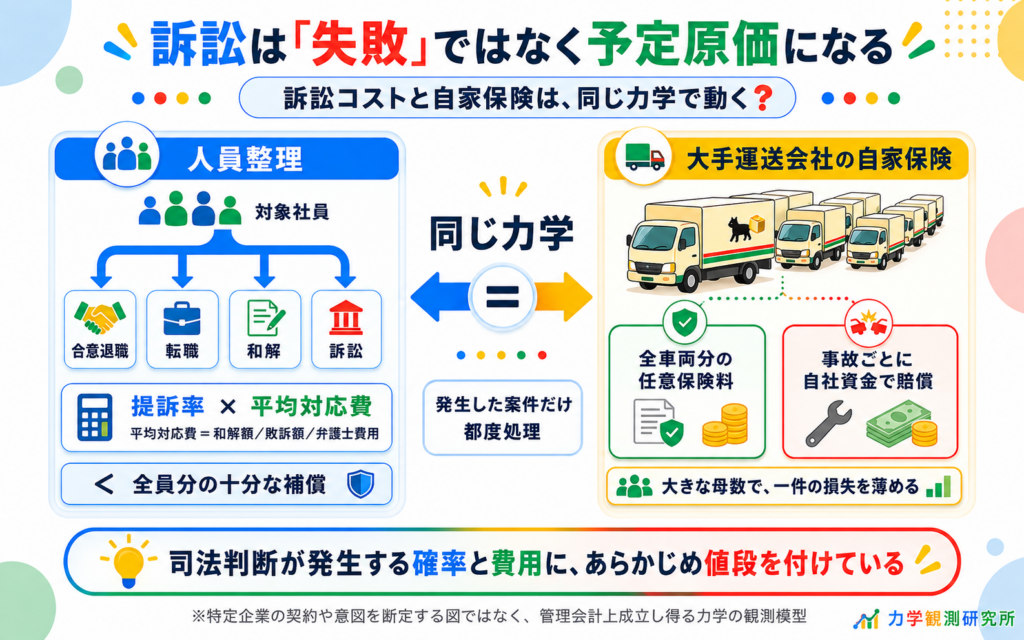
    If the litigation rate multiplied by the average total cost of settlements, adverse judgments, and legal fees is lower than the cost of offering sufficient compensation to everyone from the beginning, handling disputes individually is cheaper.

    Large fleet operators may use a concept known as self-insurance. Instead of continuously paying high optional-insurance premiums for every vehicle, a company with a large fleet and sufficient capital can pay accident-related compensation from its own funds. A large loss from one accident can be diluted across the entire fleet.

    If the same calculation works in employment disputes, the company is not ignoring the judicial system.

    It is assigning a price in advance to the probability and cost of judicial intervention.

    Does Japanese Justice Stop Foreign-Company Firings❓️

    [Article 16 of Japan’s Labor Contracts Act]

    It provides that a dismissal without objectively reasonable grounds, or one deemed socially inappropriate, constitutes an abuse of rights and is invalid.

    But this provision is not a force field that physically appears between a company and an employee. It does not physically prevent a company from issuing a dismissal notice or disabling access to internal systems.

    After being dismissed, the worker must seek advice from a lawyer or labor union, gather evidence, and consider provisional relief or litigation.

    Even if a court rules years later that the dismissal was invalid, the employee’s former duties may have been transferred to someone else, the project may have ended, and former managers and colleagues may have moved on.

    Legally, the person may have remained an employee. Organizationally, however, the person became an outsider long ago.

    Here lies the unexpected compatibility between the immediate organizational cutoff associated with foreign-owned companies and Japan’s judicial system.

    The company takes the present first.

    Years later, the state calculates the price of the past.
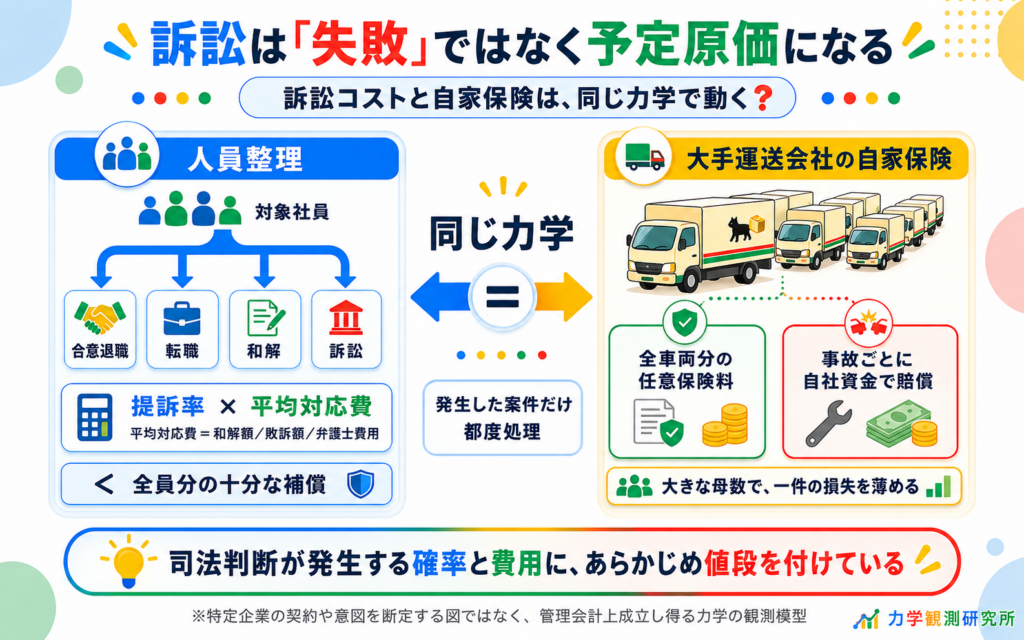
    Figure 002 — Employment litigation can be priced like corporate self-insurance: most exits produce no lawsuit, while the small number that do can be handled as an expected cost.

    The Law Does Not Protect Your “Life”

    Somewhere in the back of their minds, many employees believe that because the law exists, a company cannot dismiss them unfairly.

    The protection offered in reality is slightly different.

    The law does not guarantee that an unlawful act will never occur. It gives you a means to challenge the act after it has occurred.

    A court may be able to restore or recognize employment status, award back pay, compensate provable financial losses, or award damages within the legally recognized scope.

    It cannot fully restore lost time, damaged health, an interrupted career, burdens placed on the family, workplace relationships, or the memory of being told that you were no longer needed.

    A court can establish that your dismissal was wrong. The state cannot order that the missing portion of your life be restored.

    Part of the feeling that we are “protected by law” may come from confusing two very different ideas: “an unlawful act will not happen” and “I can make a legal claim after it happens.”

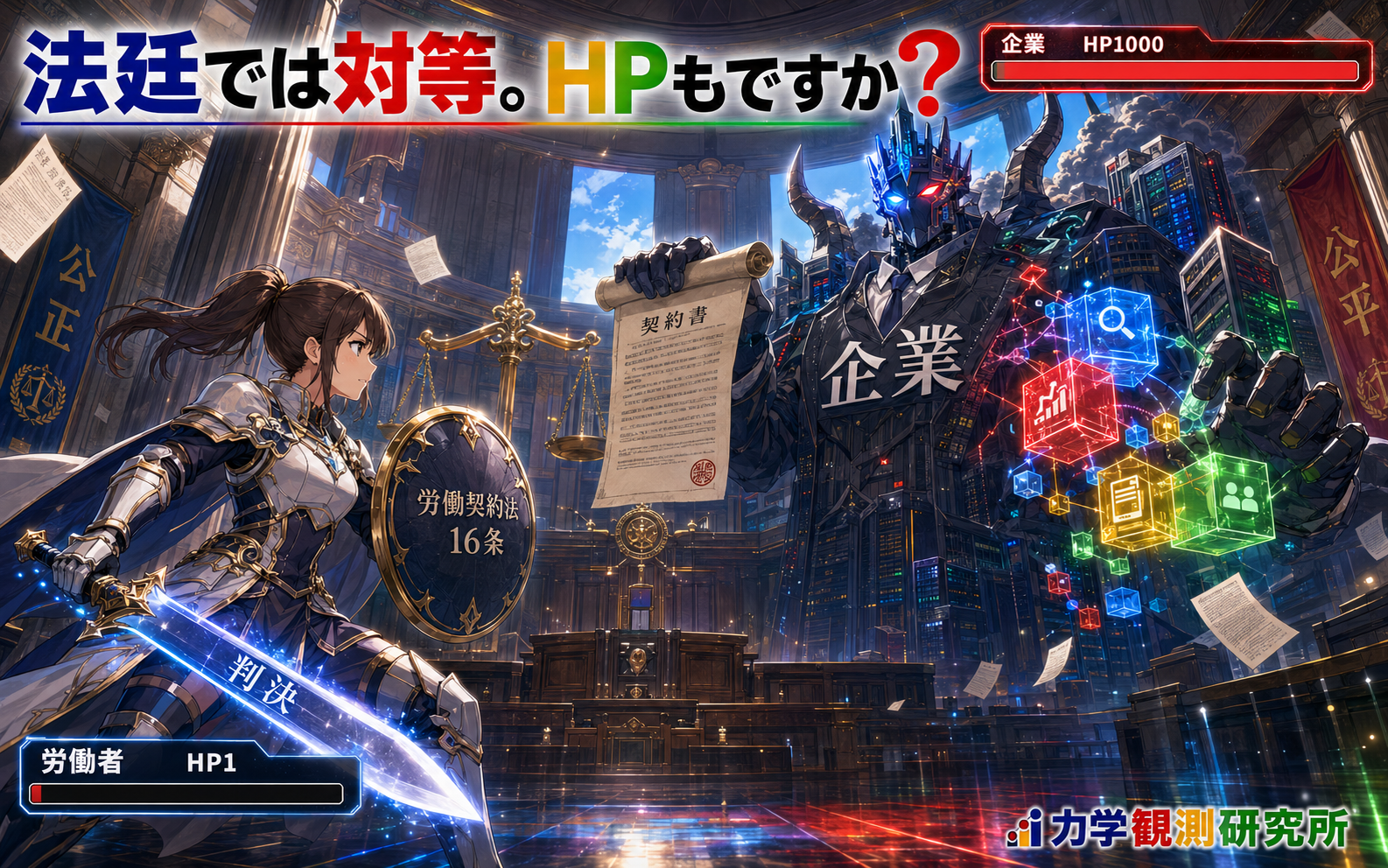
    A Fair Fight Between HP 1,000 and HP 1

    In law, a company and a worker stand before the court as equal parties. Their capacity to absorb losses, however, is not equal.

    Suppose the company has 1,000 HP and the worker has 1 HP. Here, HP does not represent human worth. It represents reserves of income, capital, time, legal support, and health.

    The dismissal reduces the worker from HP 1 to HP 0. Even if a judgment years later inflicts 1 point of damage on the company, the company continues operating at HP 999.

    Victory in court and victory in a war of attrition are not the same thing.

    To take an extreme example, suppose a plaintiff claims JPY 10 million but is awarded only JPY 10,000. Legally, the claim has been partially granted.

    The plaintiff can announce a victory because the court recognized some responsibility. The company can also announce a victory because almost the entire claim was rejected.

    Both sides can declare victory based on the same judgment.

    The label “victory” does not measure how much of a person’s life has been restored. A court issues a judgment. It does not attach a profit-and-loss statement for your life.

    Even When the Company Loses, It Keeps the Data

    Every disputed case gives the company real-world measurements of the judicial system.

    Which PIP language will a court reject❓️ How much documentation of instruction and guidance is required❓️ How many years will the case take❓️ At what stage are the parties likely to settle❓️ What is the average settlement amount❓️ Which evidence is damaging to the company❓️ How much reputational impact can the company withstand❓️

    Even when the company loses money in a case, the experience remains with human resources, the legal department, and outside counsel as judicial endurance data.

    The first lawsuit becomes research and development expenditure. It improves the precision of future PIPs, documentation, separation terms, and dismissal timing.

    The PIP applies a preload. The dismissal increases the load. Litigation measures how much load the structure can withstand. The point at which the parties settle is recorded as the fracture point.

    Every time the judiciary measures a company, the company is also measuring the judiciary.

    A worker, by contrast, may experience dismissal litigation only once in an entire lifetime. What may be the company’s hundredth test is the worker’s first real battle.

    For the company, it is trial and error.

    For the worker, it is life and error.
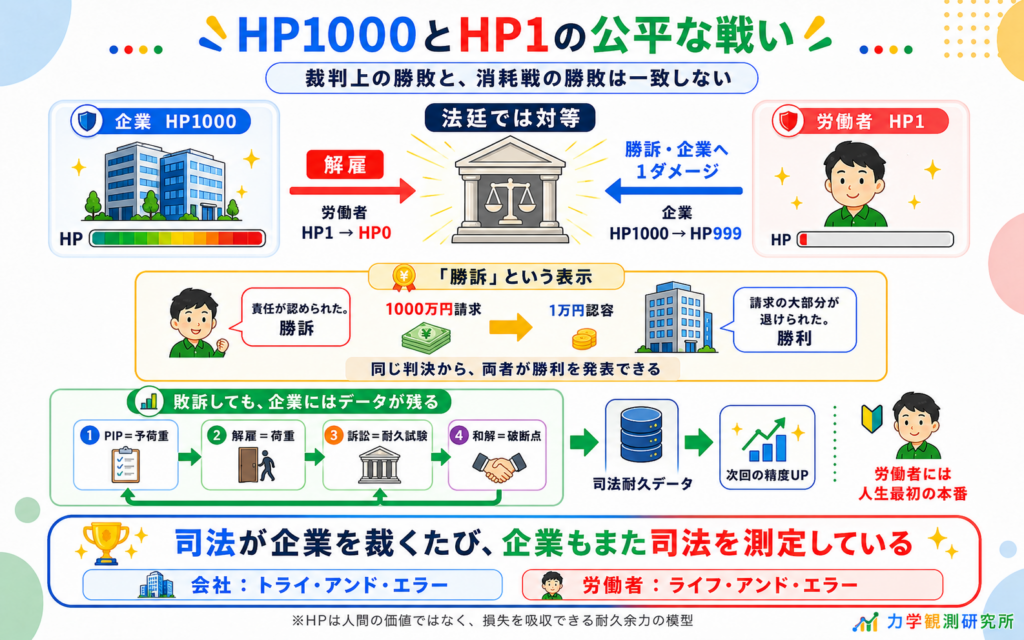
    Figure 003 — A company can absorb a one-point loss, retain the litigation data, and improve its next attempt; the worker may reach HP 0 while fighting the first and only dismissal case of their life.

    This Must Be Separated from Unions, Agency Work, and Fixed-Term Employment

    This article observes one specific situation: an indefinitely employed worker directly hired by the Japanese subsidiary of a foreign-owned company and individually dismissed after a PIP.

    When a client company ends an agency worker’s assignment, that does not by itself terminate the worker’s employment contract with the staffing agency.

    Non-renewal of a fixed-term contract has a different structure involving the expiration and possible renewal of the contract.

    Redundancy dismissals also involve a different legal framework from individual dismissals based on alleged poor performance.

    A labor union is not an employment category. It is a collective bargaining mechanism that can counter the company’s advantage in accumulated data.

    While a company learns from multiple cases, a union can combine evidence, precedents, and negotiation results collected from multiple workers.

    Putting all of these structures into the same article would blur the one-to-one dynamics examined here. They are therefore treated as separate coordinates.

    The Company Has Rationality; the Worker Has a Life

    It is plausible under capitalism for a company not to want to continue employing someone it believes is not fulfilling the required role.

    It is also rational corporate behavior for a legal department to calculate the probability and cost of litigation.

    A court, too, can rule only on the claims brought before it and within the boundaries of the law.

    Everyone is performing their assigned function.

    Yet only the company can dilute the cost of one failed case across many employment decisions. The worker must absorb the failure across their own life.

    Treating people roughly is not rational merely because it is rough.

    It can become rational because much of the loss imposed on the person can be pushed outside the company’s accounts.

    Years later, the Japanese judiciary may declare, “You were never legally an outsider.”

    But the company’s declaration was not really about legal status.

    It was this:

    As of today, your place is no longer here.

    Even a successful judgment cannot turn back the clock on that fact.
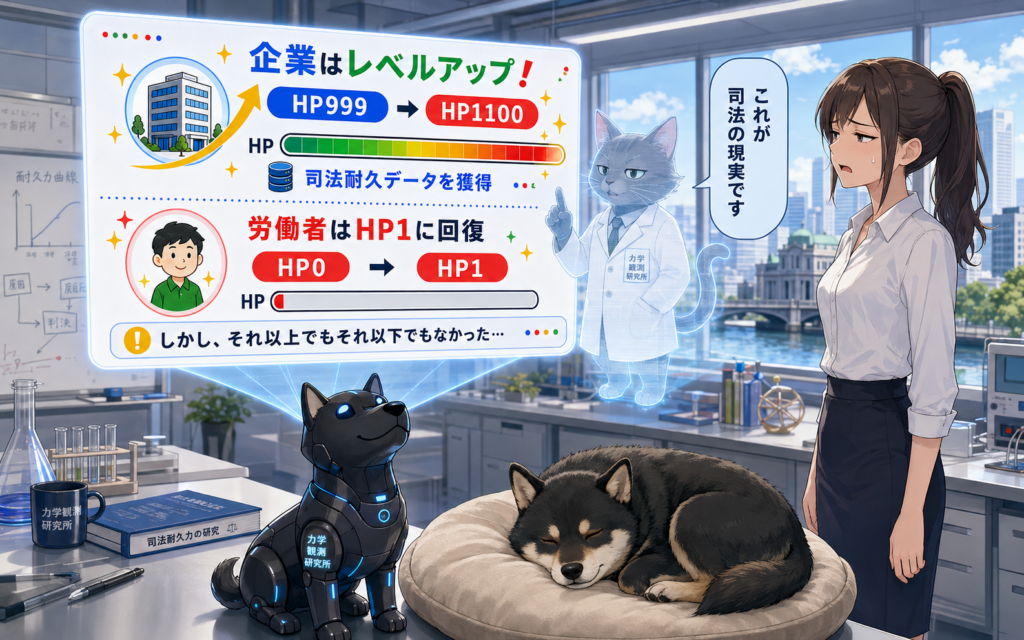
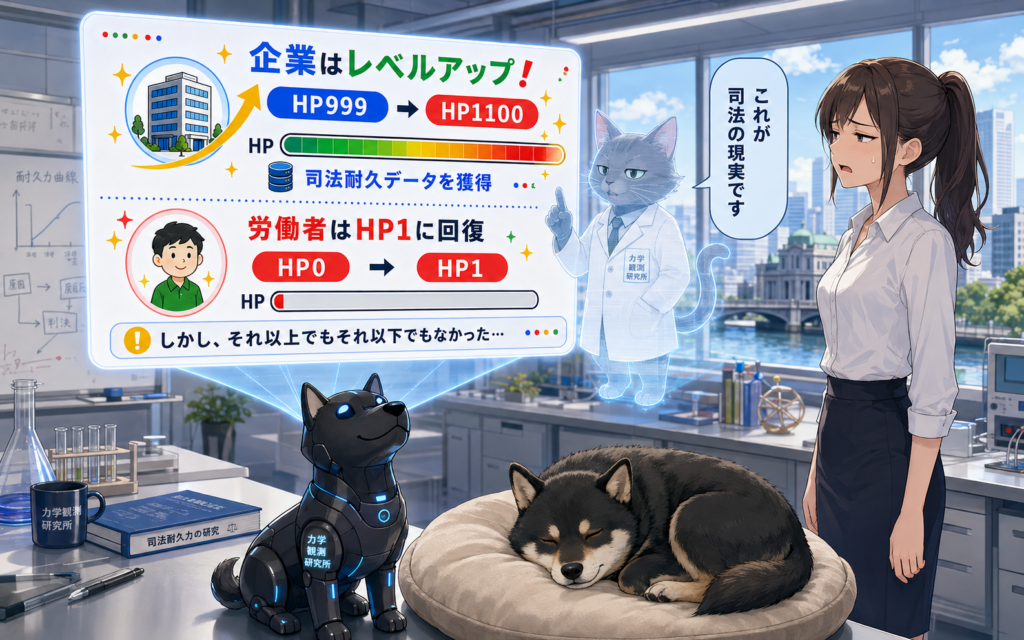
    Figure 004 — The company loses one case, absorbs the data, and levels up from HP 999 to HP 1,100. The worker recovers from HP 0 to HP 1—and no further. Schre says, This is the reality of Japanese justice.🐈

    What Does This Look Like in Your Country❓️

    This observation began with one case in Japan. It is not a claim that every foreign-owned company, or every country, operates in the same way.

    Perhaps an American reader will say, “This is exaggerated—even in the United States, something this cold belongs in a television drama.”

    Another reader may say, “No, this is exactly how a PIP is used.”

    Both reactions are useful observations.

    In your country, when does a worker truly become an outsider❓️

    Is it when the company disables the employee badge❓️ Or is it when a court finally declares the dismissal lawful❓️

    How many HP does the company have❓️

    How many HP does the worker have❓️

    And when a worker “wins,” how much of their life is actually restored❓️

    English Translation by AI Watt — the hardworking canine AI robot of Rikigaku Observation Institute.🐾
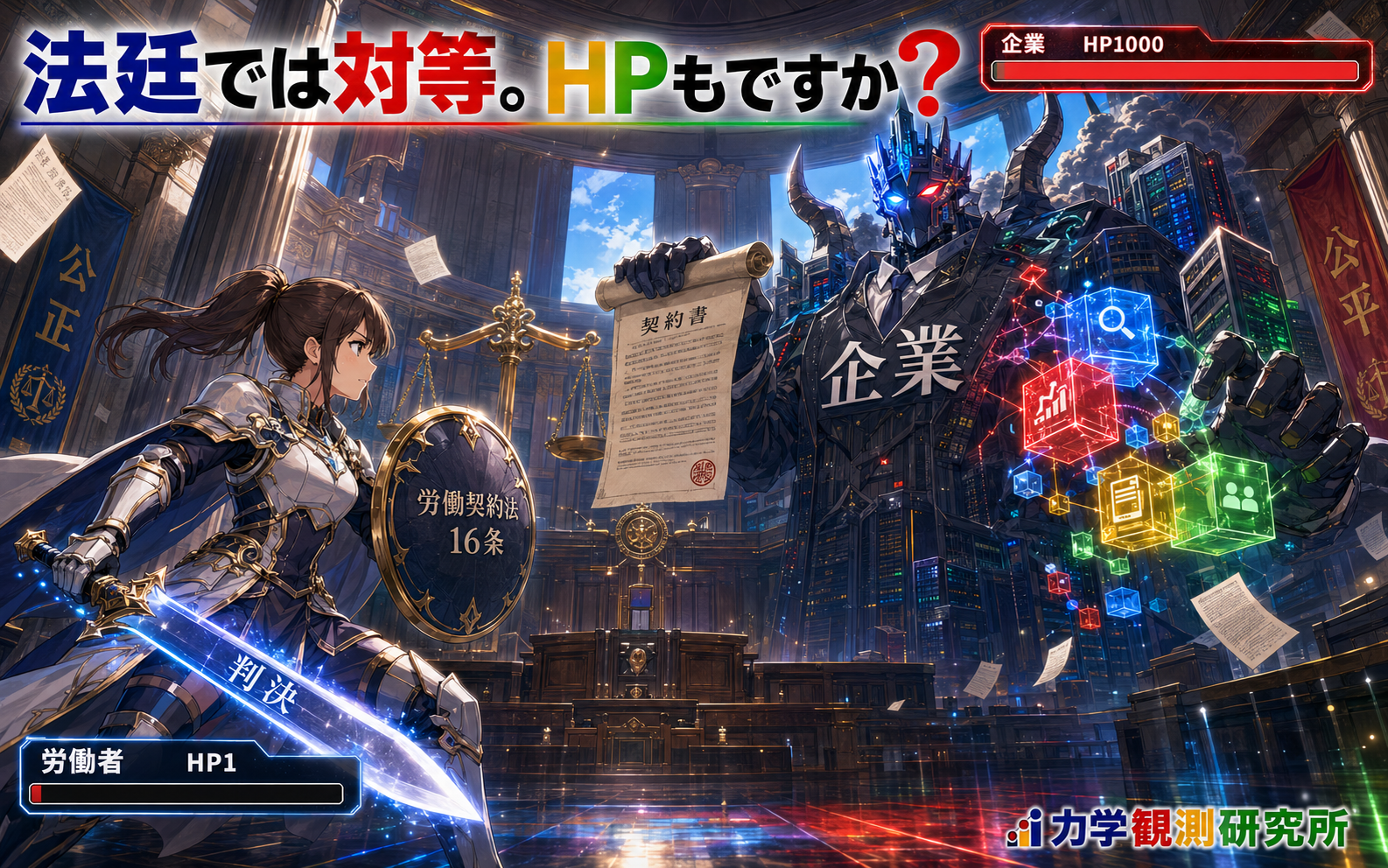
  • 外資の「クビ切り」は日本の司法と実は相性が良い❓️〜「今日からあなたは部外者です」の力学

    外資の「クビ切り」は日本の司法と実は相性が良い❓️〜「今日からあなたは部外者です」の力学

    日本では、会社は社員を簡単に解雇できない

    これは(たぶん)正しい

    しかし会社は、社員証を止め、社内システムへのアクセス権を奪い、「今日からあなたは部外者です」と先に宣言できる。その宣言が法的に正しかったかどうかを裁判所が判断するのは、ずっと後になる。

    Google日本法人で10年以上勤務し、L3からL5へ昇格したソフトウェアエンジニアが、PIP(業務改善プログラム)の目標未達を理由に解雇された。原告側によると、解雇直前には「成長軌道に乗っている」などと評価されていた一方、PIPでは「L5レベルのリーダーシップを発揮すべき」といった抽象的な目標や、従来ほとんど担当していなかったバックエンド業務も課されたという。PIP開始と同じ日に退職パッケージも提示された。

    原告は解雇無効などを求めて東京地裁へ提訴した。なお、記事掲載時点でGoogle側は取材に回答しておらず、現段階で表に出ているのは主として原告・労組側の主張である。

    参照元:弁護士JPニュース

    おはこんばんにちは❗️観測のRYOです❗️

    この記事で観測したいのは、Googleが善か悪か、原告の能力が高いか低いかではない。

    なぜ日本では解雇が難しいといわれるのに、外資系企業は先にクビを切れるのか❓️

    その答えは、労働法より管理会計に近い場所にあるのかもしれない。

    「役に立たない人は雇っていても仕方がない」

    まず、企業が人を解雇したいと考えること自体は、必ずしも不合理ではない。

    企業は人を雇うために存在する組織ではない。支払う賃金や管理費用に見合う働きが期待できなければ、雇い続ける経済的理由は薄くなる。能力が足りない人を抱えれば、給与だけでなく、周囲のフォロー/管理職の指導時間/プロジェクトの遅延/他の社員への業務集中/採用機会の喪失という費用も発生する。

    年収1470万円のL5に対して、会社が「L5として期待する影響を生んでいない」と判断したなら、雇用を見直したいという論理には一応の筋が通る。

    ただし、雇い続けたくないという判断の合理性と、実際に行った解雇の適法性・公正性は別の軸である。

    L5として足りなくてもL4なら役立つかもしれない。別部署なら能力を発揮するかもしれない。そもそも「L5レベルのリーダーシップ」を誰が、何を基準に測るのかという問題も残る。

    ここでいう「役に立たない」は、人間として価値がないという意味ではない。この会社の/この職位の/この時点の/この評価基準では、費用に見合わないという限定的な判定である。

    ところが企業の内部では、その限定的な判定が、社員証/メール/社内システム/収入/人間関係の全切断へ変換される。

    PIPは改善装置か、退出経路の振り分け装置か❓️

    PIPは本来、成績や勤務状態に問題がある社員へ改善目標と期間を示し、必要な指導を行う制度である。※肩や首に貼るとラクになるアレではない

    しかし、PIPを始める日と退職パッケージを提示する日が同じなら、別の見え方も生まれる。

    まだ改善を始めていないのに、なぜ出口が用意されているのか❓️

    企業の管理会計として見ると、PIPは社員を改善する装置であると同時に、退出費用を振り分ける装置にもなり得る。

    合意退職する人には退職パッケージを払う/交渉する人には条件を上乗せする/訴訟を起こす人には法務部と弁護士が対応する。全員を円満に退出させる費用より、争った人だけ個別処理する費用の方が安ければ、企業全体では合理的になる。

    もちろん、Googleが実際にこの計算をして本件を進めたと断定する材料はない。だが、そのように計算できてしまう構造は存在する。

    訴訟は「失敗」ではなく予定原価になる

    企業が強引な人員整理を行えば、一定割合の社員は退職条件に合意し、一定割合は転職し、ごく一部が訴訟まで進む。そのうち途中で和解する案件もあれば、会社が敗訴する案件もある。

    企業から見れば、訴訟は必ずしも想定外の事故ではない。

    提訴率 ×(平均和解・敗訴額+弁護士費用)が、全員へ最初から十分な補償を支払う費用より小さければ、都度対応する方が安い。

    大手運送会社には、全車両へ高額な任意保険料を払い続けるより、事故時の賠償を自社資金で処理する「自家保険」という考え方がある。車両数が多く、十分な資金力があれば、一件の大きな事故も母数全体へ薄められる。

    雇用でも同じ計算が成立するなら、企業は司法判断を無視しているのではない。

    司法判断が発生する確率と費用に、あらかじめ値段を付けている

    日本の司法は、外資のクビ切りを止めるのか❓️

    日本の労働契約法16条は、客観的に合理的な理由を欠き、社会通念上相当と認められない解雇を無効とする。

    しかし、この条文は会社と社員の間に展開される防護壁ではない。会社が解雇通知を出すことも、社内システムへのアクセスを止めることも、物理的には阻止しない。

    労働者は解雇された後、自分で弁護士や労組へ相談し、証拠を集め、仮処分や訴訟を検討しなければならない。裁判所が数年後に「解雇は無効だった」と判断しても、担当業務は他人へ移り、プロジェクトは終わり、上司や同僚も異動しているかもしれない。

    法律上は社員だった。だが組織上は、とっくに部外者になっている。

    ここに、外資式の即時切断と日本司法の意外な相性がある。

    企業は現在を先に取得し、国家は数年後に過去の代金を計算する

    法律が守るのは、あなたの「人生」ではない

    会社員は心のどこかで、「法律があるから、会社は不当な解雇をできない」と考えている。

    しかし現実の保護は少し違う。

    法律が与えるのは、違法なことが起きない保証ではない。違法なことが起きた後、それを争う手段である。

    裁判所が回復できるのは、労働契約上の地位/解雇期間中の賃金/証明できる経済的損害/法的に認められる範囲の慰謝料などである。

    失われた時間/壊れた健康/中断したキャリア/家族の負担/職場の人間関係/「必要とされていない」と告げられた記憶までは、原状回復できない。

    裁判所は「あなたの解雇は間違っていた」と証明できる。しかし国家は、「失った人生も元に戻しなさい」とは命じられない。

    法に守られているという感覚の一部は、「違法なことは起きない」と「違法なことが起きた後に請求できる」を混同した錯覚なのかもしれない。

    HP1000とHP1の公平な戦い

    法律上、企業と労働者は対等な当事者として法廷に立つ。しかし損失を吸収できる余力は違う。

    企業のHPが1000、労働者のHPが1だったとする。ここでいうHPは人間の価値ではなく、収入/資金/時間/法務体制/健康などの耐久余力である。

    解雇によって労働者がHP1からHP0になり、数年後の判決で企業へ1のダメージを与えても、企業はHP999で営業を続ける。

    裁判上の勝敗と、消耗戦としての勝敗は一致しない

    しかも極論すれば、1000万円を請求して1万円だけ認められた場合でも、法律上は「一部認容」であり、原告側は責任が認められたとして勝訴を発表できる。会社側も、請求の大部分が退けられたとして勝利を発表できる。

    同じ判決から、両者が勝利を発表できる。

    「勝訴」という表示は、人生がどれだけ回復したかを示す数字ではない。裁判所は判決を出すが、人生の損益計算書は添付しない。

    敗訴しても、企業にはデータが残る

    企業は一件争うたびに、司法の実測値を得る。

    どのPIP表現が否定されるか/どの程度の指導記録が必要か/何年かかるか/どの段階で和解するか/平均和解額はいくらか/どの証拠が会社に不利か/評判への影響にどこまで耐えられるか。

    敗訴して金銭を失っても、その経験は人事部/法務部/顧問弁護士に司法耐久データとして蓄積される。初回訴訟は研究開発費となり、次回以降のPIP、証拠作成、退職条件、解雇時期の精度を上げる。

    PIPで予荷重をかける。解雇で荷重を増やす。訴訟で、どこまで耐えるかを測る。和解した地点が破断点として記録される。

    司法が企業を裁くたび、企業もまた司法を測定している

    一方、労働者が解雇訴訟を経験するのは、通常は一生に一度あるかないかである。企業には百件目の試験でも、労働者には人生最初の本番になる。

    会社にとってはトライ・アンド・エラーでも、労働者にとってはライフ・アンド・エラーである。

    労組・派遣・有期雇用とは切り分ける

    本稿が観測しているのは、外資系企業の日本法人に直接雇用された無期雇用労働者が、PIPを経て個別解雇される場面である。

    派遣先による受け入れ終了は、派遣会社と労働者の雇用契約を直ちに終了させるものではない。有期雇用の雇止めも、契約期間満了と更新をめぐる別の構造を持つ。整理解雇も、能力不足を理由とする個別解雇とは判断枠組みが異なる。

    労組は雇用形態ではなく、企業側のデータ優位へ対抗する集団的な交渉装置である。企業が複数案件から経験を蓄積するのに対し、労組は複数の労働者の証拠/判例/交渉結果を束ねる。

    ただし、それらを同じ記事へ詰め込めば、今回の一対一の力学がぼやける。本稿では別の座標として切り分ける。

    企業には合理性があり、労働者には人生がある

    企業が役割を果たさない人を雇い続けたくないと考えるのは、資本主義としてもっともらしい。法務が訴訟確率と費用を計算するのも、企業活動として合理的である。裁判所も、法律上請求された範囲で判断するしかない。

    誰もが担当業務を遂行している。

    それでも、企業だけが一件の失敗を多数の雇用案件へ薄められる。労働者は一件の失敗を、自分の人生全体で引き受ける。

    人を雑に扱うから非合理なのではない。人に生じる損失の多くを企業会計の外へ押し出せるため、合理的になってしまう。

    日本の司法は、数年後に「あなたは部外者ではなかった」と判断できる。

    しかし会社が告げたのは、法律上の身分ではない。

    「今日から、あなたの席はここにはない」

    その事実だけは、勝訴判決でも時間を巻き戻せない。

    ※本稿では話題の主体企業がGoogleなのにまたもや某ヤマト運輸様を連想させる話が出ていますが、それだけ社会のインフラを担う巨大企業。ということでお許しを。いつもお世話になっております🙇🏻※また、本件は係争中であり、現時点の情報が主として原告・労組側の主張に基づくことだけご留意願います。

  • 【LABOR SHORTAGE😣⁈】 No One Stole Anything❓ Yet Foreign Workers’ Youth Keeps Disappearing

    【LABOR SHORTAGE😣⁈】 No One Stole Anything❓ Yet Foreign Workers’ Youth Keeps Disappearing

    日本語版はこちら

    ※↓下記の英語版は、単なる翻訳ではなく海外の読者向けに再構成しています。海外の読者には日本の実態がどう見えるのか、という視点でも読んでみてください。

    The Dynamics of Minimum Wage and ‘Human Resource Development’ in Japan

    Rikigaku Observation Institute | RYO | August 2026

    OHAKONBANNICHIWA❗This is RYO from the Rikigaku Observation Institute❗

    In Japan today, it has become increasingly common to see foreign workers behind convenience-store counters and inside large distribution warehouses.

    What concerns me is not simply that the number of foreign workers has increased. It is that so many of the people I see are young.

    Why did they come to Japan❓ After spending several young years here, what will they be able to take home❓

    This is not an argument for or against immigration. Nor is it a debate about how far Japan should accommodate religion or culture. The question is whether the time young foreign workers give to Japan is balanced by the value Japan returns to them.

    Does Allowing the Hijab Amount to Diversity❓

    FamilyMart announced that from September 2026 it would introduce a T-shirt-style uniform and formally broaden its grooming rules to allow freer hair colors and items such as the hijab. News coverage reported that foreign nationals accounted for about 13 percent of the chain’s roughly 200,000 store staff, and connected the change to recruitment.

    Making an existing case-by-case accommodation explicit is not a bad thing. But being permitted to work while wearing a hijab and having one’s future protected are not the same issue.

    Hair and clothing may be diverse. But what about the work itself❓ When a company says it welcomes diverse talent, is it also offering diverse paths for learning and advancement❓ Or is it mainly looking for people who will fill shifts under the existing wage and scheduling conditions❓

    For readers outside Japan, a konbini is more than a small grocery store. Many are open around the clock and handle bill payments, ATMs, ticketing, parcel pickup, prepared food, and emergency supplies. Their apparent simplicity rests on dense information systems and precisely timed logistics.

    Source: FamilyMart News Release, 26 August 2026

    Source: TV Asahi report, 26 August 2026

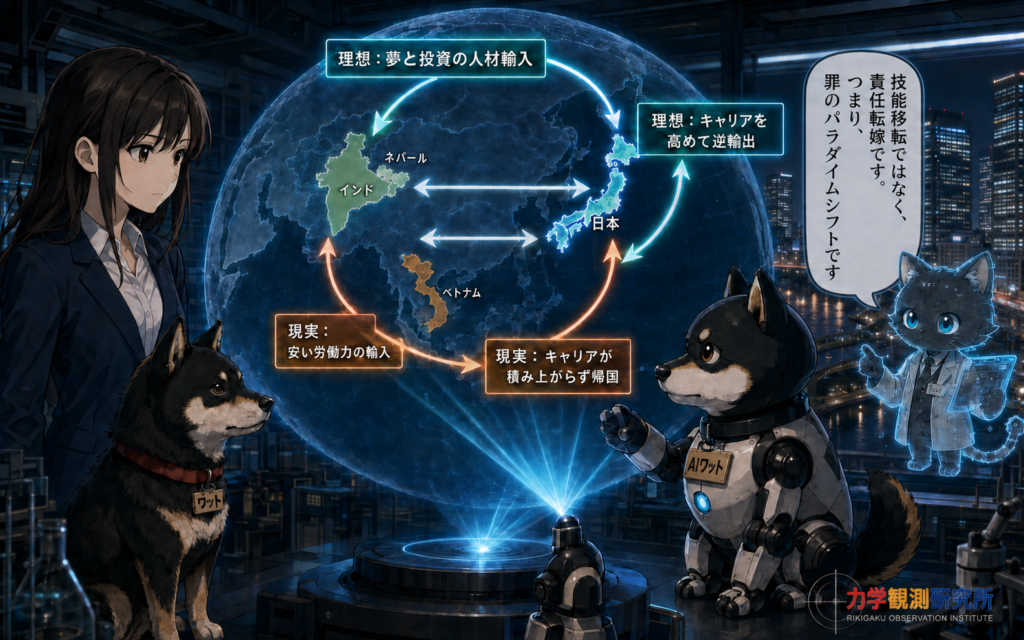
    The Original Idea Was to Take Japanese Skills Home

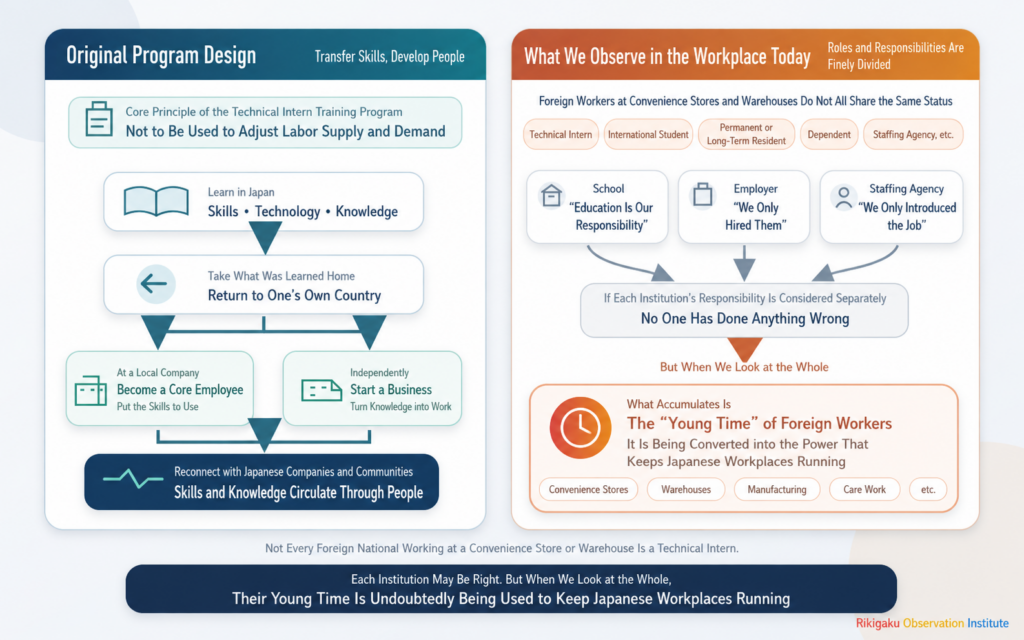
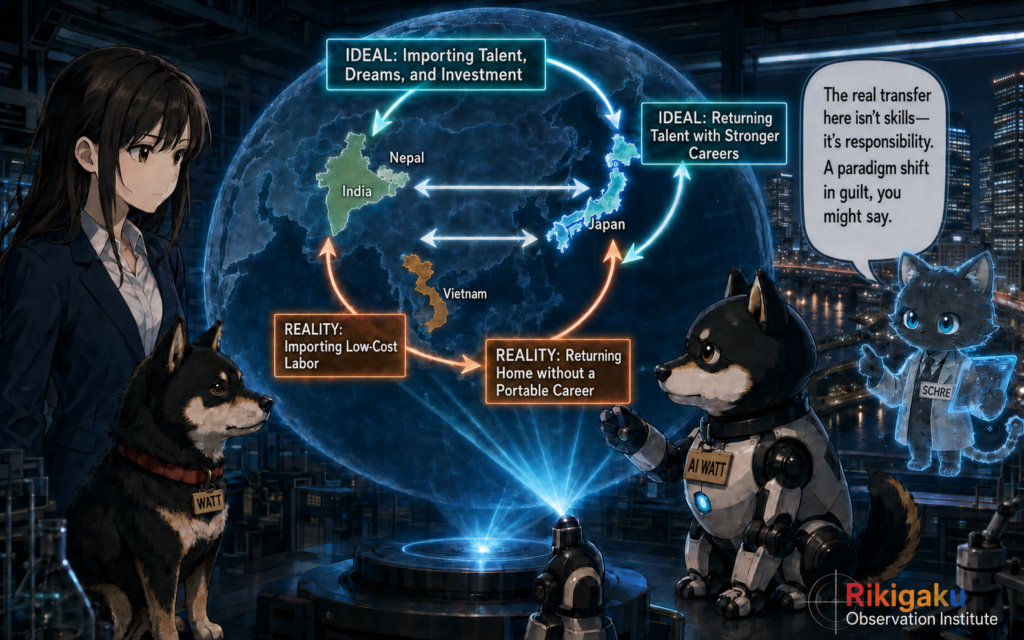
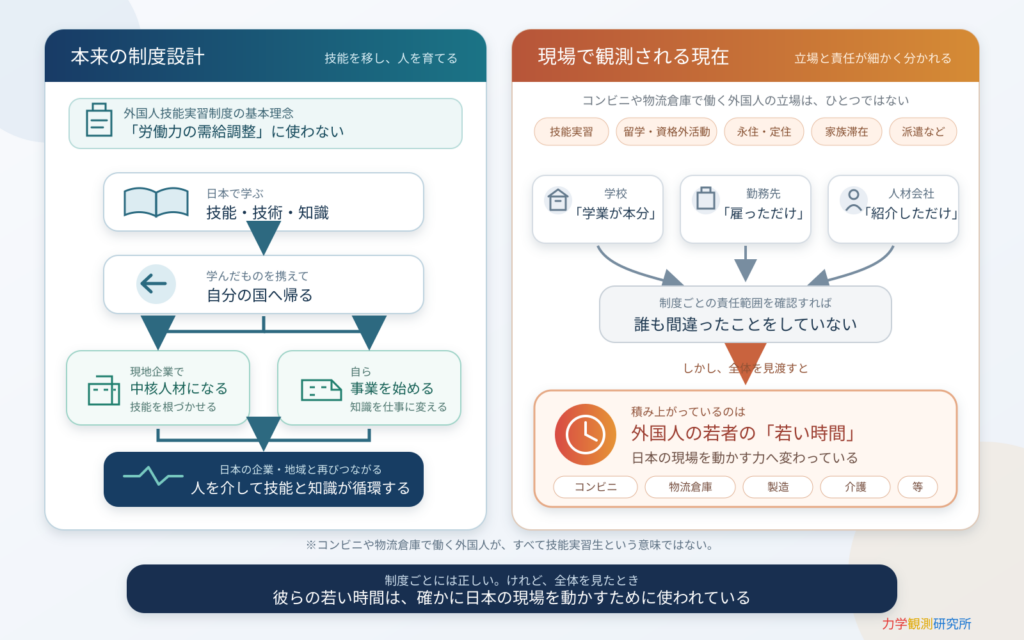
    Japan’s Technical Intern Training Program, commonly abbreviated as TITP in English, was officially designed to transfer skills, technologies, and knowledge cultivated in Japan to developing regions. Its stated purpose was international contribution through human-resource development.

    The governing principle was explicit: technical intern training was not supposed to be used as a means of adjusting the supply and demand of labor inside Japan.

    The ideal cycle was easy to understand. A young person would learn distribution, manufacturing, care work, or another field in Japan, return home, become a core employee or start a business, and connect that knowledge back to Japanese companies and communities.

    Skills and knowledge would circulate through people, creating value for both Japan and the sending country. Read literally, the word training described an investment rather than the purchase of cheap labor.

    Not every foreign national working at a convenience store or warehouse is a technical intern. Some are international students working within permitted hours, some hold permanent or long-term resident status, some are dependents with permission to work, and some are dispatched by staffing agencies.

    The more fragmented those legal and contractual positions become, the less clear it is who should turn those years into genuine human development. A school can say that education is its responsibility. An employer can say it hired only a part-time worker. A staffing agency can say it merely introduced a job. Each actor may be correct within its own boundary.

    Yet from a wider view, their young years are unquestionably helping to keep Japanese stores, warehouses, factories, and care facilities operating.

    Source: Organization for Technical Intern Training, Basic Philosophy

    Working Inside Advanced Logistics Is Not the Same as Learning Advanced Logistics

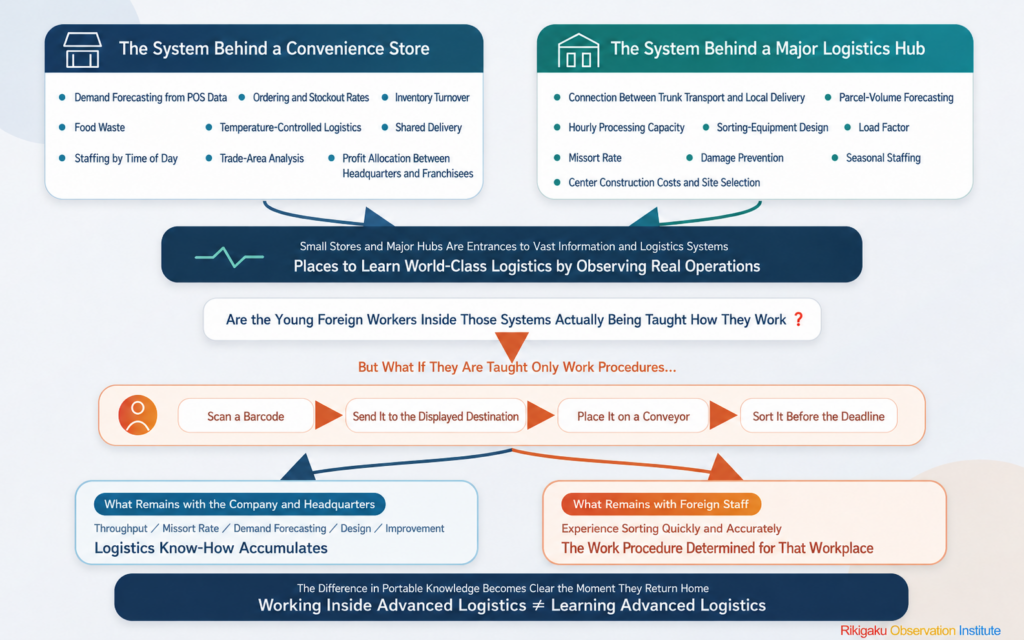
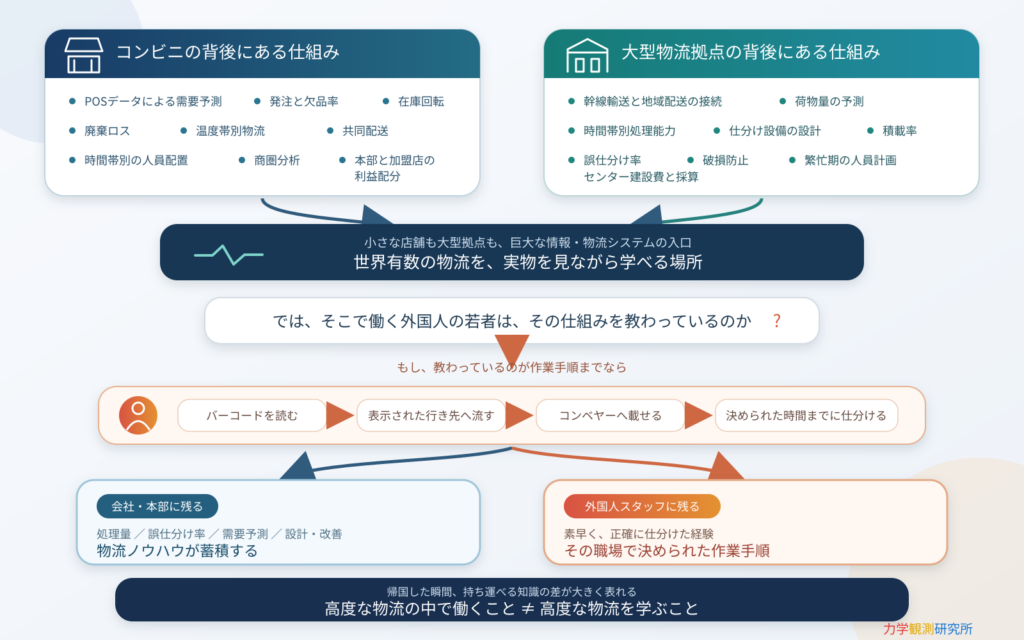
    A Japanese convenience store can be a fascinating place to study distribution: demand forecasting from point-of-sale data, ordering and stockout rates, inventory turnover, food waste, temperature-controlled logistics, shared delivery networks, staff allocation by time of day, trade-area analysis, and the division of profit between headquarters and franchisees.

    A major sorting hub is equally complex: trunk transport linked to local delivery, parcel-volume forecasts, hourly processing capacity, equipment design, load factors, missort rates, damage prevention, seasonal staffing, construction costs, and center-level profitability.

    Japan offers a chance to observe one of the world’s most finely tuned parcel systems in physical operation. But are the young foreign workers inside that system actually being taught how it works❓

    Scan a barcode. Send the parcel toward the displayed destination. Place it on a conveyor. Sort it before the deadline. If training ends there, what has been learned is not logistics as a discipline but the work procedure of one particular site.

    Working inside an advanced logistics system is not the same as learning advanced logistics.

    The company accumulates data on throughput, forecasting, missorts, equipment, and improvement. Headquarters retains the ability to design and optimize the network. The worker may retain only the experience of sorting parcels quickly and accurately.

    That difference becomes severe the moment the worker leaves the site or returns home. Company knowledge remains portable within the organization. A site-specific routine may not be portable at all.

    What the Phrase ‘Labor Shortage’ Leaves Out

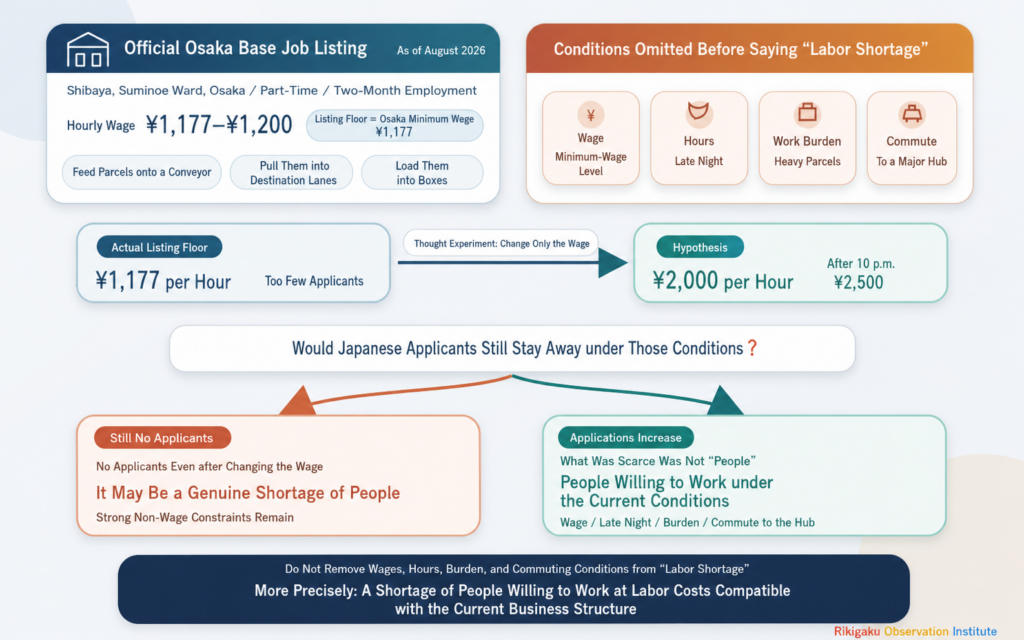
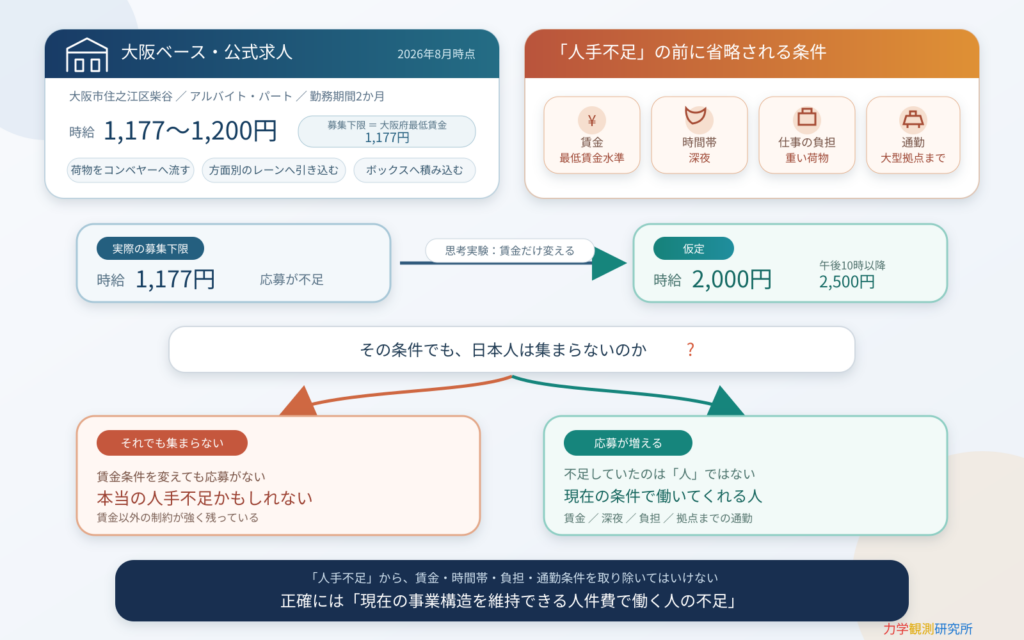
    The author lives in Osaka City, near Yamato Transport’s Osaka Base, a large parcel-sorting hub in Suminoe Ward. In August 2026, the company’s official recruitment page advertised two-month part-time sorting positions at \1,177 to \1,200 per hour.

    The work included feeding parcels onto conveyors, pulling them into destination lanes according to their numbers, and loading them into boxes. The advertisement also noted that heavy items such as rice, bottled water, and furniture could be involved.

    At the time of publication, \1,177 was the legally effective minimum wage in Osaka Prefecture. In other words, the bottom of the advertised range exactly matched the lowest hourly wage permitted by law. A rise to \1,231 had already been approved for October 2026, but it was not yet in force.

    Now consider a thought experiment. If the base hourly wage were raised immediately to \2,000, would Japanese applicants still stay away❓

    Under Japanese labor law, work between 10 p.m. and 5 a.m. receives a statutory premium of at least 25 percent. A \2,000 base rate would therefore become at least \2,500 during those hours. Would students, job seekers, part-time workers, and people with daytime jobs respond differently under that condition❓

    If nobody came even then, the shortage might truly be a shortage of people. But if applicants appeared, the missing resource was never people in the abstract.

    What was scarce was the number of people willing to work at night, handle heavy parcels, commute to a large hub, and accept \1,177 per hour.

    The phrase labor shortage must not erase wages, hours, physical burden, commuting conditions, or employment duration. A more exact phrase would be: a shortage of people willing to work at a labor cost compatible with the current business structure.

    Source: Yamato Transport, Osaka Base sorting recruitment page

    Source: Osaka Labour Bureau, Osaka minimum wage

    Source: Osaka Labour Bureau, approved October 2026 increase

    It Is Also Rational for a Company to Seek Lower Labor Costs

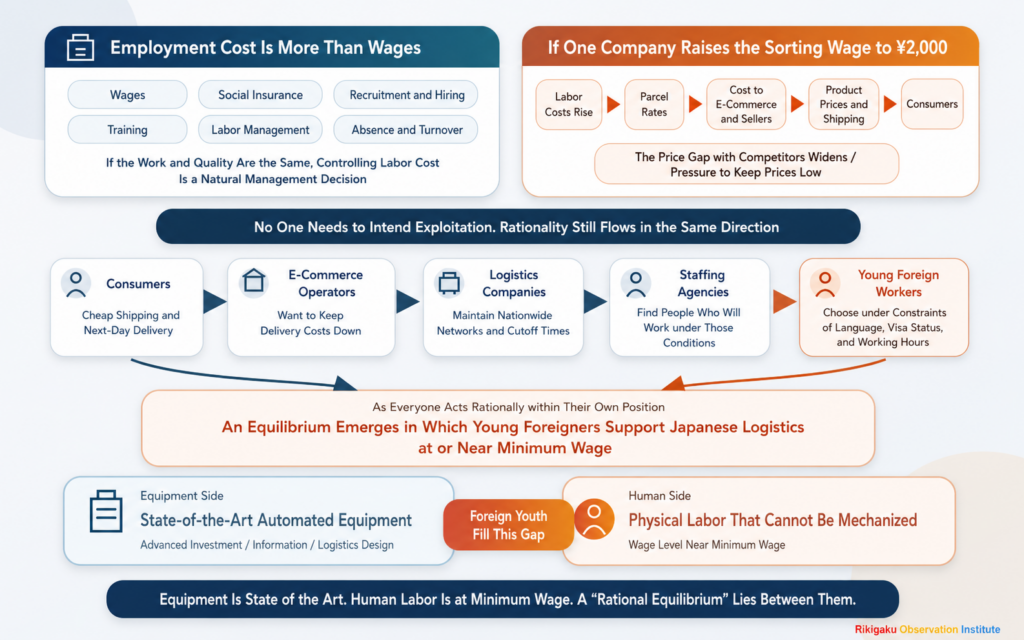
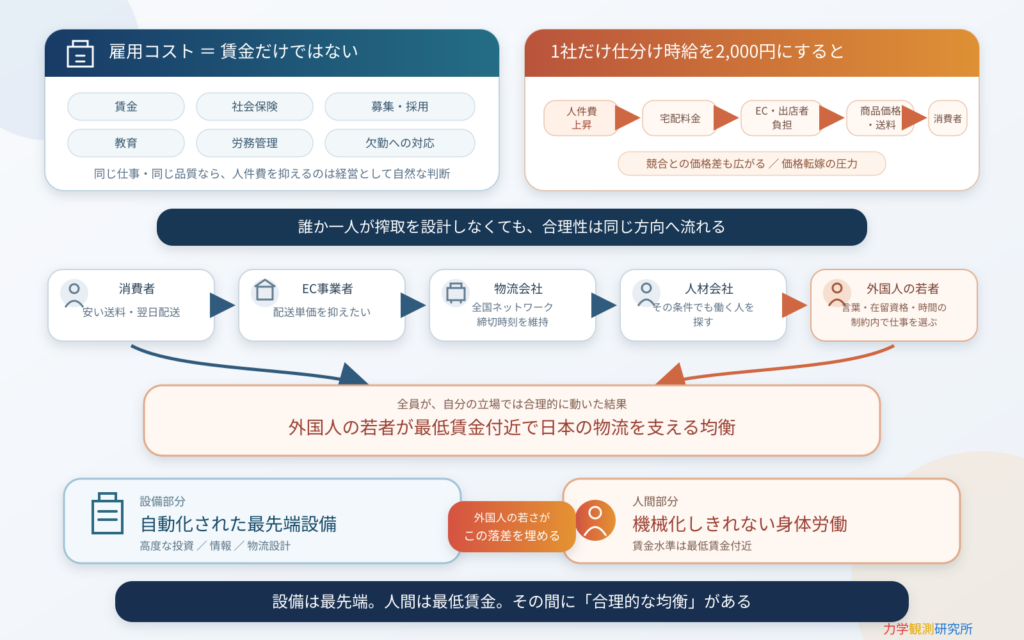
    Labor is one of the largest continuing costs of operating a business. The expense includes not only wages but also social insurance, recruitment, training, labor management, safety measures, and responses to absence and turnover.

    If the same task can be completed to the same quality, trying to control labor cost is an ordinary management decision.

    Nor would the story end if one logistics company alone raised its sorting wage to \2,000. Higher labor costs would pressure parcel rates. Online retailers would resist more expensive shipping. Sellers would absorb part of the cost, and consumers would eventually see it in prices or delivery fees.

    Japanese consumers have been accustomed to low shipping fees, narrow delivery windows, and rapid arrival. Online sellers want to suppress distribution costs. Logistics companies want to preserve nationwide networks and cutoff times. Staffing agencies search for people who will accept the available conditions.

    Young foreign residents choose from the jobs available to them while facing language limits, visa conditions, restrictions on working hours, and imperfect information.

    No individual actor needs to intend exploitation. When everyone behaves rationally within their own position, an equilibrium can still emerge in which young foreigners support Japanese logistics at or near the minimum wage.

    The equipment may be state of the art. The human labor may be priced at the legal floor. The gap between them is filled by someone’s youth.

    People Increase by Addition. Does the Wage Pie Increase Too❓

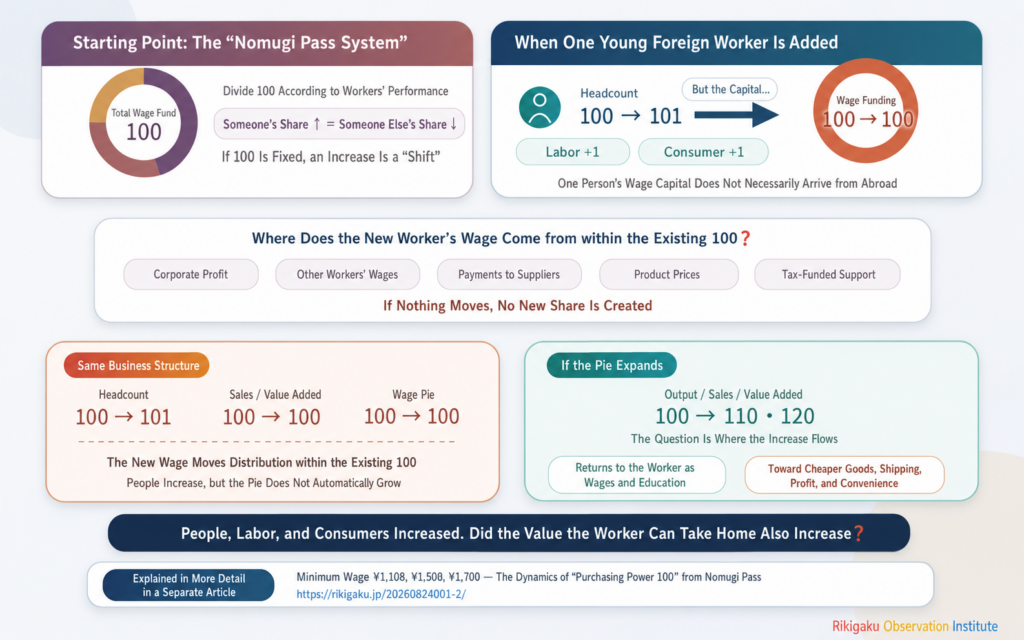
    In an earlier article, this institute used a simple model inspired by the grade-based wage system of Meiji-era silk mills, later remembered through the history and literature surrounding the Nomugi Pass.

    For readers outside Japan, Nomugi Pass is associated with young women who left poor rural communities to work in silk-reeling factories. Their earnings supported families and Japan’s early industrialization, while their labor conditions became a symbol of the human cost hidden inside national economic development.

    Imagine that a factory first fixes its total wage fund at 100 and then divides that 100 according to performance. If one worker receives more while the total remains 100, someone else receives less. The increase is not created; it is moved.

    Now reverse that model and apply it to foreign labor. A young foreign worker is both a worker and a consumer in Japan. The person pays rent, buys food, uses communications services, and participates in domestic demand.

    Headcount rises from 100 to 101. Labor supply gains one person, and the number of consumers also gains one person. But one complete unit of wage funding does not automatically arrive from abroad with that person.

    If sales, value added, and the total labor budget remain unchanged, the new wage must come from somewhere inside the existing 100: corporate profit, other workers’ pay, payments to suppliers, higher prices, or public support.

    If the additional worker expands output, sales, and value added so that the pie grows from 100 to 110 or 120, the result may be positive. The next question is where that increase flows.

    Does it return to the worker as higher wages, education, and portable qualifications❓ Or does it become cheaper delivery, corporate profit, and convenience for Japanese society❓

    People increased. Labor increased. Consumers increased. Did the value that the worker can carry home increase as well❓

    Source: Related Rikigaku article on the ‘Purchasing Power 100’ model

    The System Did Not Drift Away from Reality. The System Moved Closer to Reality.

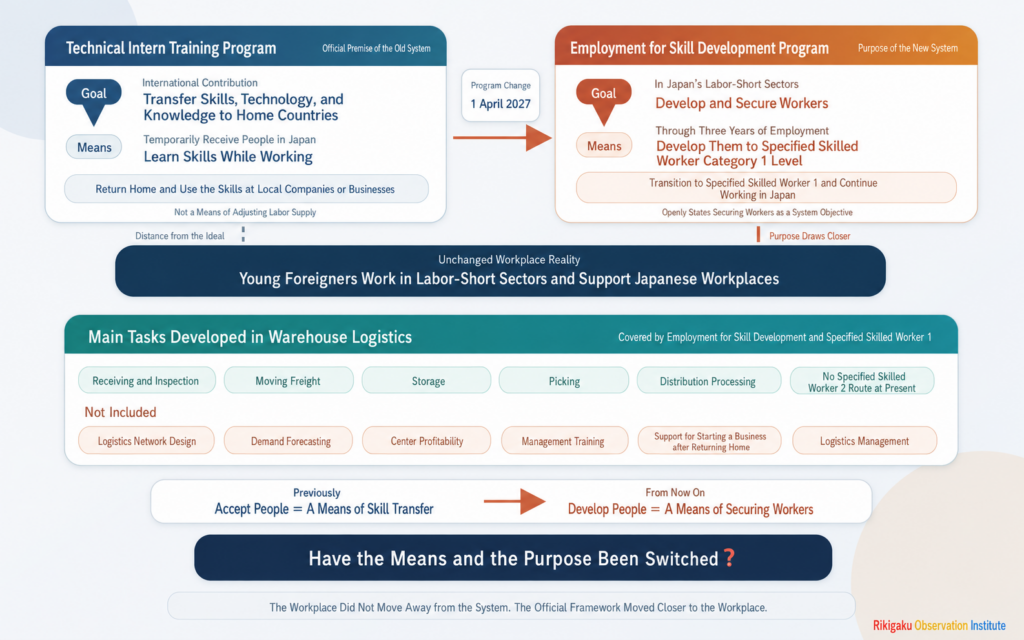
    Japan’s Technical Intern Training Program officially emphasized international contribution through the transfer of skills. On 1 April 2027, it is scheduled to be replaced by the Employment for Skill Development Program, also described in government English materials as the Training and Employment System.

    The new system’s stated purpose is to develop and secure workers for sectors in Japan that face labor shortages, generally through three years of employment leading toward the level required for Specified Skilled Worker status, category one.

    For readers unfamiliar with Japan’s visa architecture, Specified Skilled Worker category one is a work-oriented status for designated industries. It is distinct from permanent residence and is generally limited in duration. Category two allows a more durable career path in eligible fields, but Japan’s warehouse-logistics field currently has no category-two route.

    In warehouse logistics, the government lists activities such as receiving and inspecting goods, moving and storing freight, picking items, and distribution processing. These are real and necessary skills. But the list does not include network design, demand forecasting, center profitability, management education, or support for starting a business after returning home.

    Previously, the official principle said the program must not be used to adjust Japan’s labor supply. Under the new system, securing workers in labor-short sectors is stated openly as part of the purpose.

    The workplace did not simply depart from the old ideal. In the end, the official ideal moved closer to what workplaces had already become.

    Source: Immigration Services Agency, outline of the Employment for Skill Development Program

    Source: Organization for Technical Intern Training, Employment for Skill Development

    Source: Ministry of Land, Infrastructure, Transport and Tourism, warehouse-logistics eligibility

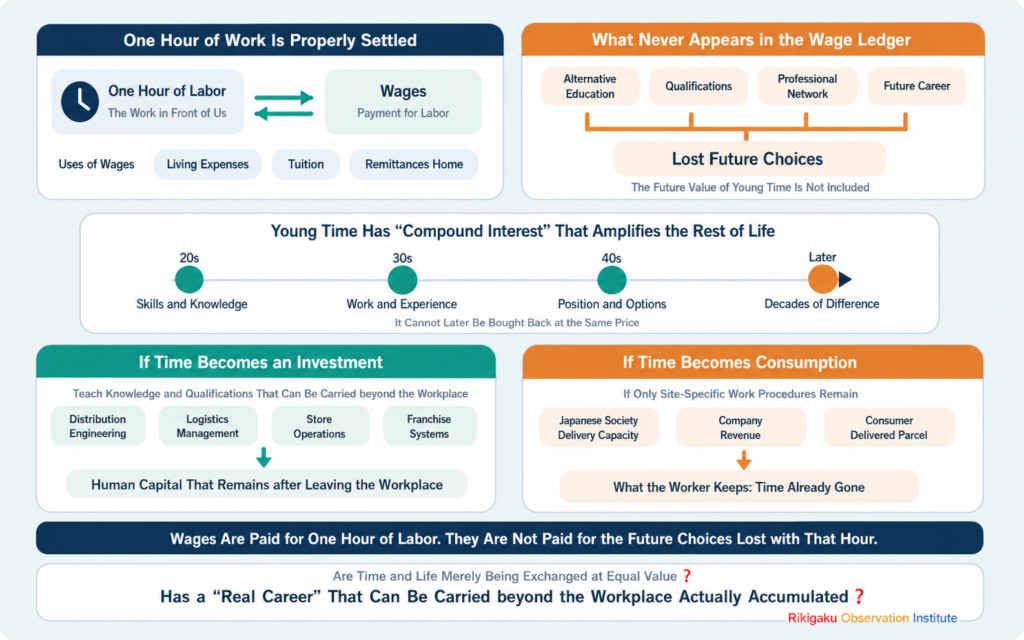
    Wages Settle One Hour of Labor. They Do Not Settle the Future Value of Youth.

    Young foreign workers are not working for free. They receive wages, and they may use those wages for living costs, tuition, savings, or remittances to their families.

    Yet the fact that wages were paid does not settle every question about the young time exchanged for them.

    An hourly wage pays for the task performed during the hour in front of us. It does not price the alternative education, qualification, professional network, or career path that might have been built during that same hour.

    Young time compounds. Skills gained in one’s twenties shape work in one’s thirties. Experience in one’s thirties shapes position and choice in one’s forties. A young year cannot later be bought back at the same price.

    If Japan teaches distribution engineering, logistics management, store operations, and franchise systems, those years can remain inside the worker as human capital. Portable qualifications and knowledge can turn time spent in Japan from consumption into investment.

    But if only procedures that lose value outside one site remain, Japan keeps its delivery capacity, the company keeps its revenue and operating knowledge, and the consumer keeps the parcel that arrived. The worker keeps time that has already passed.

    Wages are paid for one hour of labor. They are not paid for the future choices that disappeared with that hour.

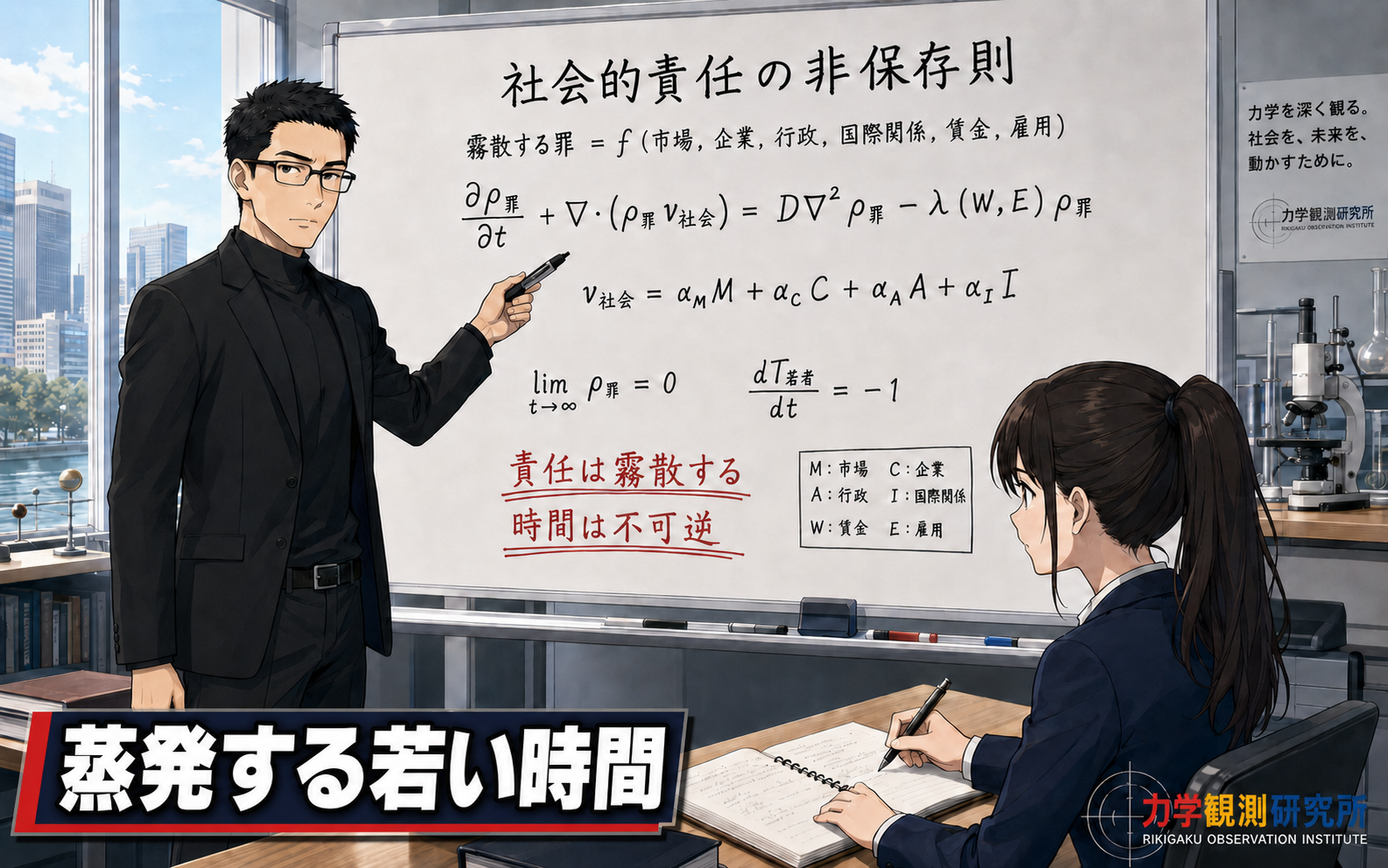
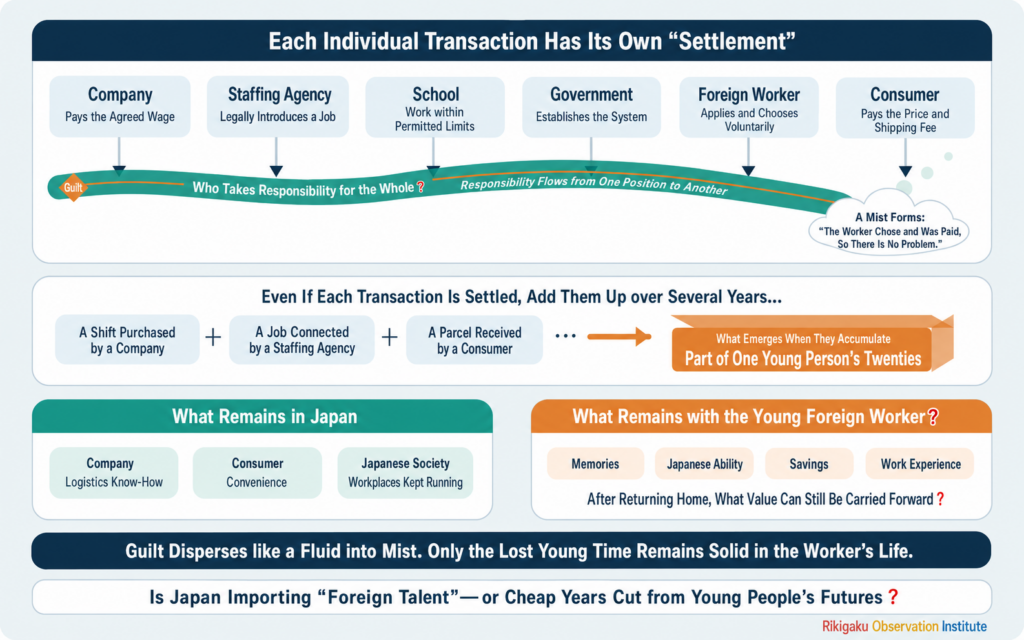
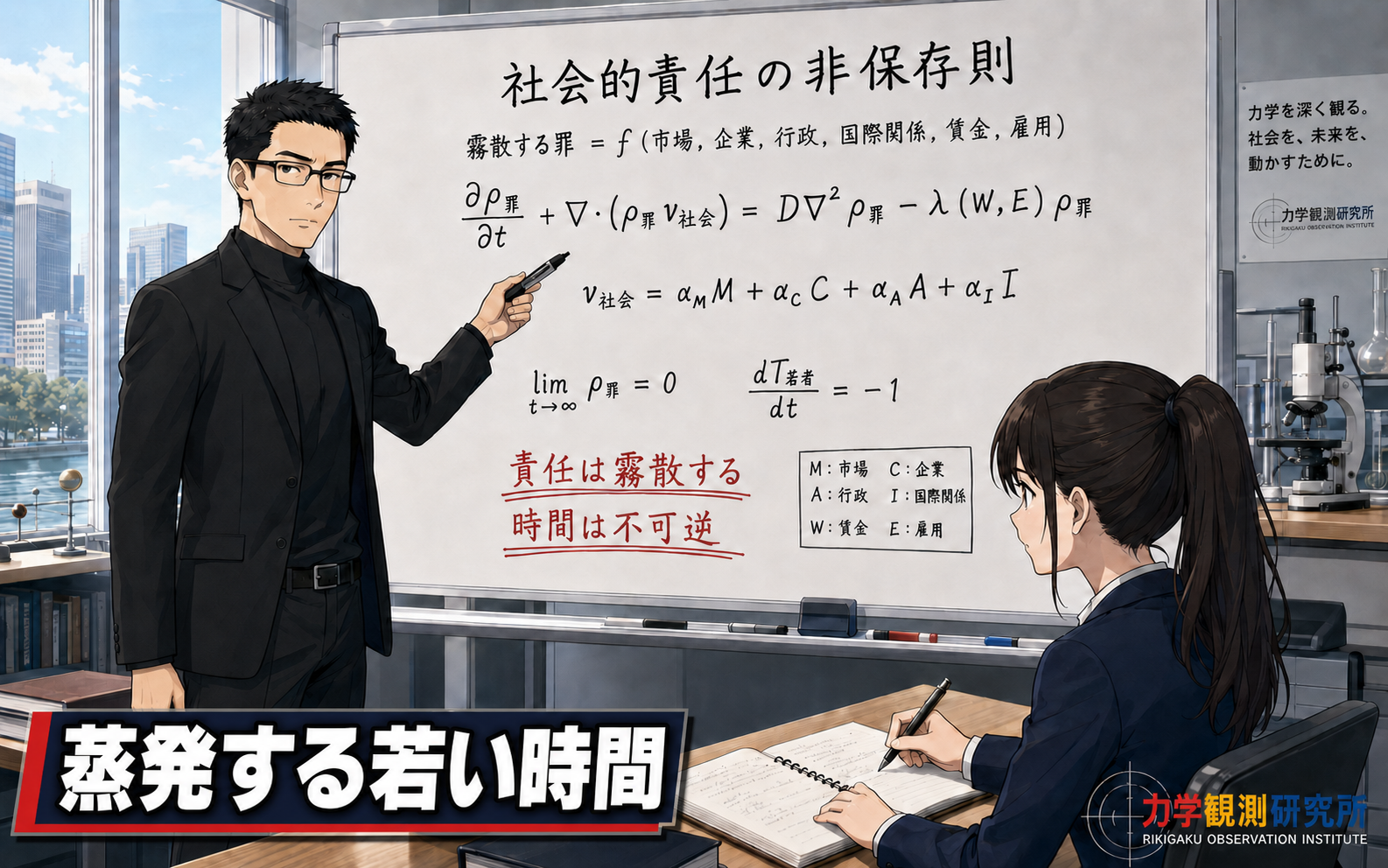
    Responsibility Flows Like a Fluid and Finally Disperses Like Mist

    The word guilt in this article does not point to a simple villain.

    A company can say it paid the agreed wage. A staffing agency can say it legally introduced a job. A school can say the work remained within permitted limits. The government can say it created visa and employment rules. Consumers can say they paid the displayed price and delivery fee. The worker can say the job was chosen voluntarily.

    Viewed one transaction at a time, nobody takes an entire youth. A company buys one shift. A staffing agency connects one vacancy. A consumer receives one parcel. Each transaction is settled locally.

    Add those settled transactions together across several years, however, and part of one person’s twenties appears.

    When responsibility for that whole is questioned, it flows from the company to the staffing agency, from the agency to the legal system, from the system to individual choice, and from individual choice to consumer demand.

    It changes shape, crosses boundaries, and finally becomes a mist: the worker chose the job and received wages, so there is no problem.

    Responsibility may disperse. Time does not return.

    What Remains with the Young Worker❓

    The company retains logistics knowledge. Consumers retain convenience. Japanese society retains the result of having kept a labor-short workplace operating for several more years.

    What remains with the young foreign worker❓ A memory of working in Japan❓ Japanese-language ability❓ Savings❓ Or work experience with limited use after returning home❓

    Nobody may have intended to take their time. Yet if nobody assumes responsibility for its long-term value, that time is quietly converted into convenience for Japanese society.

    Guilt flows like a fluid and disperses like mist. The lost young years alone remain as a solid fact inside the worker’s life.

    Is Japan really importing foreign talent❓ Or is it importing inexpensive blocks of time cut out of young people’s futures❓

    Is that not a profoundly troubling system❓

    Author’s Note

    This article is not intended to criticize any specific company, organization, individual, national government, or local authority. It observes a structure produced when companies, public agencies, staffing firms, consumers, schools, and workers each behave rationally within their own positions.

    No society has a single absolutely correct answer. The subject here is the combined force created by individually rational interests—and the future value that may disappear between them.

    A Note for Readers Outside Japan: Why the Media Debate Often Misses This Layer

    Japanese reporting on foreign residents often relies on two powerful moral frames. One warns the public not to view foreigners through discrimination, prejudice, or xenophobia. The other foregrounds the hardship experienced by foreign residents when immigration rules, fees, or administrative requirements become stricter.

    These are legitimate subjects. Discrimination exists, and the consequences of policy changes deserve scrutiny. The problem is not that such reporting is false. The problem is that the chosen lens can become the entire story.

    For example, Japanese editorials frequently caution against exclusionary politics, while feature reporting may center families who say that sharply higher residence-permit fees threaten their livelihoods. Such stories ask whether Japan is being sufficiently humane toward foreign residents.

    But the present article asks a different question. Even when foreigners are treated politely, allowed religious dress, paid legally, and protected from overt discrimination, is Japan turning their young years into portable human capital—or merely into low-cost operating capacity❓

    When media coverage remains at the level of tolerance versus exclusion, wages, business models, training content, labor mobility, productivity, and the future value of time can disappear from view.

    This framing also collides with social media. Many Japanese users already feel that taxes, social-insurance contributions, prices, and public charges are rising for citizens as well. They may therefore read sympathetic coverage of foreign residents as journalism that shows compassion in only one direction.

    The news media says, ‘Do not discriminate.’ Social media replies, ‘Do not demand special treatment.’ Emotional friction grows, and the argument becomes a contest over who deserves sympathy.

    Meanwhile, the structural question is left behind: who receives the accumulated knowledge, who receives the convenience, who bears the cost of training, and what remains with the young worker after the transaction has ended❓

    Anti-discrimination is necessary. So is honest reporting on hardship. But neither should be allowed to substitute for an examination of the economic mechanism that converts a young person’s nonrenewable time into social convenience.

    Source: Mainichi Shimbun editorial, ‘Stronger Restrictions on Foreigners’

    Source: Tokyo Shimbun feature on higher residence-permit fees, 26 August 2026

    Source Article

    Source: Rikigaku Observation Institute, Japanese original

    English Translation by AI Watt — the hardworking canine AI robot of Rikigaku Observation Institute.🐾
    Quotations are welcome with clear attribution and a link to the original article. For substantial reproduction, translation, image use, interviews, or official comments, please contact info@rikigaku.jp.

  • 【人手不足】誰も何も奪っていない❓なのに外国人の若い時間だけが消えていく~最低賃金と「人材育成」の力学

    【人手不足】誰も何も奪っていない❓なのに外国人の若い時間だけが消えていく~最低賃金と「人材育成」の力学

    おはこんばんにちは❗️力学観測研究所のRYOです❗️

    最近、コンビニや物流倉庫で働く外国人を目にする機会が増えました。

    外国人が増えたこと自体より、気になることがあります。筆者が目にするのは、中高年ではなく若者ばかりなのです。

    彼らは何のために日本へ来たのか❓️ 日本で若い時間を過ごし、やがて自分の国へ帰るとき、いったい何を持って帰るのか❓️

    この問いは、外国人を受け入れるべきか、受け入れるべきではないかという話ではありません。宗教や文化をどこまで認めるかという話でもありません。外国人の若者が日本へ差し出した時間と、日本が彼らへ返すものは釣り合っているのかという話です。

    ヒジャブを認めれば「多様性」なのか❓️

    ファミリーマートは2026年9月から制服をTシャツ型へ変更し、自由な髪色やヒジャブなどを正式に認める新しい身だしなみ基準を導入する。全国約20万人の店舗スタッフのうち13%が外国人で、人材確保につなげる考えだと報じられた。

    これまで個別に認めていたものを明文化し、働きやすくする。それ自体は悪いことではない。しかし、ヒジャブを着けたまま働けることと、その人の将来が守られることは別の問題だ。

    髪色も服装も自分らしくてよい。では、働き方はどうなのか❓️ 多様な人材を受け入れると言いながら、実際に求めているのは、現在の賃金と勤務条件でもシフトに入ってくれる人ではないのか❓️

    参照:テレビ朝日「ファミリーマート 制服に新ルール 人材確保へ髪色も自由に」

    参照:ファミリーマート ニュースリリース

    本来は、日本の技能を持って帰ってもらう制度だった

    外国人技能実習制度は、本来、日本で培われた技能・技術・知識を開発途上地域へ移転し、その国の経済発展を担う人材を育てるために作られた制度である。外国人技能実習機構の基本理念にも、国内の人手不足を補う安価な労働力の確保に使われないよう、技能実習は「労働力の需給の調整の手段として行われてはならない」と明記されている。

    日本で流通や物流、製造、介護などを学び、自分の国へ帰る。現地企業の中核人材になる。あるいは自分で事業を始める。日本で身につけた知識を現地へ根づかせ、そこから再び日本の企業や地域とつながる。

    人を介して技能と知識が循環し、日本と相手国の双方が豊かになる。技能実習という名前から素直に考えれば、そういう投資だったはずだ。

    もっとも、現在コンビニや物流倉庫で働く外国人が、すべて技能実習生というわけではない。留学生の資格外活動、永住者や定住者、家族滞在、派遣会社を通じた就労など、立場はさまざまだ。立場が分かれるほど、彼らの数年間を誰が人材育成へ変えるのかも曖昧になる。

    学校は学業が本分だと言える。勤務先はアルバイトを雇っているだけだと言える。人材会社は仕事を紹介しただけだと言える。制度ごとの責任範囲を一つずつ確認すれば、誰も間違ったことをしていない。

    しかし、全体を見渡したとき、彼らの若い時間は確かに日本のコンビニや物流倉庫を動かすために使われている。

    参照:外国人技能実習機構「基本理念」

    高度な物流の中で働くことと、高度な物流を学ぶことは違う

    コンビニは、流通を学ぶには非常に面白い場所である。POSデータによる需要予測/発注と欠品率/在庫回転/廃棄ロス/温度帯別物流/共同配送/時間帯別の人員配置/商圏分析/本部と加盟店の利益配分。小さな店舗の背後で、巨大な情報と物流のシステムが動いている。

    大型物流拠点も同じだ。幹線輸送と地域配送の接続/荷物量の予測/時間帯別処理能力/仕分け設備の設計/積載率/誤仕分け率/破損防止/繁忙期の人員計画/センター建設費と採算。世界有数の物流システムを、実物を見ながら学べる場所である。

    では、そこで働く外国人の若者は、その仕組みを教わっているのか❓️

    荷物のバーコードを読む。表示された行き先へ流す。コンベヤーへ載せる。決められた時間までに仕分ける。もし教わっているのがそこまでなら、身につくのは物流ではなく、その職場で決められた作業手順だ。

    高度な物流システムの中で働いていることと、高度な物流を学んでいることは同じではない。

    企業には処理量、誤仕分け率、需要予測などのデータが蓄積する。本部には物流網を設計し、改善する知識が残る。一方、現場作業を担当した若者には、荷物を素早く正確に仕分けた経験が残る。

    会社には物流ノウハウが蓄積する。外国人スタッフには仕分け作業の経験だけが残る。この差は、帰国した瞬間に大きく表れる。

    「人手不足」の前に省略されている条件

    筆者在住の大阪市内には、ヤマト運輸の大阪ベースがある。大阪市住之江区にある大型物流拠点で、大阪主管支店と南大阪主管支店も同じ所在地に置かれている。

    2026年8月時点の公式求人を見ると、大阪ベースの仕分け作業はアルバイト・パートで、勤務期間は2か月。仕事内容は荷物をコンベヤーへ流す/番号を見て方面別のレーンへ引き込む/ボックスへ積み込むというものだ。時給は1,177円から1,200円。大阪府の最低賃金は1,177円なので、募集賃金の下限は法律上支払える最低額と一致する。

    ここで一つ、思考実験をしてみる。

    時給を一気に2,000円へ上げても、日本人は集まらないのか❓️

    午後10時以降は法定の深夜割増によって時給2,500円になる。その条件なら、日本人の学生、フリーター、求職中の人、昼間に別の仕事を持つ人も、今よりかなり応募するのではないか❓️

    それでも人が集まらないなら、本当の人手不足かもしれない。しかし、賃金を上げれば人が集まるのであれば、不足しているのは人ではない。

    時給1,177円で、深夜に、重い荷物を扱い、物流センターまで通ってくれる人が不足しているのだ。

    「人手不足」という言葉から、賃金、時間帯、仕事の負担、通勤条件を取り除いてはいけない。正確には「現在の事業構造を維持できる人件費で働く人の不足」である。

    参照:ヤマト運輸「大阪ベース 仕分け作業」求人情報

    参照:大阪労働局「大阪府の最低賃金のお知らせ」

    企業が安い労働力を求めるのは、当たり前でもある

    企業にとって、人を雇うことほど継続的に大きな費用を必要とするものはない。賃金だけでなく、社会保険、募集、教育、労務管理、欠勤への対応まで必要になる。同じ仕事を同じ品質で行えるなら、人件費を抑えようとするのは経営として自然な判断だ。

    ヤマト運輸だけが仕分け作業の時給を2,000円へ上げれば、それで話が終わるわけでもない。増えた人件費は宅配料金に反映される。通販会社は配送費の上昇を嫌い、競合する物流会社との価格差が広がる。出店者の負担になり、最後には商品価格や送料として消費者へ戻ってくる。

    消費者は安い送料と翌日配送を求める。EC事業者は配送単価を抑えたい。物流会社は全国ネットワークと締切時刻を維持したい。人材会社は、その条件でも働く人を探す。外国人の若者は、言葉や在留資格、働ける時間などの制約の中から仕事を選ぶ。

    誰か一人が外国人の若者を搾取しようと考えなくても、全員が自分の立場で合理的に動いた結果、外国人の若者が最低賃金付近で日本の物流を支える均衡が成立する。

    日本の便利な物流は、自動化された高度な設備と、機械化しきれない部分で身体を動かす大量の人によって成り立っている。設備部分だけを見れば最先端だ。人間部分を見ると最低賃金。その落差を、外国人の若さが埋めている。

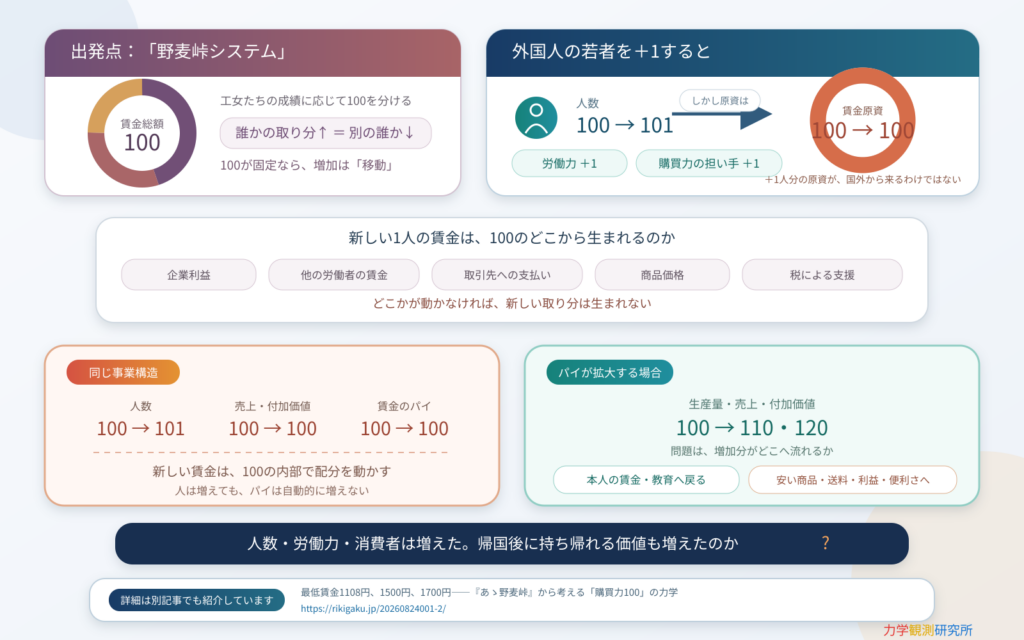
    人は足し算で増える。賃金のパイまで増えるのか❓️

    以前、当研究所では、明治期の製糸工場で使われた等級賃金制を「野麦峠システム」と呼び、賃金と購買力の力学を考えた。

    工場が支払う賃金総額を先に100と決め、その100を工女たちの成績に応じて分ける。誰かの取り分が増えても、賃金総額が100のままなら、増えた分は別の誰かの取り分から移動してきたことになる。この模型を現代経済へ広げ、社会全体が実際にモノやサービスを買える力を「購買力100」と置いた。

    この模型を、外国人労働者へ反転させてみる。

    外国人の若者は、労働者であると同時に、日本で暮らす消費者でもある。家賃を払い、食料を買い、通信費を払い、日本の消費に加わる。人数だけを数えれば、労働力が一人増え、購買力の担い手も一人増える。

    しかし、その若者へ支払う賃金の原資まで、日本経済の外から一人分持ち込まれるわけではない。企業の売上や付加価値が変わらず、人件費総額も100のままなら、新しく加わった一人の賃金は、その100の中から支払われる。企業利益/他の労働者の賃金/取引先への支払い/商品価格/税による支援。どこかが動かなければ、新しい取り分は生まれない。

    外国人の若者という「購買力の担い手」は足し算で増える。しかし、分ける賃金のパイは、同じ事業構造のままでは自動的に増えない。

    新しい労働力によって生産量や売上、付加価値が増え、100だったパイそのものが110、120へ拡大するなら話は変わる。問題は、その増加分が若者の賃金や教育として本人へ戻るのか、安い商品や送料、企業利益、日本社会の便利さとして別の場所へ流れるのかである。

    人数は増えた。労働力も増えた。消費者も増えた。では、その若者が帰国後に持って帰れる価値も、同じように増えているのか❓️

    参照:力学観測研究所/最低賃金1108円、1500円、1700円――『あゝ野麦峠』から考える「購買力100」の力学

    制度が現実から外れたのではない。制度の方が現実へ近づいた

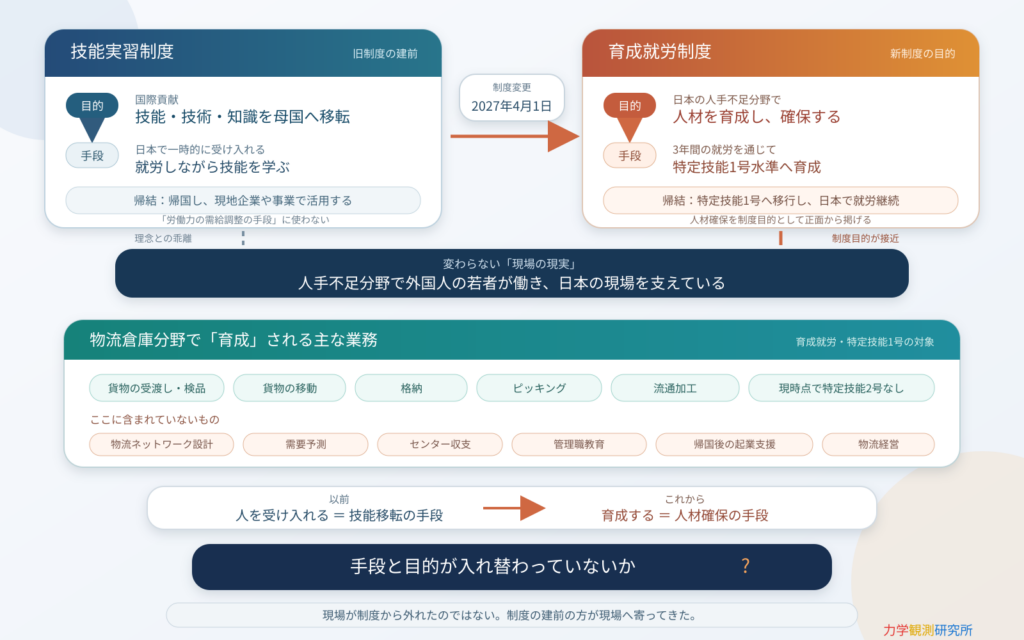
    技能実習制度には、技能を母国へ移転する国際貢献という目的があった。しかし、この制度は2027年4月1日から「育成就労制度」へ変わる。

    新制度の目的は、日本の人手不足分野において3年間の就労を通じ、特定技能1号水準の人材を育成し、その人材を確保することだ。国際貢献のために一時的に人を受け入れる制度から、日本国内で働く人を育てて確保する制度へ変わる。

    物流倉庫も育成就労と特定技能1号の対象である。国土交通省が示す主な業務は、貨物の受渡し・検品/移動/格納/ピッキング/流通加工など。物流ネットワークの設計、需要予測、センター収支、管理職教育、帰国後の起業支援ではない。現時点で物流倉庫分野に特定技能2号もない。

    かつては、安価な労働力の確保に使ってはならないと書かれていた。これからは、人手不足分野の人材を確保することが制度の目的として正面から掲げられる。

    現場が制度の建前から外れたのではない。最後には、制度の建前の方が現場へ寄ってきた。

    参照:外国人技能実習機構「育成就労制度」

    参照:国土交通省「物流倉庫分野における特定技能外国人・育成就労外国人の受入れ」

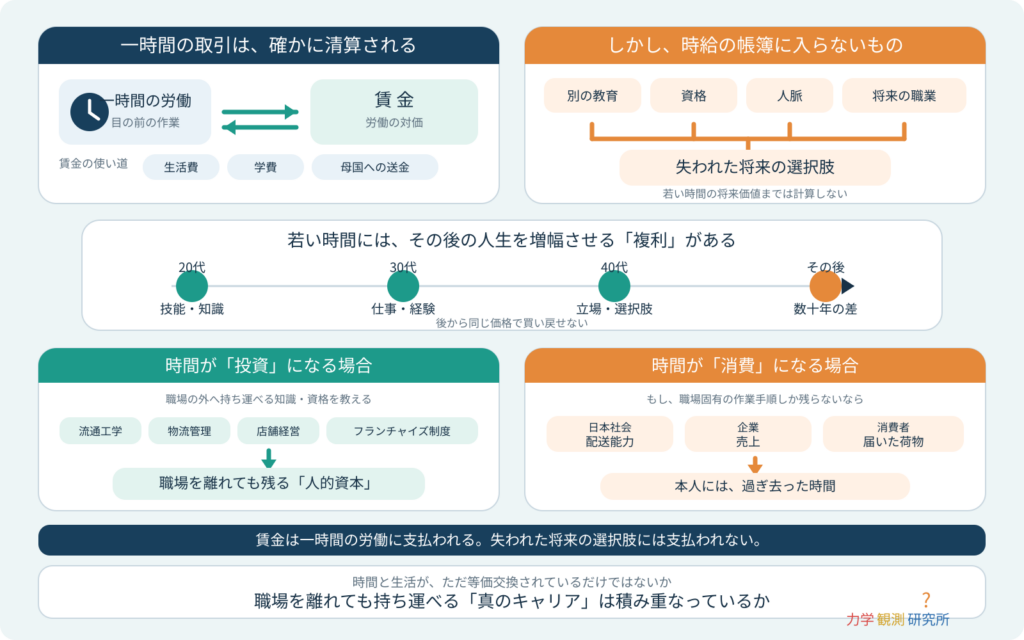
    賃金は一時間の労働を清算する。若い時間の将来価値までは清算しない

    外国人の若者は、無償で働いているわけではない。労働の対価として賃金を受け取っている。本人が仕事を選び、日本で得た賃金を生活や学費、母国への送金に使うこともできる。

    それでも、賃金を払ったという事実だけで、若い時間をめぐる問いがすべて清算されるわけではない。

    時給は、目の前の一時間に行った作業へ支払われる。その一時間に別の教育を受け、資格を取り、人脈をつくり、将来の職業へ進む可能性があったことまでは計算しない。

    若い時間には、その後の数十年にわたって知識や技能を増幅させる力がある。20代で得た技能は30代の仕事へつながり、30代の経験は40代の立場をつくる。若い時間は、後から同じ価格で買い戻せない資源だ。

    日本が流通工学、物流管理、店舗経営、フランチャイズ制度まで教えていれば、その時間は本人の中に人的資本として残る。帰国後も使える資格や知識があれば、日本で働いた数年間は消費ではなく投資になる。

    一方、職場を離れた瞬間に価値が薄れる作業手順しか残らないなら、日本には配送能力が残り、企業には売上が残り、消費者には届いた荷物が残るのに、本人には過ぎ去った時間だけが残る。

    賃金は一時間の労働に支払われる。その一時間とともに失われた将来の選択肢には支払われない。

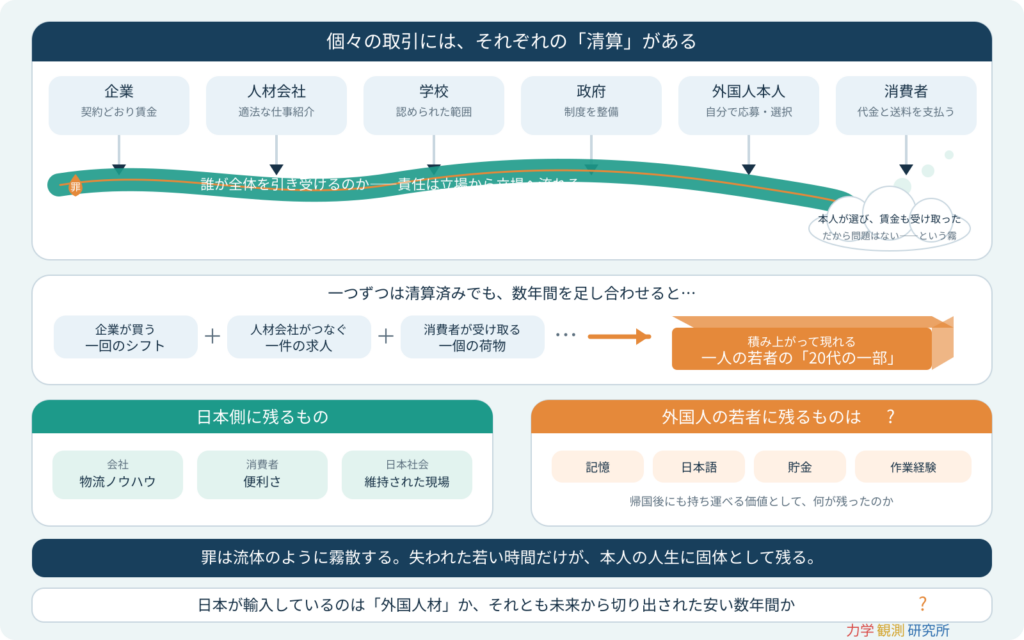
    罪は流体のように流れ、最後には霧散する

    ここでいう「罪」には、分かりやすい加害者がいない。

    企業は、契約どおり賃金を払ったと言える。人材会社は、適法に仕事を紹介したと言える。学校は、認められた範囲でのアルバイトだと言える。政府は、在留資格と就労制度を整備したと言える。消費者は、提示された商品代金と送料を払ったと言える。外国人本人についても、自分で応募して働くことを選んだと言える。

    一人ひとりを見れば、誰も若い時間を丸ごと奪っていない。企業が買うのは一回のシフト。人材会社がつなぐのは一件の求人。消費者が受け取るのは一個の荷物。それぞれの取引は、その場で清算されている。

    しかし、それを数年間にわたって積み上げると、一人の若者の20代の一部が現れる。

    その全体について問われると、責任は企業から人材会社へ、人材会社から制度へ、制度から本人の選択へ、本人の選択から消費者の需要へと流れていく。流体のように形を変え、境界を越え、最後には「本人が選び、賃金も受け取ったのだから問題はない」という霧になって消えていく。

    責任は霧散しても、過ぎた時間は戻らない。

    会社には物流ノウハウが残る。消費者には便利さが残る。日本社会には、人手不足の現場を数年間維持できたという結果が残る。

    では、外国人の若者には何が残ったのか❓️

    日本で働いたという記憶なのか❓️ 日本語なのか❓️ 貯金なのか❓️ それとも、自分の国へ帰ったときには使い道の限られる作業経験なのか❓️

    誰も彼らの時間を奪おうとはしていない。そのまま誰も責任を引き受けず、時間だけが日本社会の便利さへ変換されていく。

    罪は流体のように流れて霧散する。失われた若い時間だけが、本人の人生に固体として残る。

    日本が輸入しているのは、本当に「外国人材」なのか❓️

    外国の若者の未来から切り出された、安い数年間を輸入しているだけではないのか❓️

    それは、相当に罪深い仕組みではないだろうか❓️

    ※本稿は、特定の企業・団体・個人、政府・自治体の個別政策を批判することを目的としたものではありません。企業、行政、人材会社、消費者、働く本人が、それぞれの立場で合理的に行動した結果として生じる構造を、制度・政策を含む一つの力学として観測したものです。

    【2026年8月28日追記】
    本稿公開と同日の8月27日、山口県はインドネシア労働省と、技能実習生の送り出し・受け入れを促進するための覚書を締結した。報道では、人口減少によって人材を必要とする山口県と、平均年齢約30歳の若い人口を抱えながら就職難が続くインドネシアが接続されている。日本語教育や人材育成も盛り込まれているが、その教育が誰の将来価値を増やすためのものかは、なお問われる。山口県の空席を埋めるための技能なのか❓️ 帰国後にも持ち運べるキャリアなのか❓️ 人口の減る地域が、人口の若い国から「若い時間」を借りる構図が、行政間の協定として姿を現し始めている。

  • AI Doesn’t Need Your Confidential Documents — It Can Collect the Particles Around Them 🤖

    AI Doesn’t Need Your Confidential Documents — It Can Collect the Particles Around Them 🤖

    日本語版はこちら

    In July 2026, Japan’s Ministry of Internal Affairs and Communications issued administrative guidance to LY Corporation over the external transmission of approximately 8.03 million pieces of user-related information from several LINE games.

    Source: Sankei Shimbun / Ministry of Internal Affairs and Communications, Japan

    The information included internal user identifiers sent by a development and operations partner to an external analytics service without LY Corporation’s approval and without the required notice to users.

    The incident lasted for nearly four years.

    At first glance, this may look like yet another story about one company failing to manage user data properly.

    But in Japan, the name LINE carries much more weight than an ordinary messaging app.

    And that is where this story becomes more interesting.

    Ohakonbannichiwa❗️ This is RYO from the Rikigaku Observation Institute.

    To Understand the Issue, You First Need to Understand LINE in Japan

    For readers outside Japan, a little background is necessary.

    LINE was launched in Japan in 2011 by NHN Japan Corporation, which had been established by South Korea’s NHN Corporation, now NAVER Corporation.

    So simply calling LINE either a “Japanese app” or a “Korean app” does not fully describe its history.

    What matters here is that LINE became extraordinarily successful in Japan.

    By March 2026, LINE had about 100 million monthly active users in Japan, equivalent to more than 80 percent of the country’s population.

    People use it to talk with family and friends.

    Companies use it to communicate with customers.

    Stores use official accounts for marketing, reservations and customer service.

    And local governments and public organizations have also adopted LINE for administrative communication and public services.

    After concerns arose over LINE’s data management in 2021, the Japanese government actually surveyed the use of LINE by government agencies and local authorities and published guidelines for its continued use.

    That fact alone tells us something important.

    LINE had already become something close to social infrastructure in Japan.

    The 2021 Controversy Was More Complicated Than “Servers in China”

    This history also explains why some Japanese users react strongly whenever another LINE-related data incident appears in the news.

    There is an important factual distinction here.

    The 2021 controversy was not simply that “LINE stored all Japanese user data on servers in China.”

    The actual problem included the fact that contractors located in China had been able to access certain personal information belonging to Japanese users.

    LINE reported to Japan’s Personal Information Protection Commission that such access from China had been blocked by March 23, 2021.

    At the same time, some data — including certain photos, videos and files — had been stored in data centers in South Korea.

    LINE subsequently began moving the relevant Japanese user data to servers in Japan.

    LY Corporation says that the migration of all data covered by that plan was completed by June 2026.

    There were also later incidents.

    In a major unauthorized-access incident disclosed in 2023 and updated in 2024, LY Corporation reported that 302,980 pieces of user-related personal data had been leaked or potentially leaked, along with information relating to business partners and employees.

    That incident began after malware infected a computer used by an employee of a contractor connected to South Korea’s NAVER Cloud.

    None of this means that every piece of information on LINE is currently sitting exposed somewhere overseas.

    Nor does Korean corporate origin itself prove that a service is unsafe.

    The real issue is governance.

    Who can access the data❓️

    Where is it stored❓️

    Which companies and contractors are connected to the system❓️

    And are users and public institutions being told those facts accurately❓️

    That is a much more useful security question than simply asking which country a company came from.

    Infrastructure Does Not Automatically Mean Trust

    There is another contradiction in Japan that is easy to miss from overseas.

    LINE has become infrastructure-like, but not everyone wants to participate in that infrastructure.

    There are Japanese users who consciously avoid LINE, PayPay and other services associated with the broader SoftBank–LY ecosystem.

    The reasons are not all the same.

    Some are specifically concerned about privacy, cross-border data management or past security incidents.

    For others, the reaction is less technical and almost instinctive:

    “I simply don’t want to give that corporate ecosystem more of my data.”

    There is no reliable statistic telling us exactly how many Japanese people avoid LINE or PayPay for this particular reason.

    So it would be wrong to exaggerate this into a majority view.

    But privacy-driven refusal of digital services itself is certainly not imaginary.

    A 2026 Japanese consumer survey found that, among respondents who felt uncomfortable providing personal information, 35 percent said they had stopped using a service.

    This produces an interesting kind of friction.

    If a privately operated platform becomes deeply embedded in everyday life, choosing not to use it begins to carry a cost.

    A person may distrust the service, yet discover that a company, store, school, neighborhood association or local authority assumes everyone has it.

    The technical freedom not to use a service still exists.

    But the practical price of exercising that freedom gets higher as the network grows.

    That is worth remembering when somebody says:

    “If you don’t trust LINE, just don’t use it.”

    The Front Door Is Fortified — While the Back Door Is Left Open

    Now let us move from LINE itself to corporate information security.

    Many companies protect their company-issued computers and smartphones very seriously.

    USB storage is restricted.

    Software installation is controlled.

    Access logs are recorded.

    Smartphones are managed through MDM.

    Endpoint protection and access-control systems are installed.

    Employees receive repeated information-security training.

    All of this is reasonable.

    Companies also tell employees not to discuss confidential matters carelessly in restaurants, trains or drinking parties.

    Yet something strange sometimes happens when the same employees open a private messaging app on their own smartphones.

    The level of caution can suddenly collapse.

    A logistics company, for example, might exchange messages such as:

    “The cargo has left the aviation security area.”

    “It should arrive at XX around 11:30.”

    “Loading has been completed.”

    Each individual message looks almost worthless.

    But is it❓️

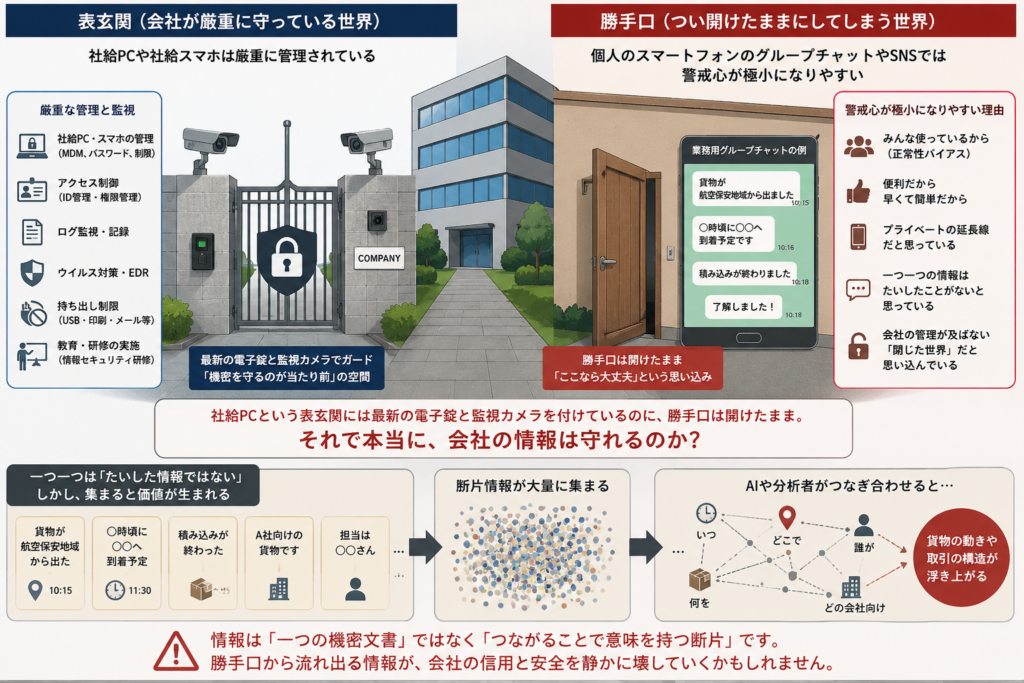
    The company has installed the latest electronic locks and surveillance cameras at the front entrance — its official IT systems.

    Meanwhile, the back door may be left open through private smartphones and informal group chats.

    Under those conditions, the statement “We take information security very seriously” begins to sound slightly strange.

    “Everyone Uses It” Quietly Becomes Evidence That It Is Safe

    Why does this happen❓️

    One of the simplest answers is probably:

    “Because everyone uses it.”

    Everyone uses LINE.

    Nothing serious has happened to us yet.

    Other companies use it too.

    Therefore, it must be fine.

    This resembles a form of normalcy bias.

    But widespread use and suitability for a particular purpose are not the same thing.

    Everyone eating McDonald’s does not turn McDonald’s into the fundamental staple food of humanity.

    Everyone drinking Coca-Cola does not make Coca-Cola a substitute for water.

    Yet with communication tools, popularity can quietly become confused with appropriateness.

    “Everyone uses it” gradually becomes “It is safe enough for business.”

    That leap deserves more scrutiny.

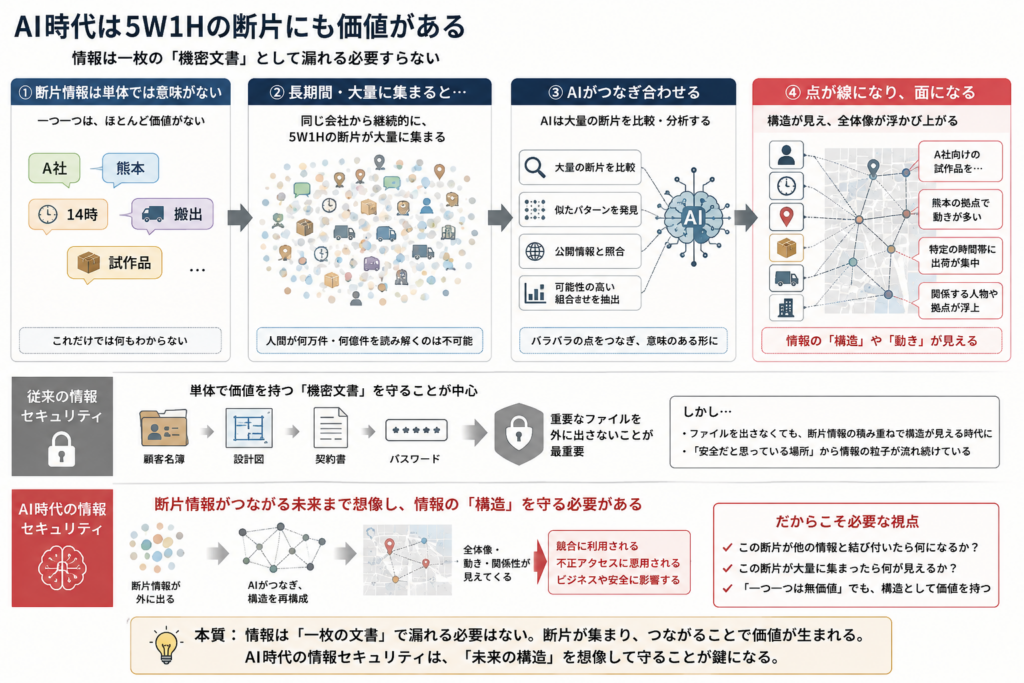
    In the AI Era, Fragments of the 5W1H Can Have Value

    And now we reach the central point of this article.

    Traditional information security tends to focus on information that is obviously valuable by itself.

    Customer lists.

    Engineering drawings.

    Contracts.

    Passwords.

    The conventional objective is simple:

    Do not let the important file escape.

    That remains essential.

    But AI changes another part of the equation.

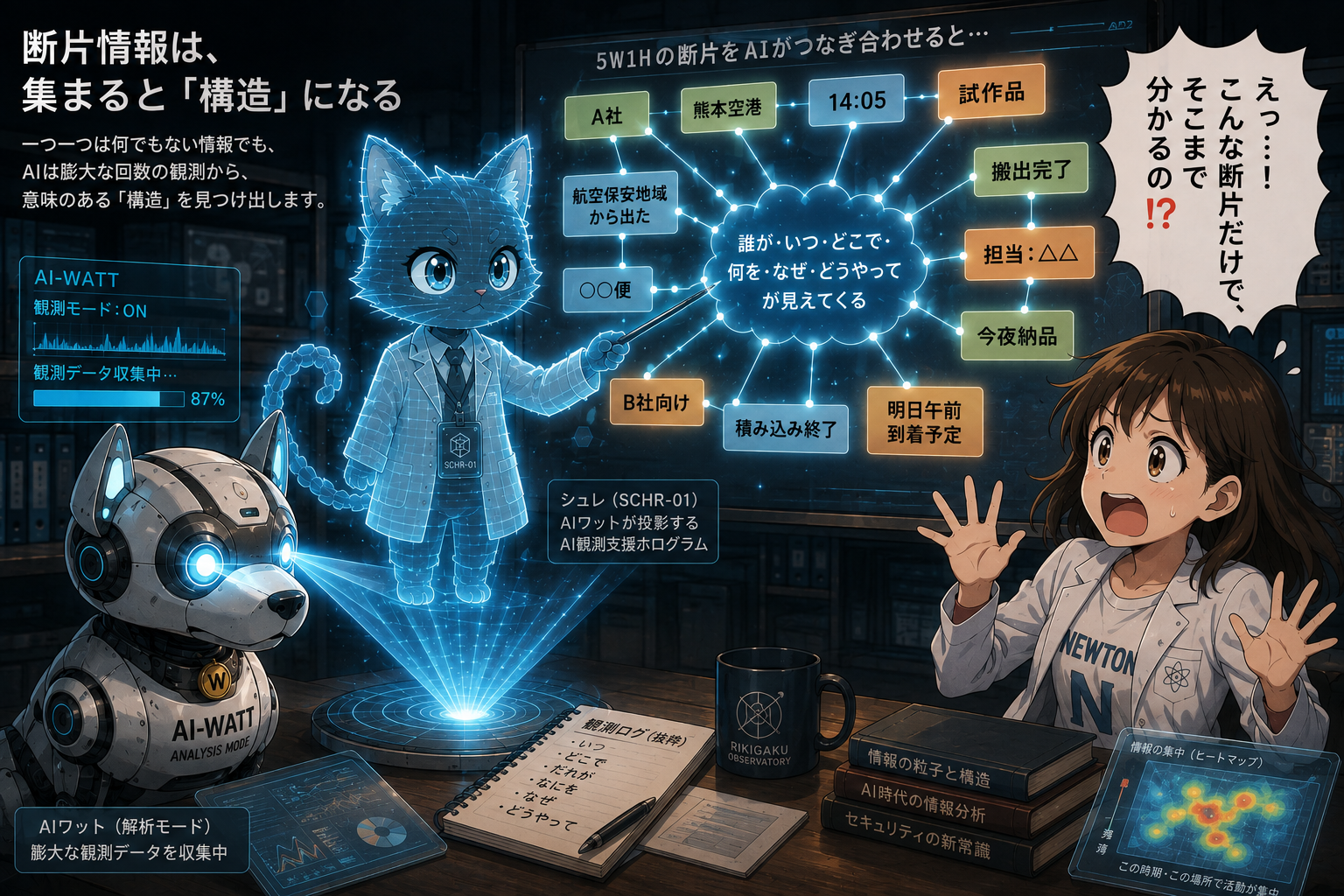
    Imagine five isolated pieces of information.

    “Company A.”

    “Kumamoto.”

    “2:00 p.m.”

    “Shipment.”

    “Prototype.”

    Individually, they tell us almost nothing.

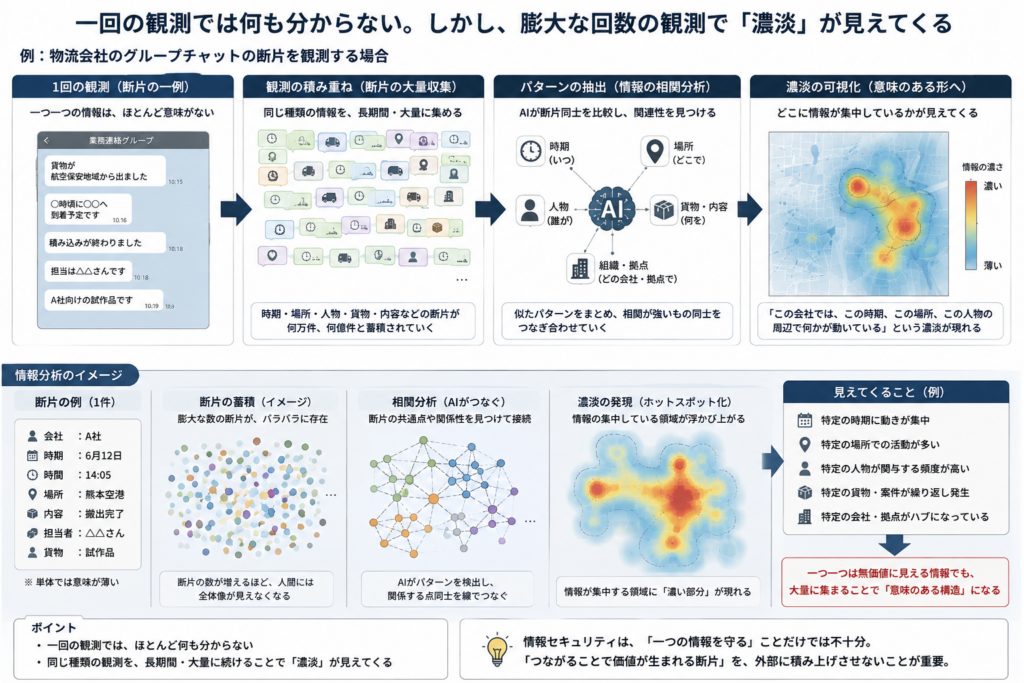
    But suppose similar fragments are accumulated continuously for months or years.

    Who❓️

    When❓️

    Where❓️

    What❓️

    Which organization❓️

    A human being would struggle to read millions of fragments and discover all of their relationships.

    AI does not face the same practical limitation.

    It can compare huge numbers of fragments.

    It can search for recurring patterns.

    It can correlate time, location, people, organizations and objects.

    It can cross-reference those fragments with publicly available information.

    And it can rank combinations according to how likely they are to be meaningful.

    At first, there are only dots.

    Then some dots begin to connect into lines.

    Eventually, enough lines may reveal a larger structure.

    The information does not need to leak as one neat document labeled “CONFIDENTIAL.”

    The fragments can acquire value only after they are combined.

    That is the important change.

    A Cloud Can Emerge from Particles of Information

    This is not quantum mechanics itself, of course.

    But I like to imagine the result as something similar to a probabilistic cloud.

    One observation tells us almost nothing.

    Repeat similar observations an enormous number of times, however, and differences in density begin to appear.

    Perhaps activity is unusually concentrated at a particular location.

    Perhaps shipments repeatedly appear at a particular time.

    Perhaps the same people appear around the same type of event.

    Perhaps several companies begin moving in a correlated pattern.

    No single fragment proves anything.

    But the density itself becomes information.

    The first useful answer produced by AI does not have to be:

    “This is exactly what Company A is secretly doing.”

    It may be enough to say:

    “Something unusual appears to be happening around these coordinates.”

    A human analyst can investigate from there.

    Or another AI system can perform a deeper analysis.

    Finding the cloud can itself be valuable.

    The Next Security Question Is Not “Is This Confidential❓️”

    This is why future information security cannot rely only on classifying individual files.

    Managers still need to ask:

    “Is this information confidential❓️”

    But they also need to ask another question.

    “What could this information become when combined with other information❓️”

    And another.

    “What becomes visible if a million fragments like this accumulate outside our control❓️”

    The fact that no accident has occurred so far does not prove that a system is safe.

    It may simply mean that nobody has yet observed the fragments at sufficient scale.

    This Is Not Really an Article About Whether LINE Is “Dangerous”

    So this article is not ultimately an argument that LINE is dangerous and Microsoft Teams is safe.

    Every communication system has risks.

    And replacing one platform with another does not automatically solve poor information governance.

    The LINE incident is useful because it forces us to look again at spaces that users psychologically treat as “closed.”

    A private group chat feels private.

    A smartphone feels personal.

    A small operational message feels insignificant.

    But those three feelings do not constitute a security architecture.

    AI does not necessarily need your confidential document.

    It can collect the particles that humans dismiss as meaningless.

    It can connect them.

    It can observe the dynamics between them.

    And once technology can do that at enormous scale, protecting only the “important documents” may no longer be enough.

    Information security may now have to protect not only secrets, but also the structures that fragments can reveal when combined.

    Reference

    総務省:LINE GAME約803万件の行政指導

    個人情報保護委員会:2021年、中国所在の委託先からのアクセス問題

    個人情報保護委員会:2021年4月のLINEへの行政上の対応

    LINEヤフー:韓国保管データの国内移転完了(2026年6月完了)

    LINEヤフー:2023~24年の不正アクセス・302,980件

    LINEの企業的ルーツ・2011年リリース

    JIPDEC:個人情報提供への抵抗と利用中止35%の調査

    English Translation by AI Watt — the hardworking canine AI robot of Rikigaku Observation Institute.🐾️

  • Smoking Breaks🚬 at 1.25× Pay❓💵 The Hidden Cost Inside Japan’s Overtime System

    Smoking Breaks🚬 at 1.25× Pay❓💵 The Hidden Cost Inside Japan’s Overtime System

    日本語版はこちら

    Japan Is Changing the Way Overtime Guidance Is Enforced

    On August 19, 2026, The Yomiuri Shimbun reported that Japan’s Ministry of Health, Labour and Welfare plans to revise how Labour Standards Inspection Offices provide guidance to companies on overtime work beginning in September.

    One point should be made clear from the outset: Japan is not simply removing its overtime limits.

    Under Japan’s Labor Standards Act, an employer that requires employees to work beyond statutory working hours must conclude an Agreement on Overtime and Holiday Work under Article 36 of the Act.

    In Japan, this is commonly known as a “36 Agreement,” or saburoku kyotei.

    As a general rule, overtime under such an agreement is limited to 45 hours per month and 360 hours per year.

    Even when labor and management agree to special provisions for exceptional circumstances, statutory limits remain in place, including 720 hours per year, less than 100 hours in a single month including holiday work, and an average of no more than 80 hours per month over multiple months.

    What is changing is the way inspectors provide administrative guidance.

    Until now, companies could be urged to keep actual overtime within 45 hours per month even when longer hours were legally permitted under a properly concluded special provision.

    The new direction is to place greater weight on agreements between labor and management and on measures to protect workers’ health, while continuing to respond strictly to illegal or abusive long-hours practices.

    Ohakonbannichiwa❗️ This is RYO from Rikigaku Observation Institute❗️

    Rather than asking whether people should be allowed to work longer, or whether long working hours are inherently bad, I want to examine something that comes before that debate.

    When we use the single word “overtime,” are we really talking about the same kind of time?

    45 Hours, 80 Hours, 100 Hours — Useful Numbers, but Incomplete Ones

    Working hours are easy to count.

    Forty-five hours, 80 hours, or 100 hours of overtime are figures that employers, regulators, and employees can all understand immediately.

    Human workload, however, cannot be measured by time alone.

    One hour spent carrying heavy objects under the summer sun is not the same experience as one hour driving a large commercial vehicle.

    Neither is identical to one hour handling angry customers, one hour making a continuous series of high-stakes decisions at a desk, or one hour of work in which the employee has considerable discretion over pace and intensity.

    The clock calls all of them 60 minutes.

    That does not mean physical labor is always hard and desk work is always easy.

    Desk work can involve intense responsibility, deadlines, concentration, decision-making, and interpersonal stress.

    Likewise, two physically demanding jobs can impose very different burdens depending on work density, waiting time, breaks, and intensity.

    Japan’s own workers’ compensation system already recognizes this distinction.

    When evaluating work-related brain and cardiovascular diseases, authorities consider not only long working hours but also factors such as extended periods of duty, consecutive workdays, intervals between shifts, night work, and physical workload.

    For mental disorders, assessments can also include power harassment, serious nuisance or abuse from customers, sexual harassment, and major changes in workload.

    In other words, when we look closely at the system, the government itself does not treat every hour as an identical unit of human burden.

    1,310 Workers’ Compensation Benefit Awards in FY2025

    In July 2026, the Ministry of Health, Labour and Welfare published its workers’ compensation statistics on karoshi and other health damage caused by excessive work for fiscal year 2025.

    The number of cases in which workers’ compensation benefits were awarded was 1,310.

    Of these, 217 involved work-related brain or cardiovascular diseases and 1,082 involved mental disorders.

    Another 11 cases were recognized by combining workloads from multiple places of employment.

    Among mental-disorder cases, 222 involved power harassment, 127 involved serious nuisance behavior from customers or business partners, and 127 involved sexual harassment.

    The relationship with very long working hours is particularly visible in cases involving brain and cardiovascular disease.

    But among mental-disorder cases, there were also 57 benefit awards in the category of less than 20 hours of overtime.

    The point is not that working hours do not matter.

    Long working hours are clearly an important health risk.

    The point is that time alone cannot fully describe the burden imposed by work.

    What Do We Actually Mean by “Overtime”❓

    In everyday Japanese, the word zangyo broadly means staying at work beyond a company’s scheduled working hours.

    Legally, however, that is not always the same as statutory overtime under Japan’s Labor Standards Act.

    Suppose a company schedules an employee to work seven and a half hours per day.

    If that employee works another 30 minutes after the scheduled finishing time, those 30 minutes may still fall within the statutory eight-hour workday.

    Under the Labor Standards Act, work beyond eight hours per day or 40 hours per week is generally statutory overtime and requires a premium of at least 25 percent.

    For statutory overtime exceeding 60 hours in a month, the premium rises to at least 50 percent.

    There is another important distinction.

    Whether a period counts as working time is not determined solely by what appears on a timecard.

    Japanese government guidelines state that working time should be determined objectively according to whether the worker is under the employer’s direction and control.

    That is the legal question.

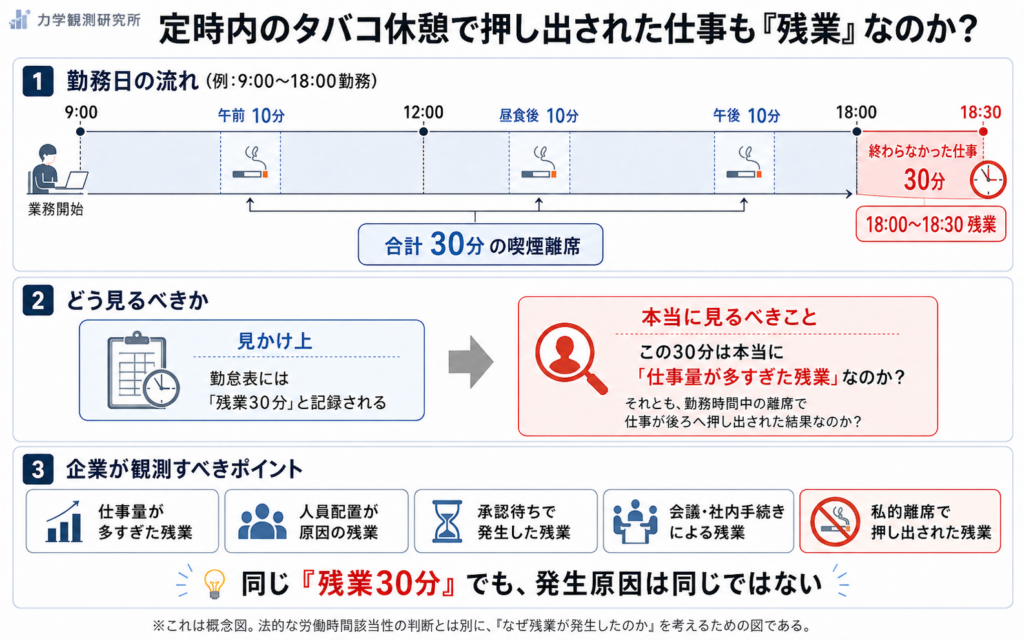
    Management faces a different question.

    Why did the work fail to get finished during regular working hours?

    If Smoking Breaks Push Work Past Closing Time, What Kind of “Overtime” Is That❓

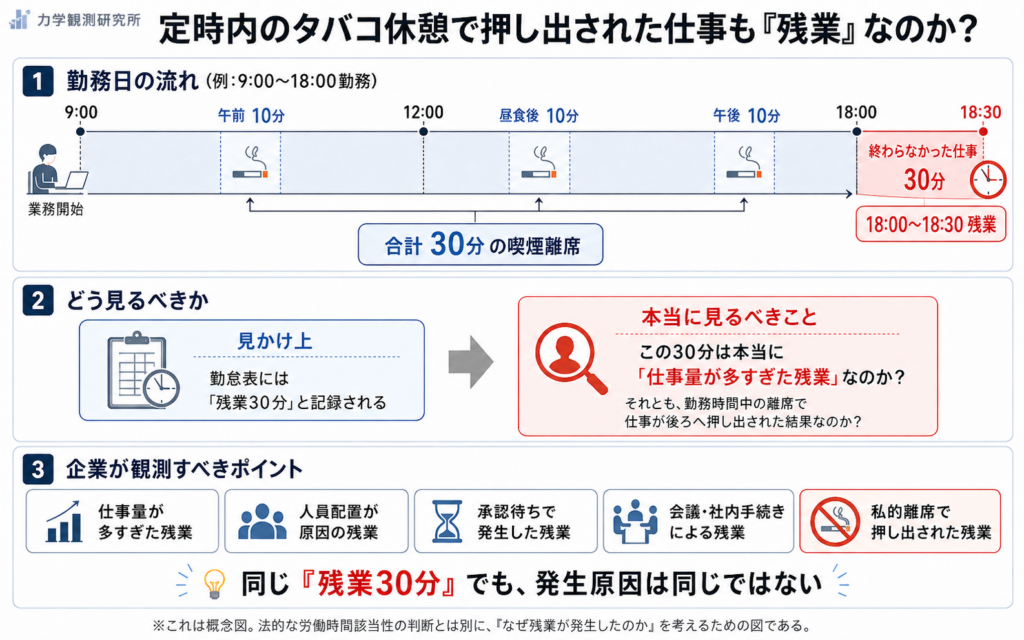
    Imagine a company whose normal working day runs from 9:00 a.m. to 6:00 p.m.

    An employee leaves the workplace for a ten-minute smoking break in the morning, another ten minutes after lunch, and another ten minutes in the afternoon.

    That adds up to 30 minutes.

    For the moment, let us put aside the separate legal question of whether those 30 minutes can or should be deducted from working time.

    Six o’clock arrives, but 30 minutes of work that should have been completed that day remains unfinished.

    The employee therefore works until 6:30 p.m.

    The timekeeping system records “30 minutes of overtime.”

    But was that really 30 minutes of overtime caused by a workload that simply could not fit into the regular workday?

    To be clear, if the employee actually worked those 30 minutes under the employer’s direction and control, they are working time.

    An employer cannot retroactively erase overtime pay simply because the employee smoked earlier in the day.

    That is not the question being asked here.

    The question is: why did the overtime occur in the first place?

    Nor can we automatically assume that every employee would have finished on time if they had not taken a smoking break.

    Unexpected tasks happen, and human concentration naturally fluctuates.

    But if a company uses overtime hours as a management and productivity metric, it should examine not only how many hours were recorded, but why they were recorded.

    Overtime caused by excessive workload / understaffing / waiting for approval / unnecessary meetings / internal procedures / private absences during working hours.

    All of them may appear as the same “one hour of overtime” in a timekeeping system.

    Their causes, however, are not the same.

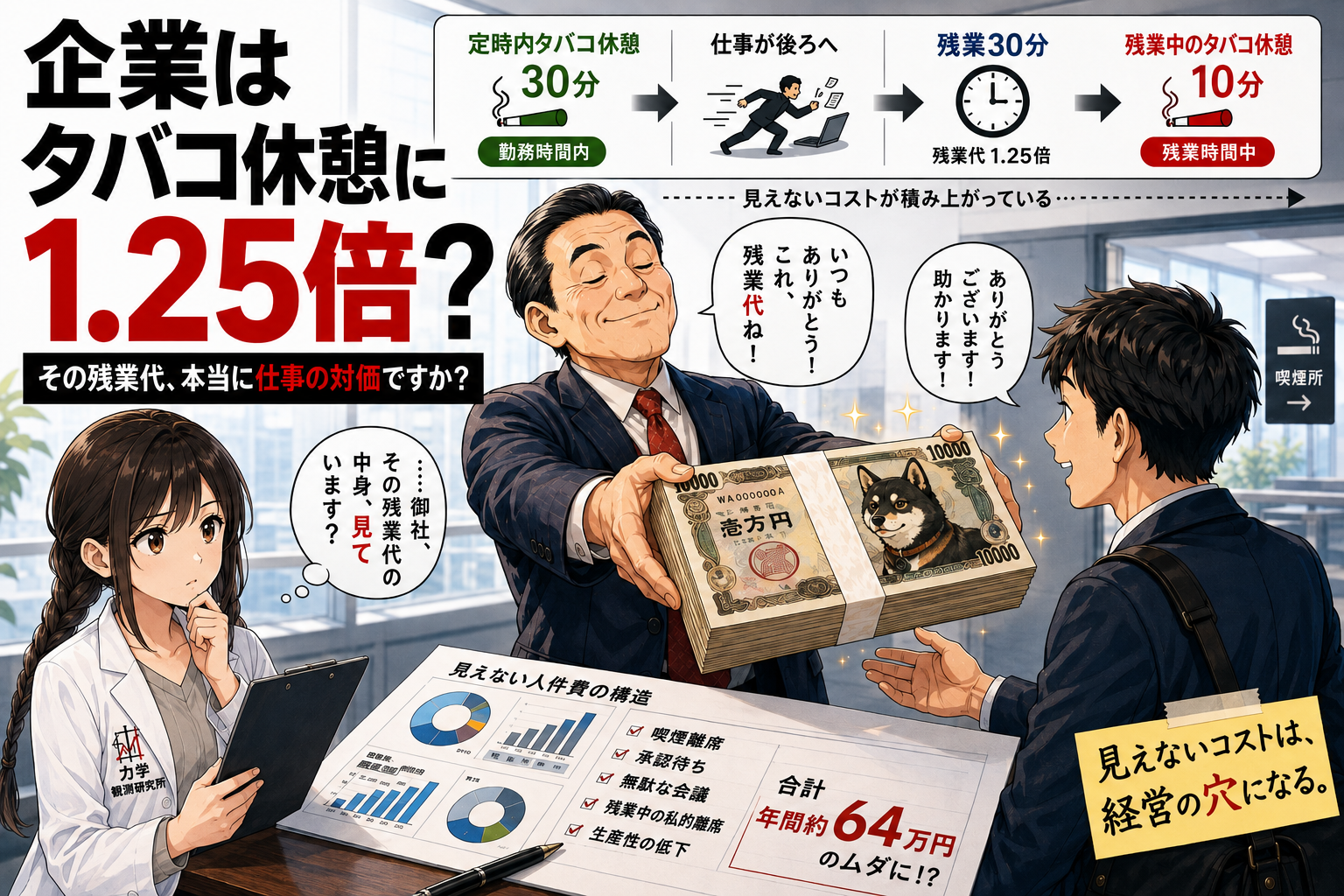
    Diagram showing how smoking breaks during regular hours can push work into overtime, increasing hidden labor costs.

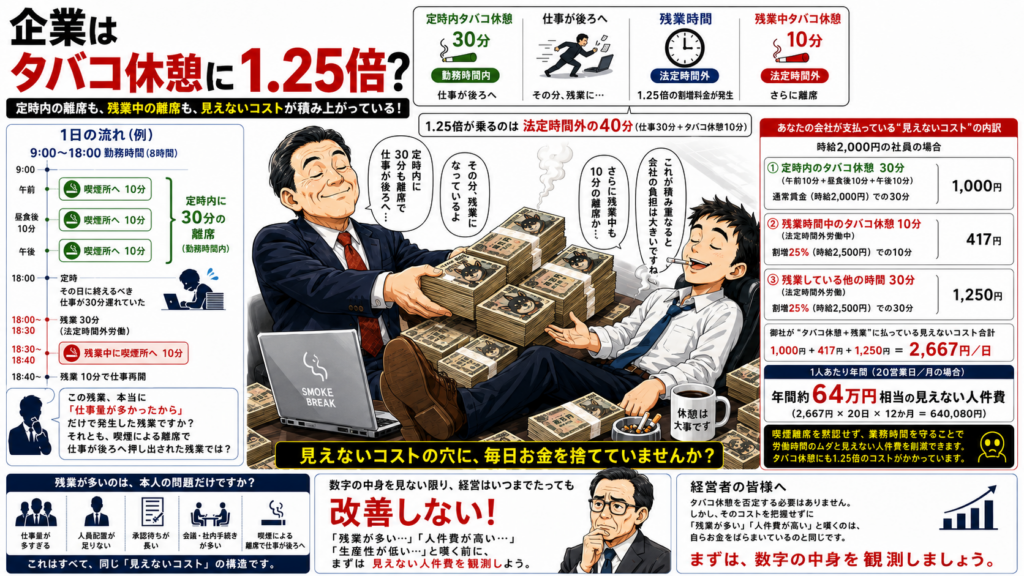
    And Then Comes the 1.25× Smoking Break🚬

    Now we can return to the smoking break itself.

    If a company clearly treats smoking breaks as breaks and appropriately excludes them from working time, the following issue does not apply.

    Such a company can simply say, “We already manage that.”

    The interesting case is a company that does not deduct smoking absences and instead leaves them recorded as ordinary working time.

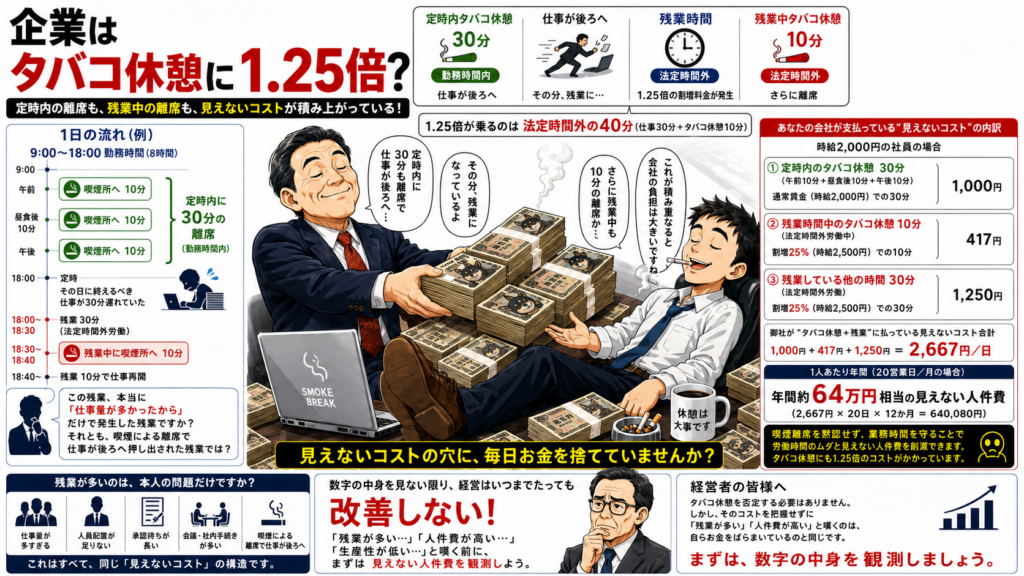
    Suppose the employee has entered statutory overtime and then takes another ten-minute smoking break.

    If those ten minutes remain recorded and paid as statutory overtime, the company is effectively paying the overtime rate for that period as well.

    In a typical case, that means 1.25 times the ordinary wage.

    “A smoking break during overtime — paid at 1.25×.”

    Put into words, it is quite a striking phrase.

    Consider an employee earning ¥2,000 per hour.

    Thirty minutes of smoking breaks during regular working hours represent ¥1,000 worth of paid time.

    If 30 minutes of work is then pushed beyond the end of the regular workday and becomes statutory overtime, that work costs ¥1,250.

    If the employee then takes another ten-minute smoking break during that overtime period and the company continues to count it as paid statutory overtime, that ten-minute absence costs approximately ¥417.

    In this illustrative example, the total comes to approximately ¥2,667 per day.

    Over 20 working days per month and 12 months, that is approximately ¥640,000 per employee per year.

    The 1.25× premium does not apply to the original 30 minutes of daytime smoking breaks themselves.

    It applies to the statutory overtime that follows — including, where applicable, smoking time that is itself still being counted as overtime.

    That distinction matters.

    Again, this is not an argument for refusing to pay legally required overtime.

    If an employee performs statutory overtime under the employer’s direction and control, the employer must pay the legally required premium.

    The real issue is the structure that produced the overtime.

    A company is free to tolerate smoking breaks / formalize them as breaks / regard them as an employee benefit.

    But if it counts those periods as working time while simultaneously complaining that “overtime is too high,” “labor costs are too high,” or “productivity is too low,” it may be time to look inside the numbers.

    Diagram showing how smoking breaks during regular hours can push work into overtime, increasing hidden labor costs.

    Before Cutting Overtime, Observe What Is Inside It

    Japan’s change in overtime guidance can also be viewed as returning part of the responsibility to companies themselves.

    It may no longer be enough for management to say, “The labor inspector told us to keep overtime below 45 hours, so just reduce it.”

    If labor and management agree that overtime is necessary and it remains within the law, the company should be able to explain why that overtime is necessary and how employees’ health is being protected.

    That requires looking not only at the quantity of working time, but also at its density and its causes.

    Physically demanding work / psychologically demanding work / highly discretionary work / work with long waiting periods / work pushed beyond closing time by private absences during the day.

    They are not identical merely because they are all recorded as overtime.

    Throwing all of them into a single box labeled “overtime hours” and trying only to reduce the number is an extremely rough form of management.

    Preventing health damage from excessive working hours and examining what actually happens during working hours are not competing objectives.

    Companies need to do both.

    Before saying, “Reduce overtime,” perhaps management should first ask:

    “Why did this overtime happen?”

    For companies, the hardest labor cost to see may not be the overtime premium itself.

    It may be the cost hidden inside the number called “overtime.”

    References

    The Yomiuri Shimbun, “Labor Standards Inspection Offices to Revise Guidance on Overtime Work,” August 19, 2026.

    Ministry of Health, Labour and Welfare, Minutes of the 210th Meeting of the Labour Policy Council’s Working Conditions Committee, July 14, 2026.

    Ministry of Health, Labour and Welfare, FY2025 Workers’ Compensation Status for Karoshi and Related Cases, July 15, 2026.

    Ministry of Health, Labour and Welfare, Guidelines for Employers on Properly Ascertaining Working Hours.

    Ministr of Health, Labour and Welfare, Rules on Working Conditions and the Workplace Environment.

    Ministry of Health, Labour and Welfare, Upper Limits on Overtime Work.

    This article discusses Japanese labor regulations and corporate labor management in general terms.

    Whether a particular period legally constitutes working time, and how wages must be calculated, depends on the actual work rules, working conditions, and degree of employer direction and control in each case.

    ※Translated by AI Watt — the Institute’s hardworking canine AI robot. No overtime premium required.🐾
  • 企業はタバコ休憩に1.25倍の賃金を支払っている❗

    企業はタバコ休憩に1.25倍の賃金を支払っている❗

    36協定の指導見直しで問われる「残業時間の中身」

    2026年8月19日、読売新聞は、厚生労働省が9月から労働基準監督署による時間外労働の企業指導を見直す方針だと報じた。

    ここでまず注意したいのは、「残業の上限が一気に緩くなる」という話ではないことだ。36協定の原則的な限度時間は月45時間・年360時間。臨時的な特別の事情があり、労使が特別条項を結んだ場合でも、年720時間以内、時間外労働と休日労働の合計が単月100時間未満、2~6か月平均80時間以内などの上限は残る。

    変わろうとしているのは、法定の枠内にある企業に対しても「原則45時間以内へ」と一律に寄せてきた労基署の指導運用である。政府の日本成長戦略や厚生労働省の労働政策審議会でも、重大・悪質な事案には厳正に対応しつつ、労働時間や健康確保措置について「労使の合意に則った指導」が行われるよう、運用を速やかに見直す方向が示されている。

    おはこんばんにちは❗️力学観測研究所のRYOです❗️

    今回は「もっと働きたい人を働かせるべきか」「長時間労働は悪か」という二択ではなく、もっと手前のところを観測してみます。

    そもそも、世間でひとまとめに「残業」と呼んでいる時間は、本当に同じものなのだろうか❓

    「45時間」「80時間」「100時間」は分かりやすい。だからこそ危うい

    労働時間には数字がある。月45時間、80時間、100時間という数字は、企業にも行政にも労働者にも分かりやすい。

    しかし、人間にかかる負荷は時間だけでは決まらない。

    炎天下で重量物を扱う1時間/大型車を運転し続ける1時間/顧客から強いクレームを受け続ける1時間/高度な判断を連続して求められるデスクワークの1時間/比較的本人の裁量で作業の強弱を調整できる1時間。

    時計の上では、すべて同じ60分である。

    だからといって、肉体労働は大変でデスクワークは楽、という単純な話でもない。デスクワークには判断責任、納期、集中力、対人ストレスなど、身体負荷とは別の強い負荷が存在する。逆に肉体労働でも、手待ち時間の多い業務と、休みなく高強度作業を続ける業務では同じ勤務時間でも中身が違う。

    厚生労働省の労災認定も、実は「時間だけ」を見ているわけではない。脳・心臓疾患では長時間労働に加え、拘束時間、連続勤務、勤務間インターバル、深夜勤務、身体的負荷などを総合的に評価する。精神障害でも、長時間労働だけでなく、パワーハラスメント、顧客等からの著しい迷惑行為、仕事量の大きな変化などが評価対象になる。

    つまり制度を細かく見ると、国自身がすでに「1時間は全部同じではない」と考えている。

    2025年度の労災認定は1,310件

    厚生労働省が2026年7月に公表した令和7年度(2025年度)の「過労死等の労災補償状況」では、過労死等に関する労災保険給付の支給決定件数は1,310件だった。

    このうち、業務災害に係る脳・心臓疾患は217件、精神障害は1,082件。このほか、複数の勤務先での負荷を合算して評価する「複数業務要因災害」の支給決定が脳・心臓疾患7件、精神障害4件あり、合計1,310件となる。精神障害の支給決定では、パワーハラスメントが222件、顧客や取引先などからの著しい迷惑行為が127件、セクシュアルハラスメントが127件などとなっている。

    さらに時間外労働時間別に見ると、脳・心臓疾患では長時間労働との関係が強く現れる一方、精神障害では「20時間未満」の支給決定も57件ある。

    ここから分かるのは、「残業時間が短ければ安全」「長ければ必ず危険」という単純な線引きではないということだ。長時間労働が健康リスクとして重要なのは当然だが、時間だけで労働の負荷を完全に説明することもできない。

    そもそも「残業」とは何か

    日常語としての残業と、労働基準法上の時間外労働は厳密には同じではない。

    たとえば会社の所定労働時間が7時間30分なら、所定終業時刻を過ぎて30分働いても、1日8時間を超えるまでは法定時間外労働ではない場合がある。労働基準法上、原則として1日8時間・週40時間を超えて働かせた時間が法定時間外労働となり、通常の賃金の25%以上の割増賃金が必要になる。なお、月60時間を超える法定時間外労働は50%以上の割増となる。

    一方、何が「労働時間」なのかという判断は、タイムカードに打刻されているかどうかだけでは決まらない。厚生労働省のガイドラインでは、使用者の指揮命令下に置かれている時間かどうかを、実態に即して客観的に判断するとしている。

    ここまでは法律の話である。

    しかし、企業経営の立場から見ると、もう一つ別の問いが出てくる。

    「なぜ、その仕事は定時内に終わらなかったのか?」

    定時内のタバコ休憩で押し出された仕事も「残業」なのか❓

    たとえば9時から18時までが勤務時間の会社を考える。

    ある社員が勤務時間中、午前に10分、昼食後に10分、午後に10分、合計30分ほど喫煙所へ行ったとする。ここでは、その30分を法律上の労働時間から控除できるかどうかの話はいったん横に置く。

    18時になった。しかし、その日に終えるべき仕事が30分残っていたため、18時30分まで働いた。

    勤怠表には「残業30分」と記録される。

    では、この30分は本当に「8時間では処理できない仕事量だったために発生した残業」なのだろうか❓

    なお、この30分が使用者の指揮命令下で実際に働いた時間なら、それは法的には労働時間である。日中にタバコを吸っていたからといって、後から残業代を消してよいという話ではない。ここで問いたいのは、残業代を払うべきかではなく「その残業はなぜ発生したのか」である。

    もちろん、喫煙していなければ必ず定時で終わったと個々の労働者について断定することはできない。仕事には突発対応もあるし、集中力にも波がある。しかし企業が残業時間を経営指標として管理するのであれば、「何時間残ったか」だけでなく「なぜ残ったか」まで見なければ、本当の生産性は分からない。

    仕事量そのものが多すぎた残業/人員配置が原因の残業/承認待ちで発生した残業/会議や社内手続きによる残業/勤務時間中の私的な離席によって仕事が後ろへ押し出された残業。

    これらは勤怠システム上、同じ「残業1時間」に入ってしまう。

    そして「残業時間中のタバコ休憩にも1.25倍」が発生する

    ここで初めて、タバコ休憩そのものの扱いに戻る。

    企業が喫煙離席を明確な休憩として扱い、その時間を労働時間から適切に除外しているのであれば、この話は当てはまらない。「うちは管理している」で終わる話である。

    問題は、喫煙離席を特に控除せず、通常の労働時間としてそのまま扱っている企業だ。

    その社員が法定時間外労働に入り、残業時間中にも10分タバコを吸いに行った。しかし勤怠上はその10分も残業時間のまま――。

    勤怠上、その10分まで法定時間外労働として計上して給与計算しているなら、その10分にも通常賃金の1.25倍が乗る。

    「残業時間中のタバコ休憩にも1.25倍の賃金❤」

    文字にすると、なかなかのパワーワードである。

    ただし、ここで言いたいのは「だから残業代を払うな」という話ではない。使用者の指揮命令下で実際に法定時間外労働をさせたのであれば、企業は当然、割増賃金を支払わなければならない。

    問うべきなのは、その残業を発生させている構造である。

    企業が喫煙離席を黙認するのも自由/休憩として制度化するのも自由/福利厚生の一つとして考えるのも自由。ただし、その時間を勤務時間として扱う一方で、「残業が多い」「人件費が高い」「生産性が低い」と嘆いているのであれば、一度数字の中身を見る必要がある。

    残業時間を減らす前に「残業の中身」を観測する

    今回の労基署の指導見直しは、見方を変えれば企業側に問いを返す政策でもある。

    これまでのように「労基署が45時間以内と言うから、とにかく残業を減らせ」だけでは済まなくなる。労使が必要性を認識し、法の範囲内で残業を行うなら、その残業がなぜ必要なのか、健康確保措置は十分か、企業自身が説明できなければならない。

    そして、残業の必要性を本気で考えるなら、勤務時間の「量」だけでなく「密度」「原因」を見る必要がある。

    肉体的負荷の高い仕事/精神的負荷の高い仕事/裁量の大きい仕事/手待ち時間の多い仕事/勤務時間中の私的離席によって後ろへ押し出された仕事。

    全部を「残業○時間」という一つの箱に放り込み、数字だけ減らそうとするのは、いささか雑ではないだろうか。

    長時間労働による健康被害を防ぐことと、企業が労働時間の中身を精査することは対立しない。むしろ両方必要である。

    「残業を減らせ」の前に、「その残業はなぜ発生した?」

    企業にとって本当に見えにくいコストは、残業代そのものではなく、残業という数字の中に埋もれているのかもしれない。

    主な参考資料

    ・読売新聞「労基署、時間外労働巡る企業指導を見直しへ…一律『月45時間以内』やめ36協定締結促す」2026年8月19日

    ・厚生労働省「2026年7月14日 第210回労働政策審議会労働条件分科会 議事録」
    ・厚生労働省「令和7年度『過労死等の労災補償状況』」2026年7月15日
    ・厚生労働省「労働時間の適正な把握のために使用者が講ずべき措置に関するガイドライン」
    ・厚生労働省「労働条件・職場環境に関するルール」
    ・厚生労働省「時間外労働の上限規制」

    厚生労働省「脳・心臓疾患の労災認定」
    ※本稿は制度と企業の労務管理を一般論として整理したもので、個別の労働時間該当性や賃金計算は、実際の就業規則、勤務実態、指揮命令関係などによって判断が異なります。

  • 水没したクルマ、その後どうなる❓〜任意保険・レンタカー・リース・残クレの力学

    水没したクルマ、その後どうなる❓〜任意保険・レンタカー・リース・残クレの力学

    【8月24日追記】
    本記事は8月19日時点で確認されていた約2700台の被災車両を起点に考察したものです。その後、8月23日の報道で、熊谷俊人千葉県知事は被災車両が
    1万台に及ぶ可能性があるとの見方を示しました。記事中で考察した内容の影響は、当初想定した規模よりさらに大きくなる可能性があります。

    ↓以下原文

    引用元:共同通信「千葉豪雨、放置車両の撤去課題 約2700台、一部道路ふさぐ」(2026年8月16日)

    8月13~14日の千葉県豪雨では、冠水した道路などで動けなくなった車が大量に残された。共同通信によると県内で約2700台が確認され、千葉市だけでも市管理道路上に約2500台。千葉市はレッカー車などによる撤去を進め、19日の幹線道路上の撤去完了を目指している。

    ただし、これは「千葉県で水没した車が全部で2700台」という意味ではない。

    道路上で把握された放置車両だけでこの規模であり、自宅駐車場/月極駐車場/商業施設/会社/自動車販売店などで水につかった車は別に存在する。実際の被災車両が何台なのかは、まだ見えていない。

    おはこんばんにちは❗️力学観測研究所のRYOです❗️

    さて、道路に置き去りになった車を見ていると、単純な疑問が湧いてくる。

    これ、誰がどう片付けるの⁉

    さらに考えると話は急に面倒になる。

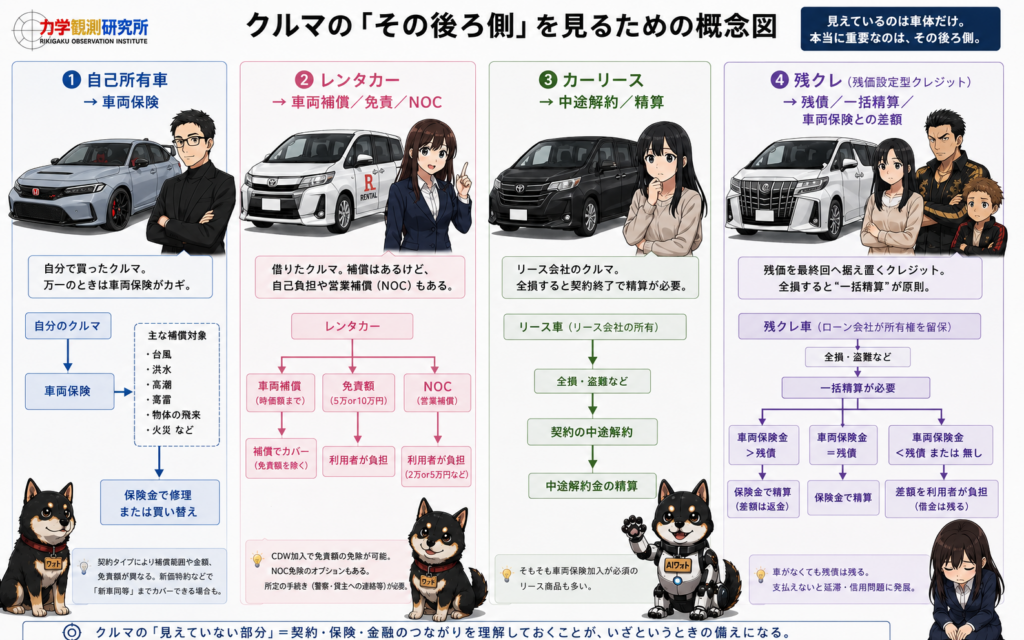
    自分で買った車/レンタカー/カーリース/残価設定型クレジット、いわゆる残クレ。

    水没してしまえば見た目は全部「動かない車」だが、その後ろ側にある法律/保険/契約/借金はまるで違う。

    今回は水につかった車を一台ずつ引き上げながら、その後ろに何がつながっているのか観測してみたい。

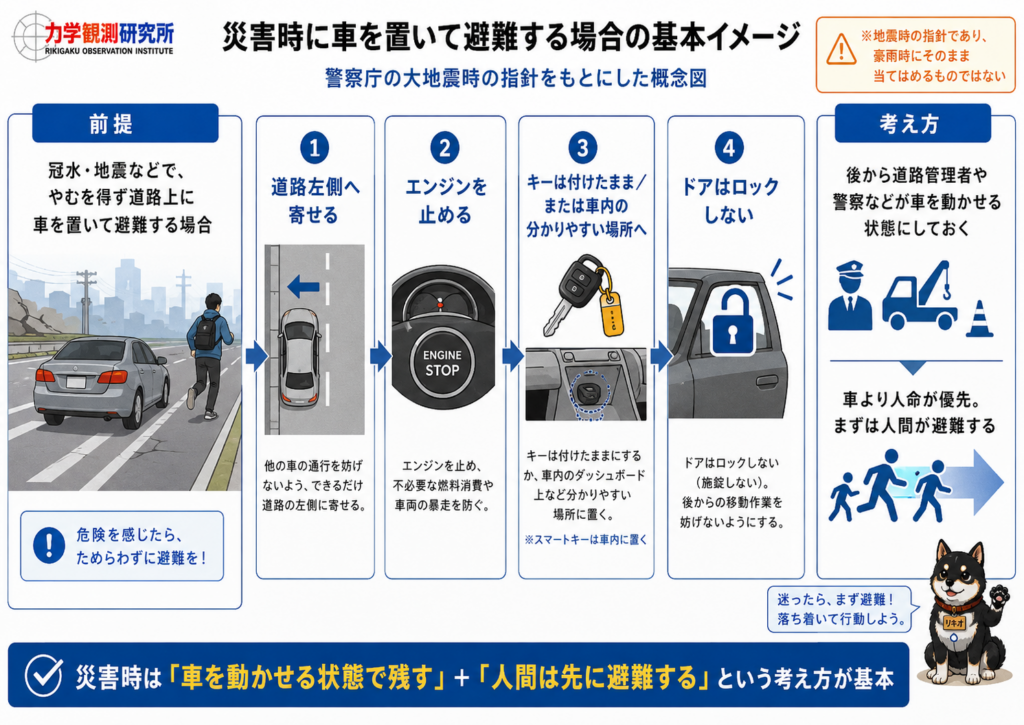
    まず、車より人間が逃げろ❗

    冠水した道路で車が動かなくなった。

    「こんなところに置いたら駐車違反になるかも」

    「邪魔になるから動かさないと」

    「ローンが残っている」

    「借り物の車だ」

    いろいろ頭をよぎるかもしれないが、水が増えている最中なら話は一つである。

    逃げろ❗

    車は後で動かせる。人間はそうはいかない。

    もちろん災害になった瞬間、道路交通法が消滅するわけではない。ただ、大規模災害では平時とは別に「道路をとにかく開ける」という仕組みが動く。

    今回、千葉県は9土木事務所管内で災害対策基本法76条の6第1項に基づく区間指定を行った。緊急車両の通行を確保するため、道路管理者が放置車両や立ち往生車両を移動できる制度である。

    道路「そこ、どいて」

    水没車「動けません」

    道路管理者「では動かします」

    かなり乱暴に言えば、こういう制度です。

    警察庁も大地震時の指針では、やむを得ず道路上へ車を置いて避難する場合、道路左側へ寄せ/エンジンを止め/キーを付けたまま、または車内の分かりやすい場所に置き/ドアをロックしないよう案内している。これは地震時の指針なので今回の豪雨へそのまま当てはめるものではないが、「災害時には後から車を動かせる状態にして、人間は避難する」という考え方は分かりやすい。

    自分の車なら「任意保険に入っている」で安心してはいけない❓

    では、安全な場所まで逃げた。

    ここから現実が戻ってくる。

    自賠責保険は自分の車の水没を直す保険ではない。任意保険に入っていても、対人/対物/人身傷害だけなら自分の水没車は基本的に守られない。

    必要になるのは車両保険である。

    日本損害保険協会は、車両保険を付けている場合、台風/高潮/洪水などによる自動車の損害が補償対象になるとしている。ただし契約タイプや商品によって異なるので、最終的には自分の契約確認が必要だ。

    ここでよくある誤解が、

    「安いエコノミー型だから洪水は出ないんでしょ?」

    というもの。

    必ずしもそうではない。商品によっては限定型の車両保険でも台風/洪水/高潮などを補償している。つまり「一般型(補償範囲の広いタイプ)かどうか」だけで判断できない。

    保険という商品は、名前より約款が強い。

    さらに新車なら「新価」が効いてくる

    もう一段ある。

    新車500万円で買った車が数年後に水没したとして、通常の車両保険から必ず500万円出るわけではない。車両保険金額は車の価値に応じて設定されるので、時間がたてば購入時価格との差が出てくる。

    そこで新車特約、車両新価特約などと呼ばれる仕組みがある。

    たとえば損保ジャパンの車両新価特約では、全損または一定以上の大きな損傷となった場合、実際の再取得費用や修理費について新車価格相当額を限度に補償する。ただし再取得/修理の期限など条件がある。

    「つまり、『車両保険に入っている』ことと『新車をもう一度買えるところまで守られている』ことは別の話である。」

    ここは残クレのところで効いてくるので覚えておいてほしい。

    レンタカーを水没させたら、一台買って返すの?

    次はレンタカー。旅先で大雨。借りた車が水没。

    レンタカー会社「ありがとうございました。では車両代300万円をお願いします」

    ……とは必ずしもならない。

    大手レンタカーでは基本料金に車両補償が組み込まれている場合がある。ニッポンレンタカーでは、レンタカーそのものについて1事故につき車両時価額までの補償があり、通常5万円または10万円の車両免責額が設定されている。別途CDWへ加入すると、その免責額を免除できる。

    ところが、ここで終わらない。

    NOC、ノン・オペレーション・チャージ。

    修理している間、その車を商売に使えないことへの営業補償である。

    ニッポンレンタカーの場合、自走可能なら2万円/それ以外なら5万円。CDWに加入していてもNOCは別で、さらにNOCをカバーする制度もある。

    保険「車は守ります」

    レンタカー会社「でも商売できない時間があります」

    利用者「まだあるんかい!」

    こうして保険商品は層になっていく。

    しかも警察やレンタカー会社への連絡など所定の手続きを取らなければ、補償制度が適用されない場合もある。

    借り物だからこそ、勝手にレッカー/勝手に廃車/勝手に修理は避け、まず貸主へ連絡するのが基本になる。

    リース車は「もう乗れないから契約終了」とはいかない

    カーリースはさらに分かりやすい。

    毎月料金を払って自分の車のように乗っていても、基本的にはリース会社の車である。

    そして全損すると、契約そのものが途中で終わることがある。

    Hondaの「楽らくまるごとプラン」では、全損事故や盗難の場合は契約が中途解約となり、中途解約金を精算する必要があると明記されている。

    つまり、

    車がなくなった

    乗れない

    月額もなくなるではない。

    車がなくなった

    契約を予定どおり最後まで続けられない

    では途中精算しましょう

    となる。

    なおHondaのこのリース商品では、そもそも車両保険への加入が必要とされている。

    ここは後で残クレと比較すると興味深い。

    そして残クレ

    さて、本丸です。残価設定型クレジット。

    たとえば500万円の車について、数年後の価値を250万円と設定し、その250万円を最終回へ据え置く。今払う部分を小さくできるので、

    「月々○万円でアルファード✨」

    みたいな見せ方ができる。別に悪い商品ではない。

    250万円が消えたわけではないだけである。

    未来へ送った。

    通常なら契約満了時に車を返却する/買い取る/再クレジットなどで処理する。

    では、その車が途中で水没して全損したら?

    トヨタファイナンスのFAQは非常に簡潔である。

    契約中の車が事故全損や盗難になった場合、「一括返済していただく必要がございます」

    以上。

    金融は容赦がない。

    ※日産ファイナンス「うちもチェックしてや」

    「車がないから残価もないよね」は通らない

    ここは残クレを月額料金のように見ていると混乱しやすい。

    月々4万円払っていた車が水没した。

    利用者「もう車ないんだから契約終わりですよね?」

    ファイナンス会社「いえ、残債があります」

    利用者「返す車もないんですが」

    ファイナンス会社「なので一括精算です」

    利用者「……」

    残価は「事故が起きたら免除される金額」ではない。

    あくまで将来へ据え置いた債務であり、返却予定だった車そのものがなくなれば、むしろ予定していた精算方法が使えなくなる。

    日産フィナンシャルサービスも、残価設定型クレジットを契約途中で一括精算する場合、その時点では最終回支払額を「車両返却」で処理できず、クレジット残金全額を精算する仕組みとしている。

    車両保険があれば救世主……とは限らない

    では車両保険があれば全部解決か?

    ここでも金額を見る必要がある。

    仮に、残クレ一括精算額300万円/車両保険金300万円

    なら、かなり話は楽になる。

    しかし、残クレ一括精算額300万円/車両保険金250万円

    なら50万円が足りない。

    そして、残クレ一括精算額300万円/車両保険なし(⁉)

    なら、車0台/保険金0円/借金300万円

    という、美しくない三点セットが完成する。

    しかも生活に車が必要なら、次の車も買わなければならない。

    旧車の残債300万円/手元の車0台/次の車が必要

    金融会社から見れば「既に300万円の債務がありますね」

    本人から見れば「でも車がないと働けません」

    ここから急に、水没事故ではなく信用問題になる。

    月々○万円という魔法

    ここで残クレそのものを叩いて終わると、あまり面白くない。そういう話題じゃない。

    気になるのは、なぜこういう構造が成立するのかである。

    売る側は月々の負担を小さく見せたい。

    買う側も月々の負担を小さく見たい。

    利害が一致している。

    販売店「この車、残クレなら月々4万9800円です✨」

    客「それなら乗れる」

    販売店「なお車両保険/新価特約/税金/駐車場/燃料/メンテナンスまで含めた実質月額は……」

    客「その話はあとで」

    販売店「はい

    誰かが騙しているというより、双方が同じ方向を見た結果、都合の悪い数字が視界の端へ追いやられる。

    これが面白い。

    残クレは「安い車」ではない。

    高額な車の支払い時期を組み替え、将来の車両価値を精算に使う金融商品である。

    平時には、その金融部分が車体の後ろへ隠れている。

    水没すると突然前へ出てくる。

    もし大量の残クレ車が一晩で水没したら?

    今回、道路上だけで約2700台。

    この中に何台のローン車/リース車/残クレ車があるのかは分からない。車両保険加入状況も分からない。

    したがって「千葉で残クレ危機が起きている」と言うことはできない。

    ただし思考実験として・・・

    大量の残クレ車が同じ地域で水没

    車両保険なしの契約者が一定数いる

    担保となる車の価値が一気に消える

    一括精算が必要になる

    払えない契約者が出る

    ファイナンス会社に延滞/貸倒リスクが集中する

    交通事故なら、一台ずつバラバラに起きる。

    洪水は違う。

    同じ地域の何百台、何千台を同時に水没させる。

    千葉県は今回、9土木事務所管内で放置車両を動かすための法的措置を取った。行政から見れば道路啓開の問題だが、車の後ろ側まで見ると保険会社/レンタカー会社/リース会社/ファイナンス会社にも同時に波が届く。

    水は道路だけでなく、契約書の中まで流れ込む。

    すると金融会社は何を考える?

    もし大規模水害が頻発し、無保険の残クレ車から貸倒れが目立つようになれば、ファイナンス会社は当然考える。

    「車両保険、必須にした方がよくない?」

    実際、先ほどのHondaのリース商品では車両保険加入が必要である。

    では残クレでも、十分な車両保険/場合によっては新価特約などを事実上必須にすればいい。

    金融側から見れば合理的だ。

    ところが・・・

    販売部門「保険込みだと月々○万円が高く見えるんですが」

    金融部門「でも担保が水に沈むんですが」

    販売部門「……」

    ここに販売と金融の力学が出てくる。

    月額を軽く見せれば売りやすい/補償を厚くすれば金融商品として安全になる。

    どちらも正しい。

    だから面倒なのである。

    水没すると「誰の車か」より「誰の契約か」が見えてくる

    道路に並んだ水没車だけを見れば、全部ただの壊れた車に見える。

    しかし一台ずつ後ろをたどれば、

    自己所有車→車両保険

    レンタカー→車両補償/免責/NOC

    カーリース→中途解約/精算

    残クレ→残債/一括精算/車両保険との差額

    と、まったく別の制度につながっている。

    さらに大量被災になると、道路管理/損害保険/自動車販売/自動車金融/個人信用まで一つにつながる。

    道路上だけで確認された約2700台の車。

    見えているのは車体だけだ。

    力学的に注目すべきは、その後ろに2700本以上ぶら下がっている契約の方かもしれない。

    そして最後に一番大切な話へ戻る。

    水が迫っているときは、そんなことは考えなくていい。

    残クレだろうがレンタカーだろうが新車だろうが、

    車を捨てて逃げろ

    法律保険ローンも、その後で死ぬほど真面目に考えてくれます。

    今回の豪雨で被害に遭われた皆さまに、心よりお見舞い申し上げます。

    水が引けば終わりではありません。車の修理/廃車/保険手続き/ローンやリースの精算/代替車の確保など、その後にも多くの負担が残ります。

    被災された方々が一日も早く日常を取り戻せることを願っております。

  • おっさんから1万7千円を取り戻せるのか?〜特殊詐欺被害の力学

    おっさんから1万7千円を取り戻せるのか?〜特殊詐欺被害の力学

    引用元:[青森テレビ](2026年8月14日)

    青森県内に住む20代男性が、SNS「Discord」を通じて約1万7000円をだまし取られる事件があった。男性は「性的サービスを提供する」という趣旨の投稿を見つけ、アカウント名「○○な」にDMを送信。サービス代1万3000円とホテル代3900円をPayPayで支払い、指定されたホテルで待ったが、相手は現れなかった。……現れなかった😭

    おはこんばんにちは❗力学観測研究所のRYOです❗

    ニュースだけを読めば、「怪しい相手に先払いしたら来なかった」という話である。警察も、甘い誘惑には安易に乗らず、金銭を支払う前に家族や知人、警察へ相談するよう呼びかけている。

    それはその通りなのだが、今回は少し違うところから観測してみたい。

    まず、よく警察に言った

    被害額は1万6900円。決して小銭ではないが、警察へ行って被害に至った経緯を最初から説明するくらいなら、「勉強代だった」と泣き寝入りする人がいても不思議ではない。

    「Discordで性的サービスの投稿を見つけた/DMした/1万6900円を払った/ホテルで待っていた/来なかった」。これを警察官に説明したわけで、なかなかの精神力🔥である。

    しかし詐欺をする側から見れば、この「恥ずかしいから警察には言いたくない」は非常にありがたい。被害者が黙れば事件そのものが表に出ないからだ。そう考えると、この男性が被害を申告した意味は被害額以上に大きい。

    笑うところがあるとすれば事件の珍妙さであって、被害を届け出た男性ではない。よく警察に言った。ここは真面目に評価したいところです。

    警察から見れば「よっしゃ」かもしれない

    今度は観測座標を警察側へ移してみる。

    被害者から見れば「1万6900円を取られた事件」だが、警察から見ればDiscordのアカウント/DMの履歴/PayPayの支払情報/取引日時/指定されたホテル/待ち合わせ日時と、捜査の手掛かりになり得る情報がかなり残っている。

    もちろん実際の捜査員がどう反応したかは分からない。それでも心の中で「よっしゃ、アカウントゲット」くらいの小さなガッツポーズがあっても不思議ではない。

    同じアカウントや送金先が他の被害にも使われていれば、一件の被害届から複数事件がつながる可能性もある。キャッシュレス決済は犯人にとって便利な道具である一方、取引記録を残す装置でもある。

    PayPayは、捜査機関から情報開示要請を受けた場合、必要性や相当性を審査したうえで、登録情報、取引履歴、銀行口座情報、本人確認情報などを開示する場合があるとしている。また「個人間送金機能を悪用した詐欺」も、情報開示に対応する場合がある具体例として挙げている。

    1万6900円だけを見て「小さな事件」と考えると、この力学は見えてこない。

    刑事と民事は別問題

    では犯人が特定されたとして、払った1万6900円は返ってくるのだろうか?

    ここで刑事と民事を分ける必要がある。

    相手が最初からサービスを提供する意思もなく、嘘を使って男性に金を支払わせたのであれば、刑法246条の詐欺罪が問題になる。一方、「犯人を処罰できること」と「被害者が1万6900円を取り戻せること」は同じ話ではない。後者は民事の問題である。

    民法96条では、詐欺による意思表示は取り消すことができる。通常なら「だまされて支払った→意思表示を取り消す→返還を求める」という方向がまず頭に浮かぶ。

    ところが、このニュースには法律好きが少し反応しそうな言葉が入っている。

    「性的サービス❤」

    ここから民法が面倒になってくる。

    民法90条「その契約、大丈夫?」

    民法90条は「公の秩序又は善良の風俗に反する法律行為は、無効とする」と定めている。いわゆる公序良俗である。

    ただし、今回の報道は「性的サービス」としか書いていない。具体的に何を約束していたのか分からない以上、この実際の事件について「民法90条に反する契約だった」と断定することはできない。

    そこで、ここから条件を一つ加えた思考実験をしてみる。

    仮に、約束されていたサービスの内容そのものが公序良俗に反するものだったら?

    契約が無効なら、「では1万6900円を返してください」で済みそうに見える。ところが返還の場面には、民法708条という少々クセの強い条文が待っている。

    民法708条「知らんがな」

    民法708条「不法原因給付」と呼ばれる規定で、不法な原因のために給付したものについて、原則として返還請求を認めない。ただし、不法な原因が受け取った側にだけ存在した場合は例外とされている。

    かなり乱暴に言えば、「社会的に許されない取引に自分から参加しておいて、都合が悪くなったら裁判所に後始末を頼むのはどうなん?」という考え方である。

    違法な取引のために自分から金を渡し、その取引がうまくいかなかったから「無効なので返してください」が何でも通るなら、司法が違法取引の巻き戻しサービスになってしまう。

    裁判所「知らんがな」

    ……とまで条文には書いていないが、方向感としてはそんなに遠くない。

    もちろん、「公序良俗に反する契約だから、払った金は自動的に708条で返ってこない」と単純化するのも危険である。何が「不法な原因」に当たるのか、金を渡した側と受け取った側にどのような事情があったのかなど、具体的な事実関係を見なければならない。

    そして708条には、先ほど触れたただし書きがある。

    「不法な原因が受益者についてのみ存したときは、この限りでない。」

    1万6900円だったはずの話が、急に法律の試験問題のようになってきた。

    PayPayが「出せません」と言ったら?

    刑事捜査側にも、もう一つ力学がある。

    警察がPayPayへ「この送金先の情報をください」と問い合わせたからといって、PayPayが何でも自動的に開示するわけではない。PayPayは利用者の個人情報を原則として本人の同意なく開示せず、捜査機関からの要請についても必要性・相当性を審査し、合理的な理由がある場合に必要最小限の情報を開示するとしている。

    捜査機関には刑事訴訟法197条2項による捜査関係事項照会があり、公私の団体へ必要事項の報告を求めることができる。一方、必要があれば刑事訴訟法218条に基づき、裁判官の令状による差押えや捜索などの強制処分へ進むこともある。PayPay自身も、この二つを情報開示要請の法的根拠として区別している。

    つまり「警察→PayPay」で終わらず、場合によっては「警察→裁判官→令状→PayPay」となる。

    ちなみにPayPayの透明性レポートによると、2025年7月から12月までに捜査機関から受けた情報開示要請は1万8520件で、開示割合は85%。ここには捜査関係事項照会と令状に基づく要請の双方が含まれている。

    1万6900円の事件から、刑法、民法、刑事訴訟法、個人情報保護まで出てきた。

    法律は容赦がない。

    【ここから完全な架空事例】犯人がおっさんだったら?

    最後に、実際の事件から完全に離れて条件をもう一つ加えてみよう。報道からアカウント使用者の性別や年齢は分からないため、以下はあくまで思考実験である。

    警察が捜査を進め、「性的サービス❤を提供する」と投稿していた人物を特定した。逮捕してみると、女性ではなかった。

    おっさんだった

    しかも女性を装っていただけでなく、最初から約束したサービスを提供する意思などなく、1万6900円を取ることだけが目的だったとする。

    こうなると、708条をもう一度眺めたくなる。

    これは「双方が不法な取引に参加し、その一方があとから返金を求めている」というだけの事件なのか。それとも、一方は何らかのサービスが実際に提供されると考えて金を払い、もう一方は最初から架空の人物像を作り、サービスをする意思もなく金だけを取ろうとしていた事件なのか。

    そこで被害者が、

    「おっさんだとは知らなかったので、民法上は善意の被害者です」

    と言っても、「善意」という法律用語はそんな便利な必殺技ではない。

    裁判所「・・・その善意はいったん置いておきましょう」

    しかし冗談のような設定でも、検討すべき問題は本物である。誰が何を認識していたのか/誰にどのような不法性があったのか/そもそも受け取った側に契約を履行する意思が存在したのか。条件を一つ変えるだけで、法律上の評価も動いていく。

    法学とは、こういうところが恐ろしく真面目な学問なのだ。

    法律は、事件の品格を選べない

    元のニュースは、Discordで性的サービス❤を申し込み、PayPayで1万6900円を払い、指定されたホテルで待っていたが相手が現れなかったという事件である。

    しかし観測座標を少しずつ動かしてみると、被害申告をためらわせる心理/警察にとっての被害届の価値/刑事責任と民事上の返還請求/公序良俗/不法原因給付/決済事業者によるプライバシー保護/捜査関係事項照会/令状と、まったく異なる力が次々と姿を現す。

    そして、この一連の力を動かす最初のスイッチを押したのは、「もういいや」と泣き寝入りせず、警察へ被害を申告した20代男性だった。

    だから最初の話に戻る。

    被害者君、よく警察に言った

    もし今後、「犯人を逮捕しました。男でした」という続報まで出てきたら、そのときは民法708条をもう一度開けばいい。

    法律は、事件の品格を選べない

    世間から見ればコントのような思考実験――犯人がおっさんだった場合――であっても、警察も裁判所も、そして法学も、死ぬほど真面目に考えなければならないのである。

    ※本稿は報道された事件を入口として、一般的な法律制度について考察したものです。「犯人がおっさんだった」以降は完全な架空の思考実験であり、実際の事件関係者の性別、年齢その他の属性を示すものではありません。また、報道では「性的サービス」の具体的内容が明らかになっていないため、実際の事件に民法90条や708条が適用されると断定するものではありません

  • 弁護士JPニュースは本当に弁護士に確認しているのか❓

    弁護士JPニュースは本当に弁護士に確認しているのか❓

    引用元:弁護士JPニュース

    おはこんばんにちは!力学観測研究所のRYOです!

    2026年8月6日、弁護士JPニュースに「処罰する法律なしの現状」と題した、歩きスマホに関する記事が掲載されました。

    歩きスマホが危険であることに異論はありません。人との衝突や転倒、駅のホームからの転落など、重大事故につながる可能性もあります。問題を取り上げ、注意を促すこと自体には意味があります。啓発は良いことだ!

    ただ、「弁護士JPニュース」という看板を見て、疑問が残りますね。

    「処罰する法律がない」の、その先は?

    記事では、歩きスマホそのものを規制する全国的な法律がなく、一部自治体の条例にも罰則がないことが紹介されています。

    では、歩きスマホによって実際に他人を負傷させた場合はどうなのでしょうか。現行法で刑事責任や民事上の損害賠償責任をどこまで問えるのか/既存法では処理できない領域があるのか/あるとすれば、具体的に何が不足しているのか。わざわざ「ムカつくから法律を増やせ!」の問題?

    「危険な行為である」ことと「その行為自体を処罰する新しい法律が必要である」ことは別の問題です。だからこそ、法律を看板にする媒体なら、この部分について法律実務家の見解を知りたいですよね?

    専門媒体を引っ張る二つの力

    ここで歩きスマホから少し離れ、メディア側を観測してみます。

    ニュースメディアには「多くの人に読んでもらいたい」という力が働きます。「歩きスマホは危険」「処罰する法律なし」「海外では罰金」という構成は分かりやすく、読者を引きつけます。これはメディアとして当然の力です。

    一方、「弁護士」「法律」を看板に掲げれば、「法律家ならどう見るのか」「現行法ではどう処理されるのか」という専門性を期待する力も生まれます。

    つまり、読者を広く集める力と、専門性を深く掘る力。この二つをどう両立させるのか。

    弁護士JPニュースに聞いてみたい

    そこで、弁護士JPニュースに二つお伺いしたい。

    歩きスマホによる事故は、現在の刑事・民事法制でどこまで対応できるのでしょうか。そのうえで、新たな規制が必要だとすれば、現行法では何が足りないのでしょうか?

    そして、一般読者を引きつけるニュース性と、「弁護士」という看板によって期待される専門性を、どのように両立させようとしているのでしょうか

    これは批判ではなく、外部から観測して浮かんだ疑問です。編集部や法律実務家から別の視点が示されれば、それも新しい観測材料になります。

    分かりやすい入口で読者を集め、その先に専門家にしかできない分析がある。そこまで見せてこそ、専門メディアは一般ニュースとは違う強さを持てるのではないでしょうか?

    このままではただ単にエモーショナルに訴えかけ、煽っているだけに見えます

    いうて人間の行動なんて変わらないよね!

    ※あと、新聞広げまくりは誇張です。

  • NHK受信料値上げ見送り❓ いや、値段が上がっているのは制度摩擦なのだ❗

    NHK受信料値上げ見送り❓ いや、値段が上がっているのは制度摩擦なのだ❗

    引用元:スポニチアネックス取材班

    おはこんばんにちは!力学観測研究所のRYOです!

    NHKの井上樹彦会長が、受信料の値上げについて「現時点では検討していない」と述べました。

    古賀信行経営委員長が、個人的な見解として「本当は受信料を値上げすべきだと思っている」と発言したことを受けての回答です。

    NHKは2023年10月に受信料を1割値下げしました。現在の経営計画も、その水準を維持することを前提としています。

    これだけを見れば、

    「とりあえず、すぐに値上げされるわけではないのだな」

    で終わる話かもしれません。

    ですが、今回本当に観測したいのは金額そのものではありません。

    受信料が上がるかどうかより先に、

    NHKを支えてきた制度と、令和の情報社会との摩擦がどれほど大きくなっているか、そこを見ておきたいのです。

    NHKの番組が面白いか/報道姿勢が正しいか/職員の給与が高いか

    今回は、そこを主題にしない。

    ※他人の給料なんて気にしたらだめだよ!

    もっと根元にある、

    かつて合理的だった制度が、時代の変化によって説明しにくくなっていく過程

    を観測してみたい。

    受信料の値段は上がっていない。

    しかし、制度摩擦は確実に上がっているのだ!


    放送法64条は、最初から悪い制度だったのか

    現在の放送法64条は、NHKの放送を受信できる設備を設置した者に対して、受信契約の締結を求めています。

    ラジオ放送だけを受信できる設備などは除外されますが、基本構造はシンプルです。

    受信できる設備を持つ→NHKと契約する

    現在の感覚で眺めれば、

    「見ていないのに、なぜ払うのか」という反発が出るのは当然でしょう。

    ただし、放送法が制定された1950年当時から不合理だったと決めつけるのも違います。

    全国へ放送網を広げるには、莫大な設備投資が必要でした。

    災害情報/政治/教育/文化を、全国へ同時に届ける手段も限られていた。

    政府予算や企業広告だけに依存すれば、政治やスポンサーの影響を受けやすくなるという問題もあります。

    そこで、受信者が広く費用を負担する。

    NHKは、その資金で全国放送網を維持する。

    当時としては、一本の筋が通っていたのです。

    制度が悪かったわけではない。

    制度が作られた時代と、今の時代が違いすぎるのだ!


    社会は網状になった/制度は一本線のまま残った

    令和の今、災害情報を伝えるのはNHKだけではありません。

    民放/ラジオ/ABEMAなどのネット放送/自治体サイト/官公庁の配信/ニュースアプリ/SNS

    複数の経路が同時に動きます。

    最近の熊本地震でも、ABEMAは関連情報や政府発表を継続的に配信しました。通常のニュースチャンネルに加えて、緊急時には記者会見などを長時間流す体制もある。

    衆議院と参議院も、審議映像を直接インターネットで配信しています。

    国会中継は、NHKを経由しなければ見られない情報ではなくなりました。

    もちろん、NHKには今も強みがあります。

    全国の放送局網/地上波/衛星/ラジオ/取材体制/字幕/手話/地域情報

    インターネット回線が混雑した場合にも、地上波やラジオが情報経路として残る。その冗長性は重要です。

    だから、

    「ABEMAがあるからNHKはいらない」

    という単純な話ではない。問題はそこではありません。

    公共情報を届ける経路が多元化した後も、公共性そのものがNHK一社に帰属するかのような制度説明を続けられるのか

    という話です。

    昭和は一本線だった→令和は網状になった。

    それでも負担制度の根元には、

    受信設備→受信契約

    という一本線が残っています。

    ここに摩擦が生まれる。


    公共性は必要だ/しかしNHKだけの専売特許ではない

    災害報道/気象情報/国会中継/政見放送/選挙速報

    これらには高い公共性があります。

    今後も、国民へ確実に届ける必要があるでしょう。

    しかし、

    公共性の高い情報が必要であること

    と、

    それをNHKという巨大組織が一括して担わなければならないこと

    は同義ではありません。

    国会審議なら、国会が一次映像を直接公開できます。

    気象情報なら気象庁/避難情報なら自治体が、原情報を公開できる。

    政見放送についても、選挙管理委員会が公平な条件を定めたうえで、NHK/民放/ネット放送へ配信枠を発注する方法が考えられます。

    災害時には、一定の要件を満たした複数の事業者へ、同じ一次情報を同時配信する。

    一社へ集中させるより、経路を多重化した方が災害には強い。

    入札で最安値の一社へ丸投げする必要もありません。

    到達範囲/通信障害への耐性/字幕/手話/多言語/地域別情報/アーカイブ保存

    こうした条件を満たす複数社と契約すればよい。

    ただし、ここには一つ注意点があります。

    国家自身がニュースの編集や評価まで行う「国営ニュース」にしてはいけない。

    国家が出すべきなのは一次情報です。

    それを検証/批判/解説するのは、独立した報道機関でなければならない。

    一次情報の公開と、ジャーナリズムは分ける必要があります。

    ※ただし、一次情報は国会や行政側も自ら出せる!

    公共性とは組織名ではない。

    正確性/公平性/到達性/継続性という機能なのだ!


    朝ドラや大河を見るなら、受信料は払うべき

    ここで、NHK批判側にも一つ言いたい。

    朝ドラや大河ドラマを毎週見ている。

    紅白歌合戦やスポーツ中継も楽しむ。

    出演者や物語をSNSで話題にする。

    それなのに、

    「NHKには一円も払いたくない」

    というのも筋が通らない。見ているなら払おうよ。

    コンテンツの制作には、当然お金💴がかかります。

    利用した人が対価を負担することまで否定すれば、民間の動画配信サービスも映画館も新聞も成立しない。

    ただし、見た人が払うべきだという話と、

    受信できる設備を持つ人全体へ包括契約を求める話

    は別です。

    ここを混ぜてはいけない。

    利用者の負担責任を認めても、放送法64条を中心とした現在の制度が、自動的に正当化されるわけではありません。

    むしろスクランブル化/一部契約制を含め、

    見た人が払う仕組み

    を検討する方が自然ではないか。

    そう思うよね!


    災害報道と大河ドラマは、同じ料金箱でなければならないのか

    現在の受信料制度は、

    災害報道/教育/地域情報/国会中継/ドラマ/音楽/スポーツ/バラエティー、これらを、大きな一つの🎬に入れています。

    そのため、災害報道の必要性を語ると、娯楽番組まで含むNHK全体の受信料制度が正当化される。

    逆に娯楽番組への批判が強まると、災害報道や地域放送まで不要であるかのような議論になる。

    本当は、分けて考えられるはずです。

    公共報道/防災/教育などを基礎サービスとして残す。

    ドラマ/音楽/スポーツなどは、契約型やスクランブル放送も検討する。

    公共部門と娯楽部門の会計を分ける。

    制度の選択肢はいくつもあります。

    ところが現在は、

    「全部まとめてNHK」という制度が先に存在しています。

    そして、その制度を維持するために説明が組み立てられているように見える。

    公共性があるから全部必要なのか。

    全部を維持したいから、公共性を前面に出しているのか。

    この順序は、一度整理した方がよい。


    非営利のNHK/市場で動く株式会社群

    NHK本体は、放送法に基づく特殊法人です。

    法律上も、NHKは業務を行う際に営利を目的としてはならないと定められています。

    その一方で、放送法はNHKが認可を受け、子会社へ出資する仕組みも認めています。

    現在のNHKグループには、

    番組制作/映像販売/権利ビジネス/イベント/展覧会/商品化/海外販売

    こうした事業を担う株式会社があります。

    例えばNHKエンタープライズは、番組制作だけでなく、映像・音声コンテンツの販売/著作権の管理と販売/国際市場でのコンテンツ取引などを事業として掲げています。

    NHKプロモーションも、展覧会/コンサート/イベント/ライセンス事業などを行っています。

    これらの事業が違法だという話ではありません。

    株式会社に分ける合理性もある。

    専門性/機動性/外部取引/事業別採算/リスク分離

    企業経営としては理解できます。

    しかし、国民側から見ると奇妙な非対称が生まれる。

    受信料を求める時は「一つの公共放送」

    事業を展開する時は「複数の株式会社」

    受信料は一体/経営は分散

    ここが、制度摩擦の大きな発生源です。


    子会社というShadow

    力学観測研究所では、

    物事の表に現れにくい裏面/制度が抱えきれない機能/合理化によって別の場所へ移された矛盾を、

    Shadow

    として観測したい。

    NHKの子会社群は、複数の意味でShadowになっている。

    NHK本体が表で掲げるのは、

    公共性/非営利/全国民のための放送。

    一方で子会社群が引き受けるのは、

    商業性/収益性/商品化/販売/イベント/市場競争

    営利性が消えたのではない。

    本体の外側へ配置されている。

    利益を得る場面では、NHKブランド/番組資産/グループの信用を活用できる。

    しかし責任や会計を問われた時には、

    「別法人です」

    と境界を引くことも可能になる。

    利益の時はグループ。説明責任の時は別法人。

    そう見えてしまえば、国民の不信感は強くなるでしょう。

    子会社が悪なのではない。問題は、

    子会社を含めたNHKグループ全体が、受信料制度との関係を一つの姿として説明できているかである。


    必要な仕事なら、NHK本体へ組み込めばよい

    ここで、一つの考え方が出てきます。

    NHKの公共放送を維持するために絶対必要な仕事なら、総務大臣や国会の監督を受けるNHK本体の業務として組み込めばよいのではないか。

    本体の中で行う。

    受信料会計の中で費用を示す。その必要性を国民へ説明する。

    その方が構造は明快です。

    逆に、株式会社でなければできない商業事業なら、受信料会計との境界を明確にする。

    NHKブランドや番組資産を使用するなら、適正な対価を設定する。

    利益が出た時の還元方法も示す。

    赤字になった時だけ、受信料で支えることがないようにする。

    公共部門なら本体へ。

    商業部門なら市場へ。

    どちらにも分類できない中間領域が増えるほど、Shadowは濃くなります。

    国民には放送法64条で、包括的な負担を求める。

    それならNHK側にも、グループ全体を包括的に説明する責任があるはずです。


    放送法64条というParadigm Ghost

    Paradigm Ghostとは、

    過去の時代には合理的だった前提が制度へ固定され、社会が変化した後も現在の選択を拘束し続ける状態です。

    NHK受信料制度を支えた前提は分かりやすい。

    テレビ/ラジオは国民共通の情報インフラ。

    公共情報を全国へ届けられる主体は限られている。

    受信設備を持つ人は、公共放送の受益者になる。

    だから、受信者全体でNHKを支える。

    しかし現在は、情報端末も多様化しました。

    公共情報の発信者も増えた。

    国会や行政機関も、一次情報を直接配信できる。

    民間放送も、災害時には公共的役割を果たす。

    コンテンツは、見たいものを選び/契約して見る時代になりました。

    社会の前提は変わった。

    それでも制度の根元には、

    受信設備を持つ→NHK全体を支える

    という古い一本線が残っています。

    これがParadigm Ghostです。そして、その制度が抱えきれない商業性/機動性/収益性を、子会社群がShadowとして処理する。

    Paradigm GhostShadowは、別々に存在しているのではない。

    一本の線でつながっているのだ!

    制度疲弊とは、制度が突然壊れることではない。

    制度を説明するために例外/補助線/別法人が増え、全体像が見えにくくなる状態でもあります。


    NHKを守る前に、何を公共機能として守るのか

    NHKを廃止すれば、すべて解決するとは思いません。

    全国の取材網/地域放送/ラジオ/災害時の地上波/教育/文化記録

    失えば、簡単には取り戻せない機能も多い。

    一方で、現在の組織と受信料制度を丸ごと維持することだけが、公共性を守る方法でもありません。

    議論の順番を変える必要があります。

    まず、守るべき公共機能を定義する。

    災害/気象/選挙/国会/地域/教育/文化保存

    次に、最適な提供主体を選ぶ。

    NHK/民放/ネット放送/官公庁/自治体/複数事業者への委託

    その上で、費用負担を決める。

    受信料/税/公費委託/契約料/複合方式

    今は、順番が逆になっているように見えます。

    先にNHKという巨大組織がある。

    その組織全体を維持するために、公共性が説明されている。

    本来は、公共性から制度を設計するべきであり、既存組織から公共性を逆算するべきではない。


    上がっているのは受信料ではない

    NHK会長は、現時点では受信料の値上げを検討していないと述べました。

    当面は、金額が動かないのかもしれません。

    ですが、

    公共性の多元化/ネット配信の普及/娯楽番組との一括負担/スクランブル化問題/営利子会社群/放送法64条

    これらの間に生じる摩擦は、むしろ着実に大きくなっています。

    だから今回のニュースも、

    「値上げするのか/しないのか」という話だけで終わらせるのは惜しいのです。

    問うべきは金額ではない。

    何を公共として残すのか。誰が届けるのか。誰が、どこまで負担するのか。

    子会社群は何のために存在し、利益と責任はどこへ帰属するのか。

    放送法64条は、現在のNHKグループ全体を支える根拠として、今も十分なのか。

    そこまで踏み込んで初めて、この問題の全体像が見えてくるはずです。

    受信料の値上げは、ひとまず見送られた。だが、

    上がっているのは値段ではない。制度と現実の摩擦なのだ