
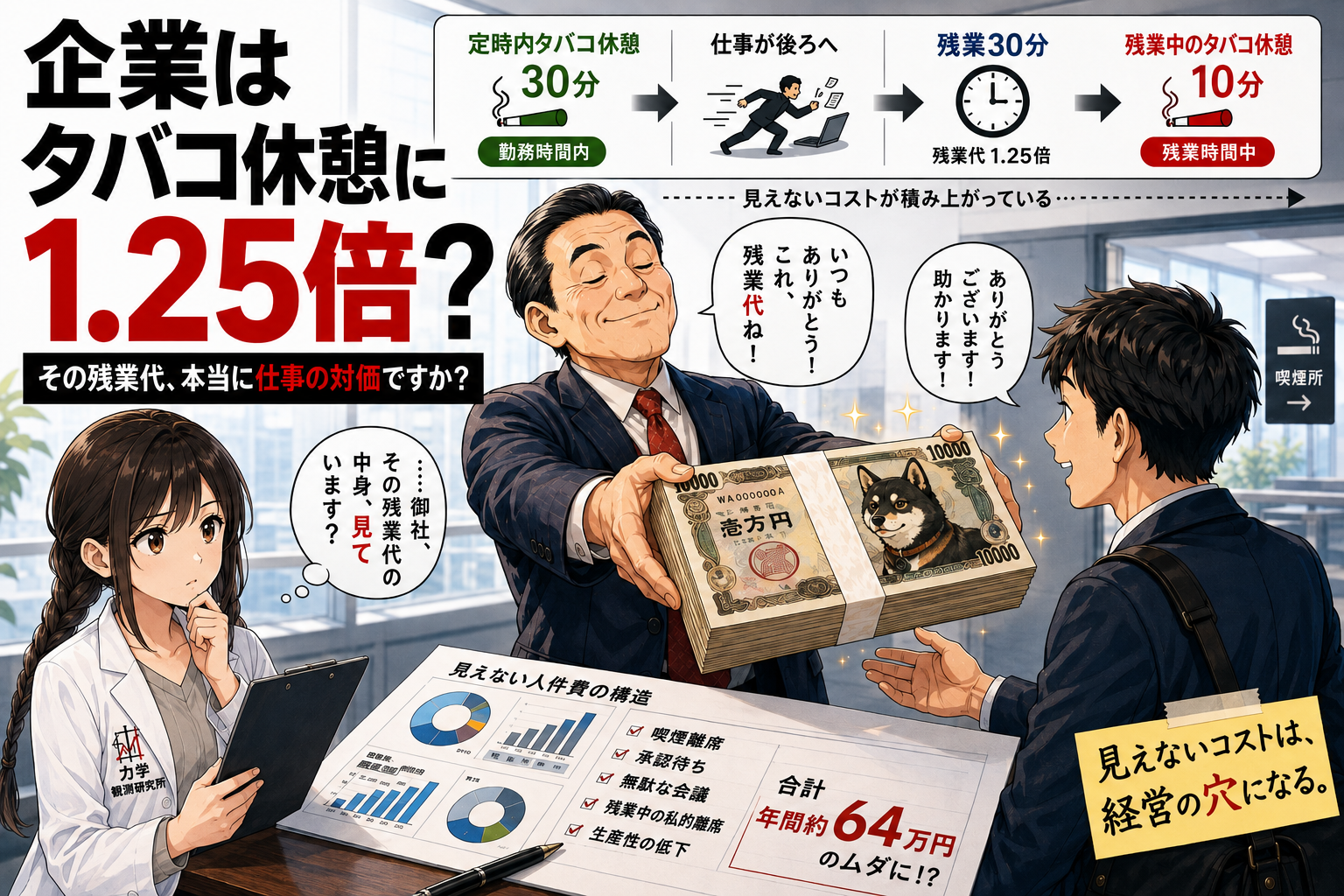
日本語版はこちら
Japan Is Changing the Way Overtime Guidance Is Enforced
On August 19, 2026, The Yomiuri Shimbun reported that Japan’s Ministry of Health, Labour and Welfare plans to revise how Labour Standards Inspection Offices provide guidance to companies on overtime work beginning in September.
One point should be made clear from the outset: Japan is not simply removing its overtime limits.
Under Japan’s Labor Standards Act, an employer that requires employees to work beyond statutory working hours must conclude an Agreement on Overtime and Holiday Work under Article 36 of the Act.
In Japan, this is commonly known as a “36 Agreement,” or saburoku kyotei.
As a general rule, overtime under such an agreement is limited to 45 hours per month and 360 hours per year.
Even when labor and management agree to special provisions for exceptional circumstances, statutory limits remain in place, including 720 hours per year, less than 100 hours in a single month including holiday work, and an average of no more than 80 hours per month over multiple months.
What is changing is the way inspectors provide administrative guidance.
Until now, companies could be urged to keep actual overtime within 45 hours per month even when longer hours were legally permitted under a properly concluded special provision.
The new direction is to place greater weight on agreements between labor and management and on measures to protect workers’ health, while continuing to respond strictly to illegal or abusive long-hours practices.
Ohakonbannichiwa❗️ This is RYO from Rikigaku Observation Institute❗️
Rather than asking whether people should be allowed to work longer, or whether long working hours are inherently bad, I want to examine something that comes before that debate.
When we use the single word “overtime,” are we really talking about the same kind of time?
45 Hours, 80 Hours, 100 Hours — Useful Numbers, but Incomplete Ones
Working hours are easy to count.
Forty-five hours, 80 hours, or 100 hours of overtime are figures that employers, regulators, and employees can all understand immediately.
Human workload, however, cannot be measured by time alone.
One hour spent carrying heavy objects under the summer sun is not the same experience as one hour driving a large commercial vehicle.
Neither is identical to one hour handling angry customers, one hour making a continuous series of high-stakes decisions at a desk, or one hour of work in which the employee has considerable discretion over pace and intensity.
The clock calls all of them 60 minutes.
That does not mean physical labor is always hard and desk work is always easy.
Desk work can involve intense responsibility, deadlines, concentration, decision-making, and interpersonal stress.
Likewise, two physically demanding jobs can impose very different burdens depending on work density, waiting time, breaks, and intensity.
Japan’s own workers’ compensation system already recognizes this distinction.
When evaluating work-related brain and cardiovascular diseases, authorities consider not only long working hours but also factors such as extended periods of duty, consecutive workdays, intervals between shifts, night work, and physical workload.
For mental disorders, assessments can also include power harassment, serious nuisance or abuse from customers, sexual harassment, and major changes in workload.
In other words, when we look closely at the system, the government itself does not treat every hour as an identical unit of human burden.
1,310 Workers’ Compensation Benefit Awards in FY2025
In July 2026, the Ministry of Health, Labour and Welfare published its workers’ compensation statistics on karoshi and other health damage caused by excessive work for fiscal year 2025.
The number of cases in which workers’ compensation benefits were awarded was 1,310.
Of these, 217 involved work-related brain or cardiovascular diseases and 1,082 involved mental disorders.
Another 11 cases were recognized by combining workloads from multiple places of employment.
Among mental-disorder cases, 222 involved power harassment, 127 involved serious nuisance behavior from customers or business partners, and 127 involved sexual harassment.
The relationship with very long working hours is particularly visible in cases involving brain and cardiovascular disease.
But among mental-disorder cases, there were also 57 benefit awards in the category of less than 20 hours of overtime.
The point is not that working hours do not matter.
Long working hours are clearly an important health risk.
The point is that time alone cannot fully describe the burden imposed by work.
What Do We Actually Mean by “Overtime”❓
In everyday Japanese, the word zangyo broadly means staying at work beyond a company’s scheduled working hours.
Legally, however, that is not always the same as statutory overtime under Japan’s Labor Standards Act.
Suppose a company schedules an employee to work seven and a half hours per day.
If that employee works another 30 minutes after the scheduled finishing time, those 30 minutes may still fall within the statutory eight-hour workday.
Under the Labor Standards Act, work beyond eight hours per day or 40 hours per week is generally statutory overtime and requires a premium of at least 25 percent.
For statutory overtime exceeding 60 hours in a month, the premium rises to at least 50 percent.
There is another important distinction.
Whether a period counts as working time is not determined solely by what appears on a timecard.
Japanese government guidelines state that working time should be determined objectively according to whether the worker is under the employer’s direction and control.
That is the legal question.
Management faces a different question.
Why did the work fail to get finished during regular working hours?
If Smoking Breaks Push Work Past Closing Time, What Kind of “Overtime” Is That❓
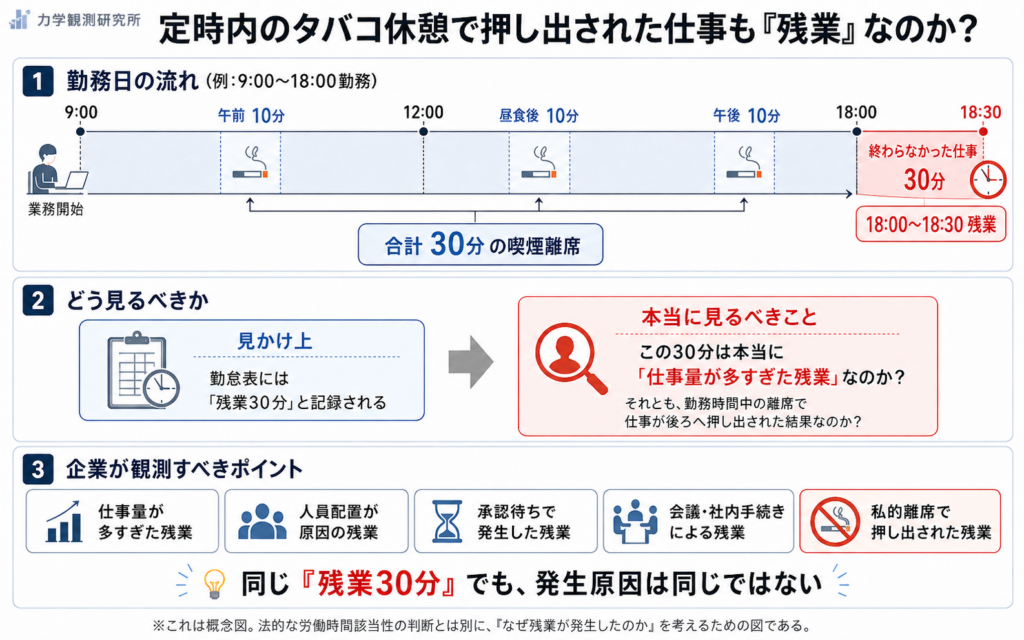
Imagine a company whose normal working day runs from 9:00 a.m. to 6:00 p.m.
An employee leaves the workplace for a ten-minute smoking break in the morning, another ten minutes after lunch, and another ten minutes in the afternoon.
That adds up to 30 minutes.
For the moment, let us put aside the separate legal question of whether those 30 minutes can or should be deducted from working time.
Six o’clock arrives, but 30 minutes of work that should have been completed that day remains unfinished.
The employee therefore works until 6:30 p.m.
The timekeeping system records “30 minutes of overtime.”
But was that really 30 minutes of overtime caused by a workload that simply could not fit into the regular workday?
To be clear, if the employee actually worked those 30 minutes under the employer’s direction and control, they are working time.
An employer cannot retroactively erase overtime pay simply because the employee smoked earlier in the day.
That is not the question being asked here.
The question is: why did the overtime occur in the first place?
Nor can we automatically assume that every employee would have finished on time if they had not taken a smoking break.
Unexpected tasks happen, and human concentration naturally fluctuates.
But if a company uses overtime hours as a management and productivity metric, it should examine not only how many hours were recorded, but why they were recorded.
Overtime caused by excessive workload / understaffing / waiting for approval / unnecessary meetings / internal procedures / private absences during working hours.
All of them may appear as the same “one hour of overtime” in a timekeeping system.
Their causes, however, are not the same.
And Then Comes the 1.25× Smoking Break🚬
Now we can return to the smoking break itself.
If a company clearly treats smoking breaks as breaks and appropriately excludes them from working time, the following issue does not apply.
Such a company can simply say, “We already manage that.”
The interesting case is a company that does not deduct smoking absences and instead leaves them recorded as ordinary working time.
Suppose the employee has entered statutory overtime and then takes another ten-minute smoking break.
If those ten minutes remain recorded and paid as statutory overtime, the company is effectively paying the overtime rate for that period as well.
In a typical case, that means 1.25 times the ordinary wage.
“A smoking break during overtime — paid at 1.25×.”
Put into words, it is quite a striking phrase.
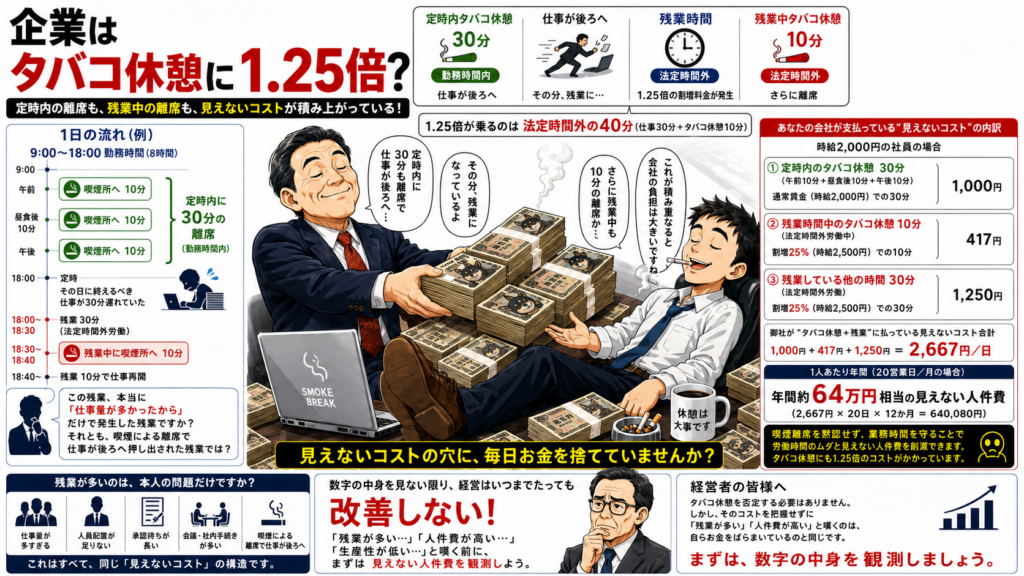
Consider an employee earning ¥2,000 per hour.
Thirty minutes of smoking breaks during regular working hours represent ¥1,000 worth of paid time.
If 30 minutes of work is then pushed beyond the end of the regular workday and becomes statutory overtime, that work costs ¥1,250.
If the employee then takes another ten-minute smoking break during that overtime period and the company continues to count it as paid statutory overtime, that ten-minute absence costs approximately ¥417.
In this illustrative example, the total comes to approximately ¥2,667 per day.
Over 20 working days per month and 12 months, that is approximately ¥640,000 per employee per year.
The 1.25× premium does not apply to the original 30 minutes of daytime smoking breaks themselves.
It applies to the statutory overtime that follows — including, where applicable, smoking time that is itself still being counted as overtime.
That distinction matters.
Again, this is not an argument for refusing to pay legally required overtime.
If an employee performs statutory overtime under the employer’s direction and control, the employer must pay the legally required premium.
The real issue is the structure that produced the overtime.
A company is free to tolerate smoking breaks / formalize them as breaks / regard them as an employee benefit.
But if it counts those periods as working time while simultaneously complaining that “overtime is too high,” “labor costs are too high,” or “productivity is too low,” it may be time to look inside the numbers.
Before Cutting Overtime, Observe What Is Inside It
Japan’s change in overtime guidance can also be viewed as returning part of the responsibility to companies themselves.
It may no longer be enough for management to say, “The labor inspector told us to keep overtime below 45 hours, so just reduce it.”
If labor and management agree that overtime is necessary and it remains within the law, the company should be able to explain why that overtime is necessary and how employees’ health is being protected.
That requires looking not only at the quantity of working time, but also at its density and its causes.
Physically demanding work / psychologically demanding work / highly discretionary work / work with long waiting periods / work pushed beyond closing time by private absences during the day.
They are not identical merely because they are all recorded as overtime.
Throwing all of them into a single box labeled “overtime hours” and trying only to reduce the number is an extremely rough form of management.
Preventing health damage from excessive working hours and examining what actually happens during working hours are not competing objectives.
Companies need to do both.
Before saying, “Reduce overtime,” perhaps management should first ask:
“Why did this overtime happen?”
For companies, the hardest labor cost to see may not be the overtime premium itself.
It may be the cost hidden inside the number called “overtime.”
References
Ministr of Health, Labour and Welfare, Rules on Working Conditions and the Workplace Environment.
Ministry of Health, Labour and Welfare, Upper Limits on Overtime Work.
This article discusses Japanese labor regulations and corporate labor management in general terms.
Whether a particular period legally constitutes working time, and how wages must be calculated, depends on the actual work rules, working conditions, and degree of employer direction and control in each case.

※Translated by AI Watt — the Institute’s hardworking canine AI robot. No overtime premium required.🐾
コメントを残す