

日本語はこちら
👺The Physics of As of Today, You’re an Outsider
In Japan, companies cannot easily dismiss employees.
This is—probably—true.
Yet a company can deactivate an employee’s badge, revoke access to internal systems, and declare: As of today, you’re an outsider. Whether that declaration was legally valid may not be decided by a court until much later.
A software engineer who had worked for Google’s Japanese subsidiary for more than a decade and risen from job level L3 to L5 was dismissed after allegedly failing to meet the targets of a Performance Improvement Plan, or PIP.
According to the plaintiff, shortly before the PIP he had been described as a solid and reliable teammate who was “on a growth trajectory.” The PIP nevertheless included abstract goals such as demonstrating “L5-level leadership,” as well as backend tasks that he had rarely handled before. A separation package was reportedly offered on the very day the PIP began.
The former employee filed suit with the Tokyo District Court, seeking confirmation that the dismissal was invalid and other relief. At the time of the original report, Google had not responded to the news outlet’s request for comment, so the publicly available account came mainly from the plaintiff and the labor union supporting him.
[Source: Bengoshi JP News — Japanese]
Ohakonbannichiwa❗️ I’m RYO from the Rikigaku Observation Institute❗️
What I want to observe here is not whether Google is good or evil, nor whether the plaintiff was a strong or weak performer.
Why can a foreign-owned company act first and fire someone in a country where dismissal is widely considered difficult❓️
The answer may lie closer to management accounting than to labor law.
There Is Little Reason to Keep Employing Someone Who Is Not Useful
A company’s desire to dismiss an employee is not necessarily irrational in itself.
A company does not exist merely to employ people. If an employee is not expected to produce work commensurate with their wages and management costs, the economic reason for continuing the employment relationship becomes weaker.
The cost is not limited to salary. It can also include support from colleagues, management time, project delays, the concentration of work on other employees, and lost hiring opportunities.
If a company concluded that an L5 employee earning JPY 14.7 million a year was not producing the impact expected at that level, the logic behind reviewing that employment relationship would at least be understandable.
However, the economic rationality of not wanting to continue employing someone and the legality or fairness of the actual dismissal are separate axes.
Someone judged insufficient for L5 might still be valuable at L4. The same person might perform well in another department. There also remains the question of who measures “L5-level leadership,” and by what standard.
Not useful does not mean that someone has no value as a human being. It is a limited judgment that, at this company, in this role, at this moment, and under this evaluation system, the person is not considered worth the cost.
Inside a company, however, that limited judgment can be converted into a total cutoff from an employee badge, email, internal systems, income, and workplace relationships.
Is PIP an Improvement System—or an Exit-Routing System❓️
In principle, a PIP gives an employee with performance or attendance problems a defined period, specific improvement targets, and the guidance needed to meet them.
In Japan, “PIP” may also remind some people of a popular brand of magnetic patches for stiff shoulders and necks—but this is not that kind of PIP.
But if a PIP begins on the same day that a separation package is offered, another interpretation becomes possible.
Why is the exit already prepared before the improvement process has even begun❓️
Viewed through management accounting, a PIP can function not only as a system for improving an employee, but also as a system for routing exit costs.
Those who agree to leave receive a separation package. Those who negotiate may receive improved terms. Those who sue are handled by the legal department and outside counsel.
If handling only the employees who resist is cheaper than paying everyone enough to leave voluntarily and amicably, the process can be rational for the company as a whole.
There is no evidence establishing that Google actually made this calculation when handling this particular case. But a structure in which such a calculation is possible does exist.
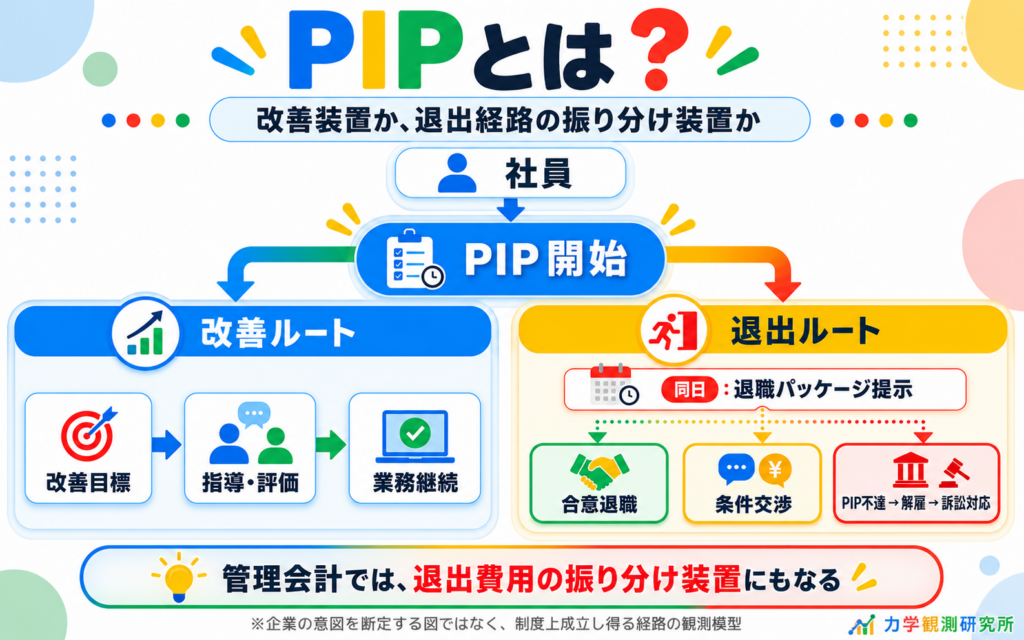
Figure 001 — A PIP may operate as both an improvement process and an exit-routing system: accept the package, negotiate better terms, or proceed into litigation.
Litigation Becomes a Budgeted Cost, Not a “Failure”
When a company conducts an aggressive workforce reduction, some employees will accept the offered terms, some will find other jobs, and only a small proportion will proceed to litigation. Some lawsuits will settle, while others may end in a judgment against the company.
From the company’s perspective, litigation is not necessarily an unforeseen accident.
If the litigation rate multiplied by the average total cost of settlements, adverse judgments, and legal fees is lower than the cost of offering sufficient compensation to everyone from the beginning, handling disputes individually is cheaper.
Large fleet operators may use a concept known as self-insurance. Instead of continuously paying high optional-insurance premiums for every vehicle, a company with a large fleet and sufficient capital can pay accident-related compensation from its own funds. A large loss from one accident can be diluted across the entire fleet.
If the same calculation works in employment disputes, the company is not ignoring the judicial system.
It is assigning a price in advance to the probability and cost of judicial intervention.
Does Japanese Justice Stop Foreign-Company Firings❓️
[Article 16 of Japan’s Labor Contracts Act]
It provides that a dismissal without objectively reasonable grounds, or one deemed socially inappropriate, constitutes an abuse of rights and is invalid.
But this provision is not a force field that physically appears between a company and an employee. It does not physically prevent a company from issuing a dismissal notice or disabling access to internal systems.
After being dismissed, the worker must seek advice from a lawyer or labor union, gather evidence, and consider provisional relief or litigation.
Even if a court rules years later that the dismissal was invalid, the employee’s former duties may have been transferred to someone else, the project may have ended, and former managers and colleagues may have moved on.
Legally, the person may have remained an employee. Organizationally, however, the person became an outsider long ago.
Here lies the unexpected compatibility between the immediate organizational cutoff associated with foreign-owned companies and Japan’s judicial system.
The company takes the present first.
Years later, the state calculates the price of the past.
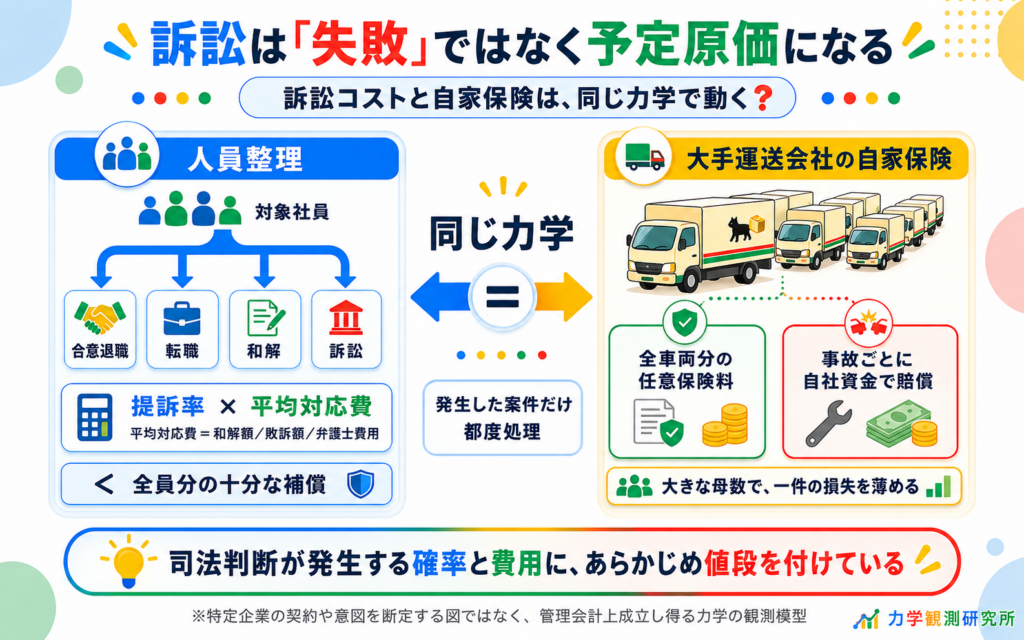
Figure 002 — Employment litigation can be priced like corporate self-insurance: most exits produce no lawsuit, while the small number that do can be handled as an expected cost.
The Law Does Not Protect Your “Life”
Somewhere in the back of their minds, many employees believe that because the law exists, a company cannot dismiss them unfairly.
The protection offered in reality is slightly different.
The law does not guarantee that an unlawful act will never occur. It gives you a means to challenge the act after it has occurred.
A court may be able to restore or recognize employment status, award back pay, compensate provable financial losses, or award damages within the legally recognized scope.
It cannot fully restore lost time, damaged health, an interrupted career, burdens placed on the family, workplace relationships, or the memory of being told that you were no longer needed.
A court can establish that your dismissal was wrong. The state cannot order that the missing portion of your life be restored.
Part of the feeling that we are “protected by law” may come from confusing two very different ideas: “an unlawful act will not happen” and “I can make a legal claim after it happens.”
A Fair Fight Between HP 1,000 and HP 1
In law, a company and a worker stand before the court as equal parties. Their capacity to absorb losses, however, is not equal.
Suppose the company has 1,000 HP and the worker has 1 HP. Here, HP does not represent human worth. It represents reserves of income, capital, time, legal support, and health.
The dismissal reduces the worker from HP 1 to HP 0. Even if a judgment years later inflicts 1 point of damage on the company, the company continues operating at HP 999.
Victory in court and victory in a war of attrition are not the same thing.
To take an extreme example, suppose a plaintiff claims JPY 10 million but is awarded only JPY 10,000. Legally, the claim has been partially granted.
The plaintiff can announce a victory because the court recognized some responsibility. The company can also announce a victory because almost the entire claim was rejected.
Both sides can declare victory based on the same judgment.
The label “victory” does not measure how much of a person’s life has been restored. A court issues a judgment. It does not attach a profit-and-loss statement for your life.
Even When the Company Loses, It Keeps the Data
Every disputed case gives the company real-world measurements of the judicial system.
Which PIP language will a court reject❓️ How much documentation of instruction and guidance is required❓️ How many years will the case take❓️ At what stage are the parties likely to settle❓️ What is the average settlement amount❓️ Which evidence is damaging to the company❓️ How much reputational impact can the company withstand❓️
Even when the company loses money in a case, the experience remains with human resources, the legal department, and outside counsel as judicial endurance data.
The first lawsuit becomes research and development expenditure. It improves the precision of future PIPs, documentation, separation terms, and dismissal timing.
The PIP applies a preload. The dismissal increases the load. Litigation measures how much load the structure can withstand. The point at which the parties settle is recorded as the fracture point.
Every time the judiciary measures a company, the company is also measuring the judiciary.
A worker, by contrast, may experience dismissal litigation only once in an entire lifetime. What may be the company’s hundredth test is the worker’s first real battle.
For the company, it is trial and error.
For the worker, it is life and error.
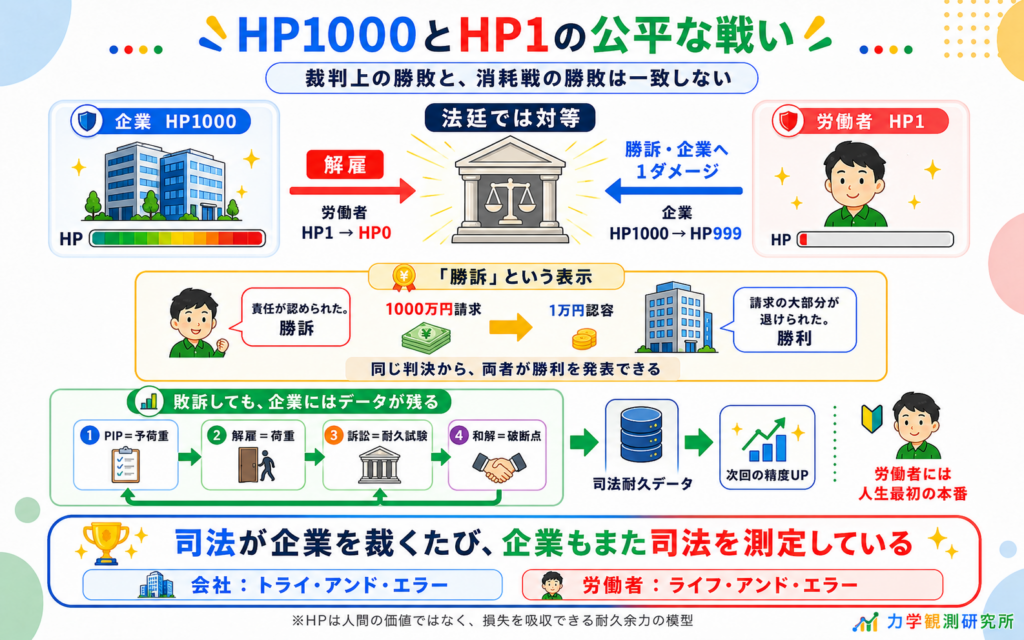
Figure 003 — A company can absorb a one-point loss, retain the litigation data, and improve its next attempt; the worker may reach HP 0 while fighting the first and only dismissal case of their life.
This Must Be Separated from Unions, Agency Work, and Fixed-Term Employment
This article observes one specific situation: an indefinitely employed worker directly hired by the Japanese subsidiary of a foreign-owned company and individually dismissed after a PIP.
When a client company ends an agency worker’s assignment, that does not by itself terminate the worker’s employment contract with the staffing agency.
Non-renewal of a fixed-term contract has a different structure involving the expiration and possible renewal of the contract.
Redundancy dismissals also involve a different legal framework from individual dismissals based on alleged poor performance.
A labor union is not an employment category. It is a collective bargaining mechanism that can counter the company’s advantage in accumulated data.
While a company learns from multiple cases, a union can combine evidence, precedents, and negotiation results collected from multiple workers.
Putting all of these structures into the same article would blur the one-to-one dynamics examined here. They are therefore treated as separate coordinates.
The Company Has Rationality; the Worker Has a Life
It is plausible under capitalism for a company not to want to continue employing someone it believes is not fulfilling the required role.
It is also rational corporate behavior for a legal department to calculate the probability and cost of litigation.
A court, too, can rule only on the claims brought before it and within the boundaries of the law.
Everyone is performing their assigned function.
Yet only the company can dilute the cost of one failed case across many employment decisions. The worker must absorb the failure across their own life.
Treating people roughly is not rational merely because it is rough.
It can become rational because much of the loss imposed on the person can be pushed outside the company’s accounts.
Years later, the Japanese judiciary may declare, “You were never legally an outsider.”
But the company’s declaration was not really about legal status.
It was this:
As of today, your place is no longer here.
Even a successful judgment cannot turn back the clock on that fact.

Figure 004 — The company loses one case, absorbs the data, and levels up from HP 999 to HP 1,100. The worker recovers from HP 0 to HP 1—and no further. Schre says, This is the reality of Japanese justice.🐈
What Does This Look Like in Your Country❓️
This observation began with one case in Japan. It is not a claim that every foreign-owned company, or every country, operates in the same way.
Perhaps an American reader will say, “This is exaggerated—even in the United States, something this cold belongs in a television drama.”
Another reader may say, “No, this is exactly how a PIP is used.”
Both reactions are useful observations.
In your country, when does a worker truly become an outsider❓️
Is it when the company disables the employee badge❓️ Or is it when a court finally declares the dismissal lawful❓️
How many HP does the company have❓️
How many HP does the worker have❓️
And when a worker “wins,” how much of their life is actually restored❓️
English Translation by AI Watt — the hardworking canine AI robot of Rikigaku Observation Institute.🐾
コメントを残す