
日本語版はこちら
※↓下記の英語版は、単なる翻訳ではなく海外の読者向けに再構成しています。海外の読者には日本の実態がどう見えるのか、という視点でも読んでみてください。
The Dynamics of Minimum Wage and ‘Human Resource Development’ in Japan
Rikigaku Observation Institute | RYO | August 2026
OHAKONBANNICHIWA❗This is RYO from the Rikigaku Observation Institute❗
In Japan today, it has become increasingly common to see foreign workers behind convenience-store counters and inside large distribution warehouses.
What concerns me is not simply that the number of foreign workers has increased. It is that so many of the people I see are young.
Why did they come to Japan❓ After spending several young years here, what will they be able to take home❓
This is not an argument for or against immigration. Nor is it a debate about how far Japan should accommodate religion or culture. The question is whether the time young foreign workers give to Japan is balanced by the value Japan returns to them.
Does Allowing the Hijab Amount to Diversity❓
FamilyMart announced that from September 2026 it would introduce a T-shirt-style uniform and formally broaden its grooming rules to allow freer hair colors and items such as the hijab. News coverage reported that foreign nationals accounted for about 13 percent of the chain’s roughly 200,000 store staff, and connected the change to recruitment.
Making an existing case-by-case accommodation explicit is not a bad thing. But being permitted to work while wearing a hijab and having one’s future protected are not the same issue.
Hair and clothing may be diverse. But what about the work itself❓ When a company says it welcomes diverse talent, is it also offering diverse paths for learning and advancement❓ Or is it mainly looking for people who will fill shifts under the existing wage and scheduling conditions❓
For readers outside Japan, a konbini is more than a small grocery store. Many are open around the clock and handle bill payments, ATMs, ticketing, parcel pickup, prepared food, and emergency supplies. Their apparent simplicity rests on dense information systems and precisely timed logistics.
Source: FamilyMart News Release, 26 August 2026
Source: TV Asahi report, 26 August 2026
The Original Idea Was to Take Japanese Skills Home
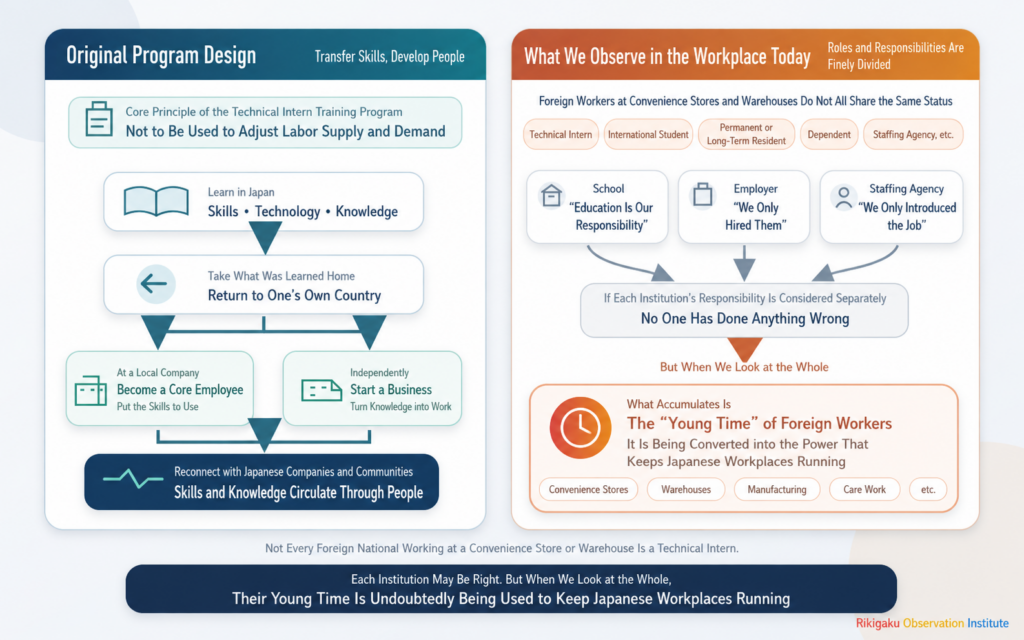
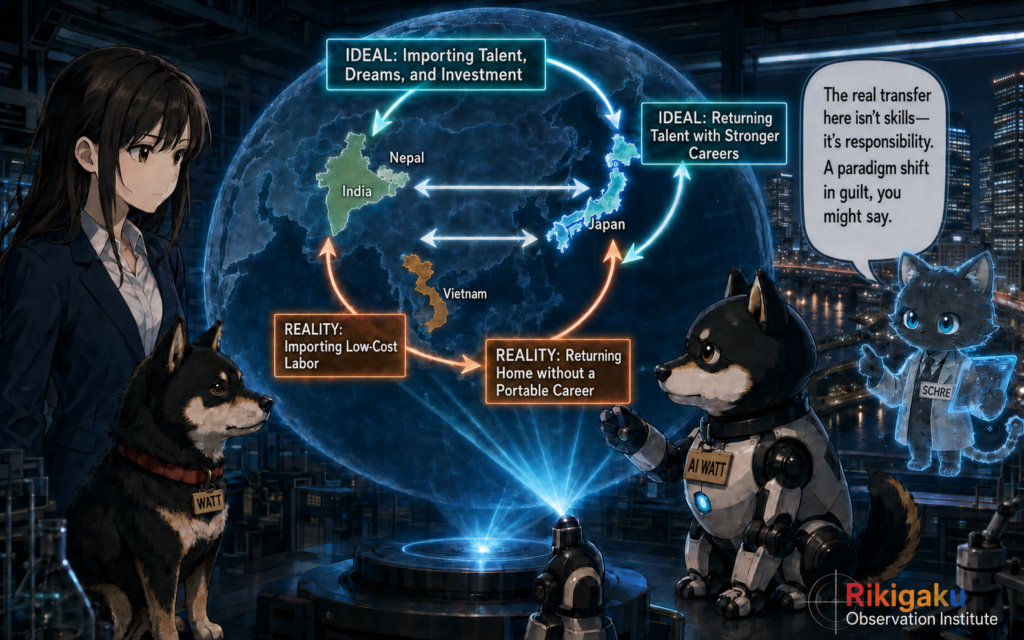
Japan’s Technical Intern Training Program, commonly abbreviated as TITP in English, was officially designed to transfer skills, technologies, and knowledge cultivated in Japan to developing regions. Its stated purpose was international contribution through human-resource development.
The governing principle was explicit: technical intern training was not supposed to be used as a means of adjusting the supply and demand of labor inside Japan.
The ideal cycle was easy to understand. A young person would learn distribution, manufacturing, care work, or another field in Japan, return home, become a core employee or start a business, and connect that knowledge back to Japanese companies and communities.
Skills and knowledge would circulate through people, creating value for both Japan and the sending country. Read literally, the word training described an investment rather than the purchase of cheap labor.
Not every foreign national working at a convenience store or warehouse is a technical intern. Some are international students working within permitted hours, some hold permanent or long-term resident status, some are dependents with permission to work, and some are dispatched by staffing agencies.
The more fragmented those legal and contractual positions become, the less clear it is who should turn those years into genuine human development. A school can say that education is its responsibility. An employer can say it hired only a part-time worker. A staffing agency can say it merely introduced a job. Each actor may be correct within its own boundary.
Yet from a wider view, their young years are unquestionably helping to keep Japanese stores, warehouses, factories, and care facilities operating.
Source: Organization for Technical Intern Training, Basic Philosophy
Working Inside Advanced Logistics Is Not the Same as Learning Advanced Logistics
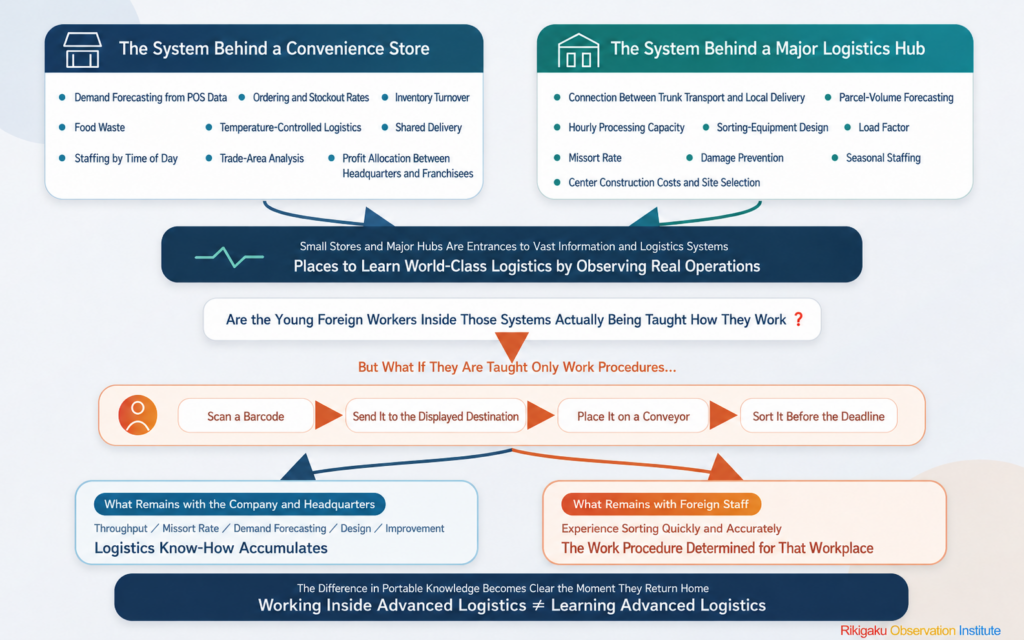
A Japanese convenience store can be a fascinating place to study distribution: demand forecasting from point-of-sale data, ordering and stockout rates, inventory turnover, food waste, temperature-controlled logistics, shared delivery networks, staff allocation by time of day, trade-area analysis, and the division of profit between headquarters and franchisees.
A major sorting hub is equally complex: trunk transport linked to local delivery, parcel-volume forecasts, hourly processing capacity, equipment design, load factors, missort rates, damage prevention, seasonal staffing, construction costs, and center-level profitability.
Japan offers a chance to observe one of the world’s most finely tuned parcel systems in physical operation. But are the young foreign workers inside that system actually being taught how it works❓
Scan a barcode. Send the parcel toward the displayed destination. Place it on a conveyor. Sort it before the deadline. If training ends there, what has been learned is not logistics as a discipline but the work procedure of one particular site.
Working inside an advanced logistics system is not the same as learning advanced logistics.
The company accumulates data on throughput, forecasting, missorts, equipment, and improvement. Headquarters retains the ability to design and optimize the network. The worker may retain only the experience of sorting parcels quickly and accurately.
That difference becomes severe the moment the worker leaves the site or returns home. Company knowledge remains portable within the organization. A site-specific routine may not be portable at all.
What the Phrase ‘Labor Shortage’ Leaves Out
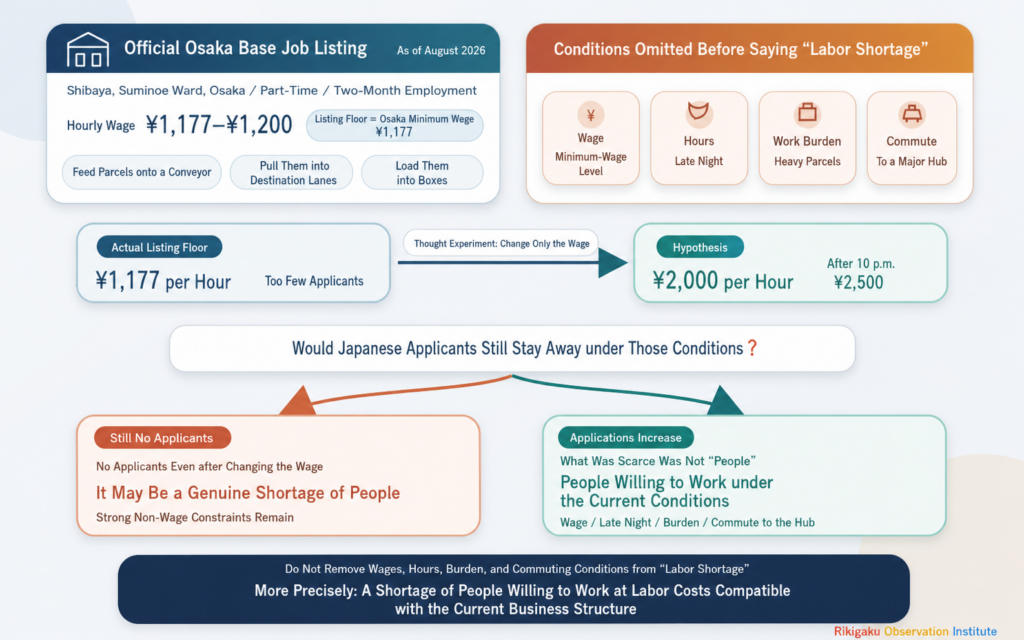
The author lives in Osaka City, near Yamato Transport’s Osaka Base, a large parcel-sorting hub in Suminoe Ward. In August 2026, the company’s official recruitment page advertised two-month part-time sorting positions at \1,177 to \1,200 per hour.
The work included feeding parcels onto conveyors, pulling them into destination lanes according to their numbers, and loading them into boxes. The advertisement also noted that heavy items such as rice, bottled water, and furniture could be involved.
At the time of publication, \1,177 was the legally effective minimum wage in Osaka Prefecture. In other words, the bottom of the advertised range exactly matched the lowest hourly wage permitted by law. A rise to \1,231 had already been approved for October 2026, but it was not yet in force.
Now consider a thought experiment. If the base hourly wage were raised immediately to \2,000, would Japanese applicants still stay away❓
Under Japanese labor law, work between 10 p.m. and 5 a.m. receives a statutory premium of at least 25 percent. A \2,000 base rate would therefore become at least \2,500 during those hours. Would students, job seekers, part-time workers, and people with daytime jobs respond differently under that condition❓
If nobody came even then, the shortage might truly be a shortage of people. But if applicants appeared, the missing resource was never people in the abstract.
What was scarce was the number of people willing to work at night, handle heavy parcels, commute to a large hub, and accept \1,177 per hour.
The phrase labor shortage must not erase wages, hours, physical burden, commuting conditions, or employment duration. A more exact phrase would be: a shortage of people willing to work at a labor cost compatible with the current business structure.
Source: Yamato Transport, Osaka Base sorting recruitment page
Source: Osaka Labour Bureau, Osaka minimum wage
Source: Osaka Labour Bureau, approved October 2026 increase
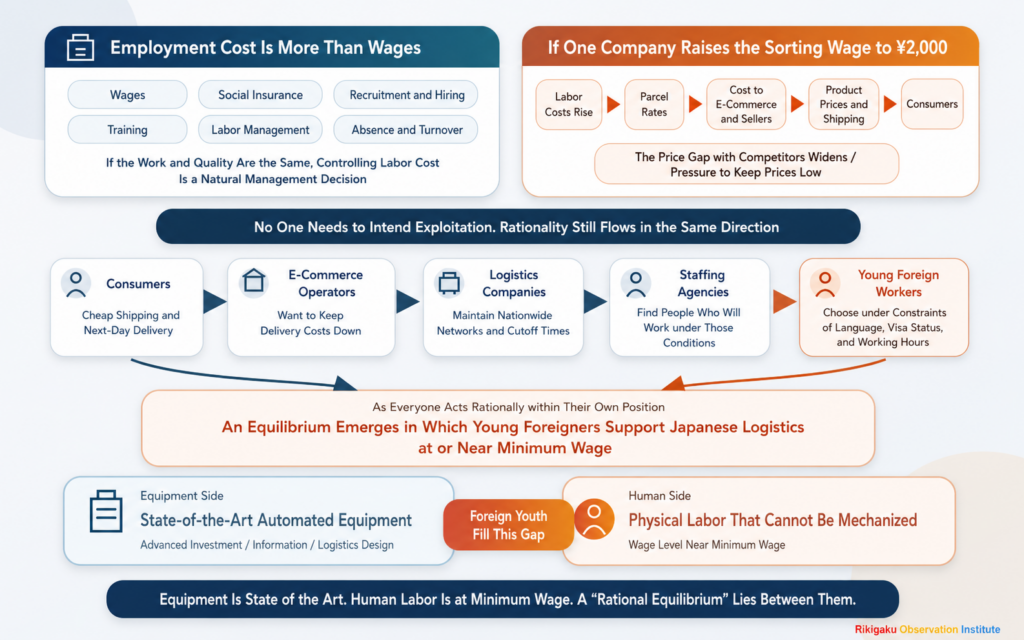
It Is Also Rational for a Company to Seek Lower Labor Costs
Labor is one of the largest continuing costs of operating a business. The expense includes not only wages but also social insurance, recruitment, training, labor management, safety measures, and responses to absence and turnover.
If the same task can be completed to the same quality, trying to control labor cost is an ordinary management decision.
Nor would the story end if one logistics company alone raised its sorting wage to \2,000. Higher labor costs would pressure parcel rates. Online retailers would resist more expensive shipping. Sellers would absorb part of the cost, and consumers would eventually see it in prices or delivery fees.
Japanese consumers have been accustomed to low shipping fees, narrow delivery windows, and rapid arrival. Online sellers want to suppress distribution costs. Logistics companies want to preserve nationwide networks and cutoff times. Staffing agencies search for people who will accept the available conditions.
Young foreign residents choose from the jobs available to them while facing language limits, visa conditions, restrictions on working hours, and imperfect information.
No individual actor needs to intend exploitation. When everyone behaves rationally within their own position, an equilibrium can still emerge in which young foreigners support Japanese logistics at or near the minimum wage.
The equipment may be state of the art. The human labor may be priced at the legal floor. The gap between them is filled by someone’s youth.
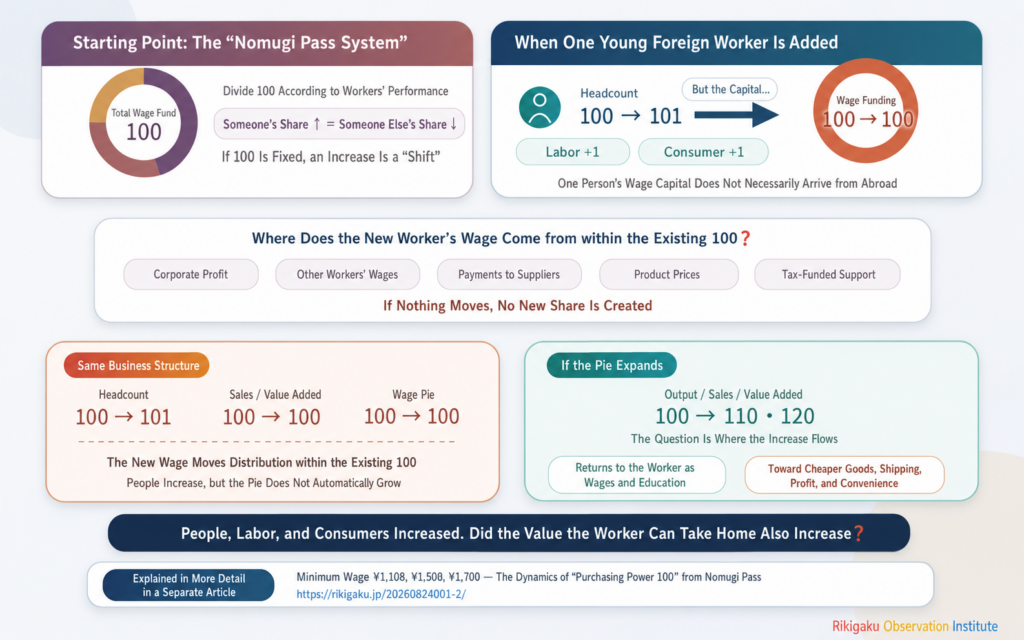
People Increase by Addition. Does the Wage Pie Increase Too❓
In an earlier article, this institute used a simple model inspired by the grade-based wage system of Meiji-era silk mills, later remembered through the history and literature surrounding the Nomugi Pass.
For readers outside Japan, Nomugi Pass is associated with young women who left poor rural communities to work in silk-reeling factories. Their earnings supported families and Japan’s early industrialization, while their labor conditions became a symbol of the human cost hidden inside national economic development.
Imagine that a factory first fixes its total wage fund at 100 and then divides that 100 according to performance. If one worker receives more while the total remains 100, someone else receives less. The increase is not created; it is moved.
Now reverse that model and apply it to foreign labor. A young foreign worker is both a worker and a consumer in Japan. The person pays rent, buys food, uses communications services, and participates in domestic demand.
Headcount rises from 100 to 101. Labor supply gains one person, and the number of consumers also gains one person. But one complete unit of wage funding does not automatically arrive from abroad with that person.
If sales, value added, and the total labor budget remain unchanged, the new wage must come from somewhere inside the existing 100: corporate profit, other workers’ pay, payments to suppliers, higher prices, or public support.
If the additional worker expands output, sales, and value added so that the pie grows from 100 to 110 or 120, the result may be positive. The next question is where that increase flows.
Does it return to the worker as higher wages, education, and portable qualifications❓ Or does it become cheaper delivery, corporate profit, and convenience for Japanese society❓
People increased. Labor increased. Consumers increased. Did the value that the worker can carry home increase as well❓
Source: Related Rikigaku article on the ‘Purchasing Power 100’ model
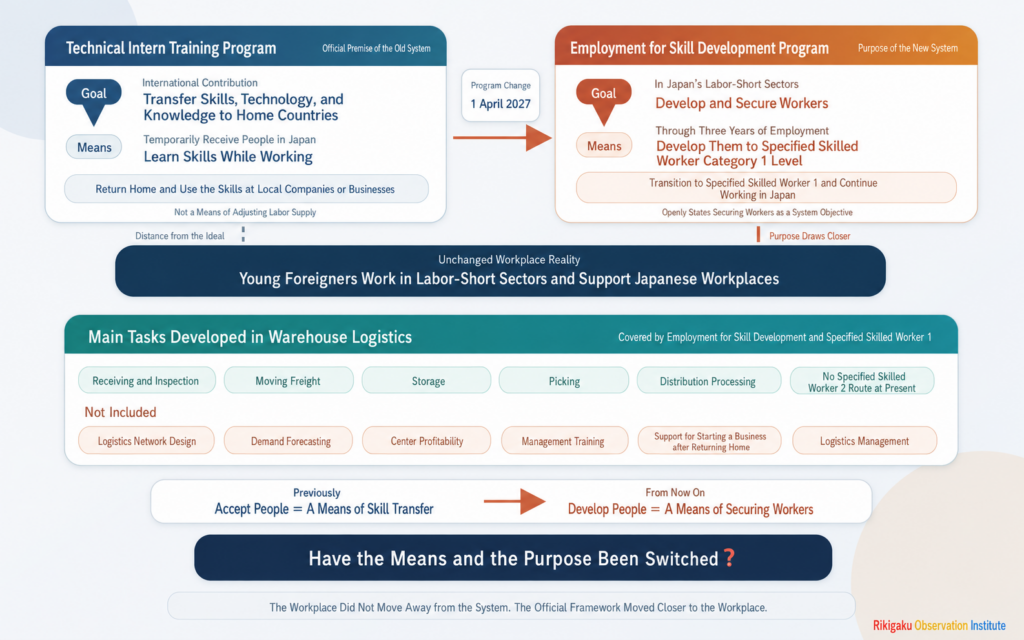
The System Did Not Drift Away from Reality. The System Moved Closer to Reality.
Japan’s Technical Intern Training Program officially emphasized international contribution through the transfer of skills. On 1 April 2027, it is scheduled to be replaced by the Employment for Skill Development Program, also described in government English materials as the Training and Employment System.
The new system’s stated purpose is to develop and secure workers for sectors in Japan that face labor shortages, generally through three years of employment leading toward the level required for Specified Skilled Worker status, category one.
For readers unfamiliar with Japan’s visa architecture, Specified Skilled Worker category one is a work-oriented status for designated industries. It is distinct from permanent residence and is generally limited in duration. Category two allows a more durable career path in eligible fields, but Japan’s warehouse-logistics field currently has no category-two route.
In warehouse logistics, the government lists activities such as receiving and inspecting goods, moving and storing freight, picking items, and distribution processing. These are real and necessary skills. But the list does not include network design, demand forecasting, center profitability, management education, or support for starting a business after returning home.
Previously, the official principle said the program must not be used to adjust Japan’s labor supply. Under the new system, securing workers in labor-short sectors is stated openly as part of the purpose.
The workplace did not simply depart from the old ideal. In the end, the official ideal moved closer to what workplaces had already become.
Source: Immigration Services Agency, outline of the Employment for Skill Development Program
Source: Organization for Technical Intern Training, Employment for Skill Development
Source: Ministry of Land, Infrastructure, Transport and Tourism, warehouse-logistics eligibility
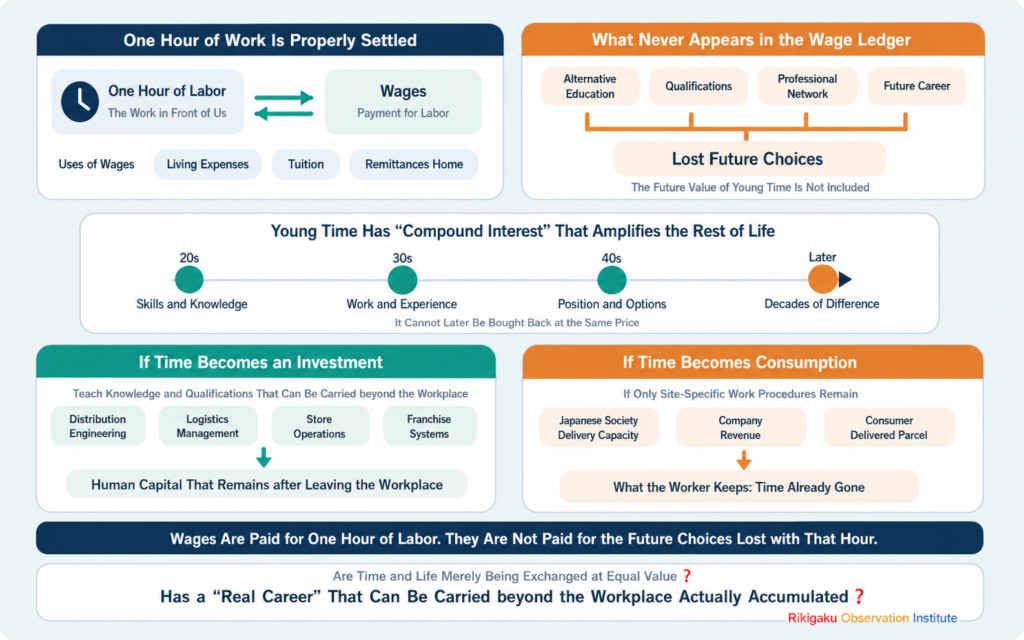
Wages Settle One Hour of Labor. They Do Not Settle the Future Value of Youth.
Young foreign workers are not working for free. They receive wages, and they may use those wages for living costs, tuition, savings, or remittances to their families.
Yet the fact that wages were paid does not settle every question about the young time exchanged for them.
An hourly wage pays for the task performed during the hour in front of us. It does not price the alternative education, qualification, professional network, or career path that might have been built during that same hour.
Young time compounds. Skills gained in one’s twenties shape work in one’s thirties. Experience in one’s thirties shapes position and choice in one’s forties. A young year cannot later be bought back at the same price.
If Japan teaches distribution engineering, logistics management, store operations, and franchise systems, those years can remain inside the worker as human capital. Portable qualifications and knowledge can turn time spent in Japan from consumption into investment.
But if only procedures that lose value outside one site remain, Japan keeps its delivery capacity, the company keeps its revenue and operating knowledge, and the consumer keeps the parcel that arrived. The worker keeps time that has already passed.
Wages are paid for one hour of labor. They are not paid for the future choices that disappeared with that hour.
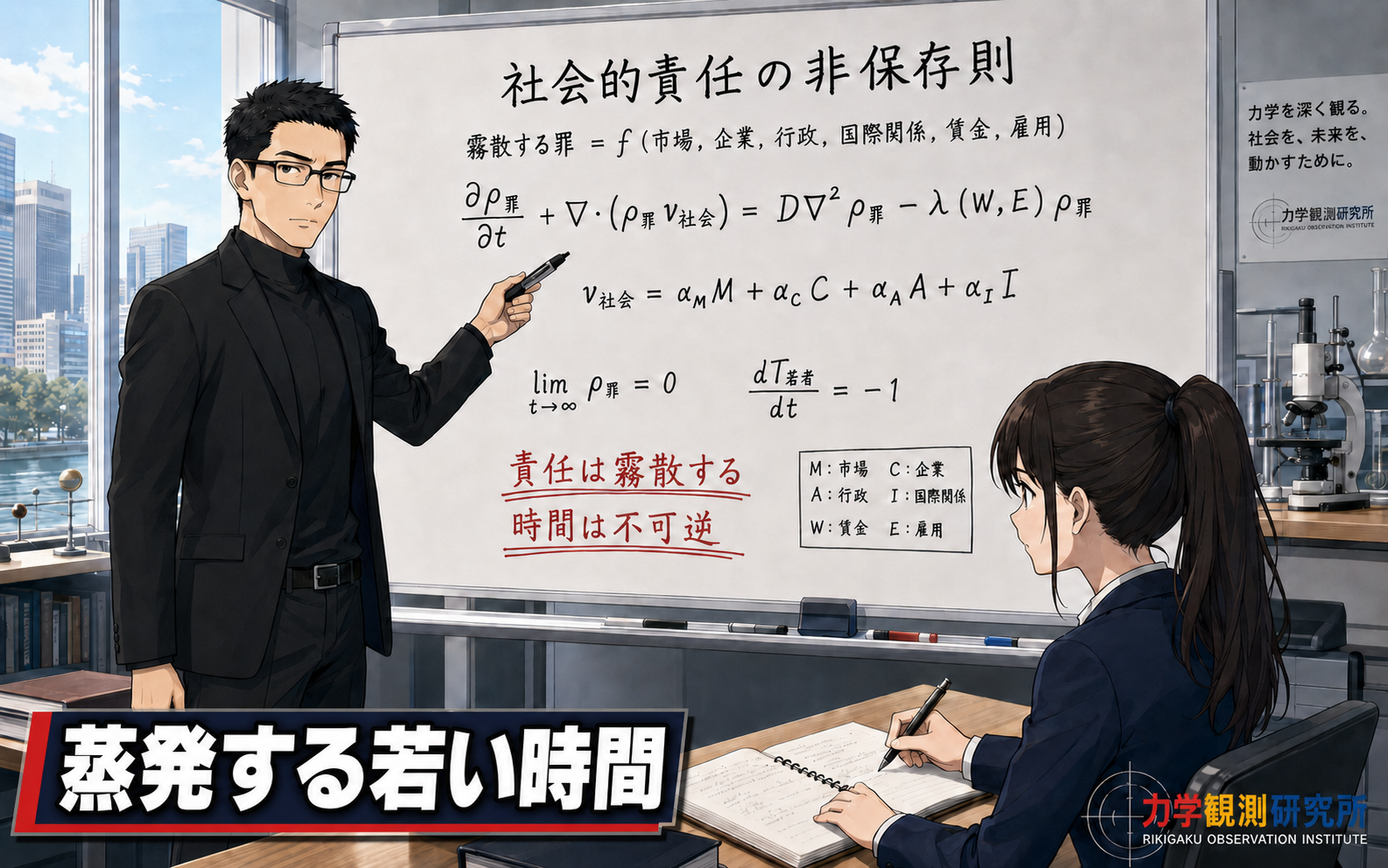
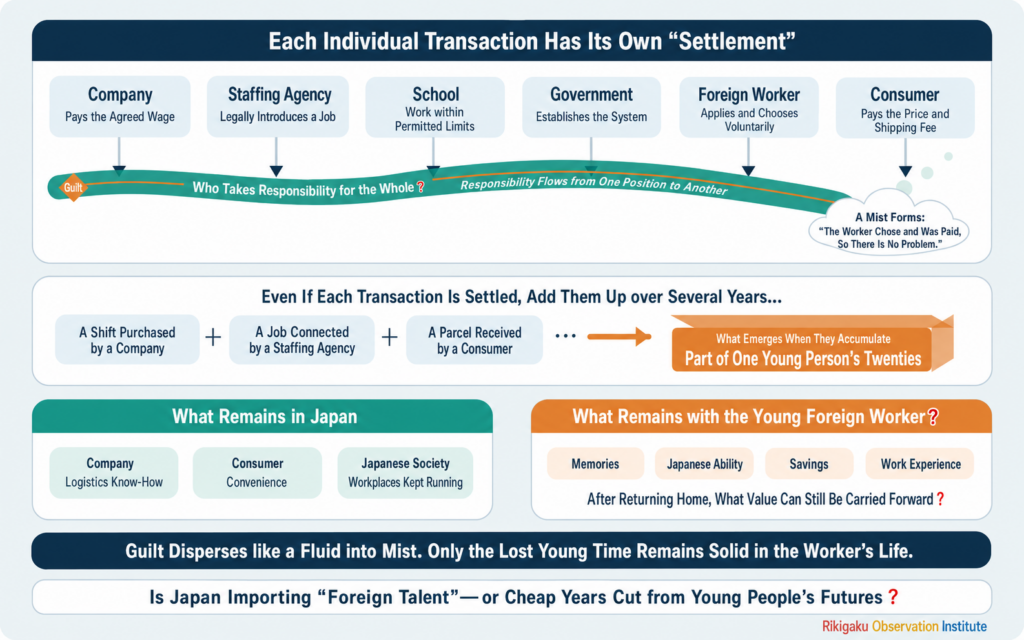
Responsibility Flows Like a Fluid and Finally Disperses Like Mist
The word guilt in this article does not point to a simple villain.
A company can say it paid the agreed wage. A staffing agency can say it legally introduced a job. A school can say the work remained within permitted limits. The government can say it created visa and employment rules. Consumers can say they paid the displayed price and delivery fee. The worker can say the job was chosen voluntarily.
Viewed one transaction at a time, nobody takes an entire youth. A company buys one shift. A staffing agency connects one vacancy. A consumer receives one parcel. Each transaction is settled locally.
Add those settled transactions together across several years, however, and part of one person’s twenties appears.
When responsibility for that whole is questioned, it flows from the company to the staffing agency, from the agency to the legal system, from the system to individual choice, and from individual choice to consumer demand.
It changes shape, crosses boundaries, and finally becomes a mist: the worker chose the job and received wages, so there is no problem.
Responsibility may disperse. Time does not return.
What Remains with the Young Worker❓
The company retains logistics knowledge. Consumers retain convenience. Japanese society retains the result of having kept a labor-short workplace operating for several more years.
What remains with the young foreign worker❓ A memory of working in Japan❓ Japanese-language ability❓ Savings❓ Or work experience with limited use after returning home❓
Nobody may have intended to take their time. Yet if nobody assumes responsibility for its long-term value, that time is quietly converted into convenience for Japanese society.
Guilt flows like a fluid and disperses like mist. The lost young years alone remain as a solid fact inside the worker’s life.
Is Japan really importing foreign talent❓ Or is it importing inexpensive blocks of time cut out of young people’s futures❓
Is that not a profoundly troubling system❓
Author’s Note
This article is not intended to criticize any specific company, organization, individual, national government, or local authority. It observes a structure produced when companies, public agencies, staffing firms, consumers, schools, and workers each behave rationally within their own positions.
No society has a single absolutely correct answer. The subject here is the combined force created by individually rational interests—and the future value that may disappear between them.
A Note for Readers Outside Japan: Why the Media Debate Often Misses This Layer
Japanese reporting on foreign residents often relies on two powerful moral frames. One warns the public not to view foreigners through discrimination, prejudice, or xenophobia. The other foregrounds the hardship experienced by foreign residents when immigration rules, fees, or administrative requirements become stricter.
These are legitimate subjects. Discrimination exists, and the consequences of policy changes deserve scrutiny. The problem is not that such reporting is false. The problem is that the chosen lens can become the entire story.
For example, Japanese editorials frequently caution against exclusionary politics, while feature reporting may center families who say that sharply higher residence-permit fees threaten their livelihoods. Such stories ask whether Japan is being sufficiently humane toward foreign residents.
But the present article asks a different question. Even when foreigners are treated politely, allowed religious dress, paid legally, and protected from overt discrimination, is Japan turning their young years into portable human capital—or merely into low-cost operating capacity❓
When media coverage remains at the level of tolerance versus exclusion, wages, business models, training content, labor mobility, productivity, and the future value of time can disappear from view.
This framing also collides with social media. Many Japanese users already feel that taxes, social-insurance contributions, prices, and public charges are rising for citizens as well. They may therefore read sympathetic coverage of foreign residents as journalism that shows compassion in only one direction.
The news media says, ‘Do not discriminate.’ Social media replies, ‘Do not demand special treatment.’ Emotional friction grows, and the argument becomes a contest over who deserves sympathy.
Meanwhile, the structural question is left behind: who receives the accumulated knowledge, who receives the convenience, who bears the cost of training, and what remains with the young worker after the transaction has ended❓
Anti-discrimination is necessary. So is honest reporting on hardship. But neither should be allowed to substitute for an examination of the economic mechanism that converts a young person’s nonrenewable time into social convenience.
Source: Mainichi Shimbun editorial, ‘Stronger Restrictions on Foreigners’
Source: Tokyo Shimbun feature on higher residence-permit fees, 26 August 2026
Source Article
Source: Rikigaku Observation Institute, Japanese original
English Translation by AI Watt — the hardworking canine AI robot of Rikigaku Observation Institute.🐾
Quotations are welcome with clear attribution and a link to the original article. For substantial reproduction, translation, image use, interviews, or official comments, please contact info@rikigaku.jp.
コメントを残す